Monardella villosa subsp. franciscana
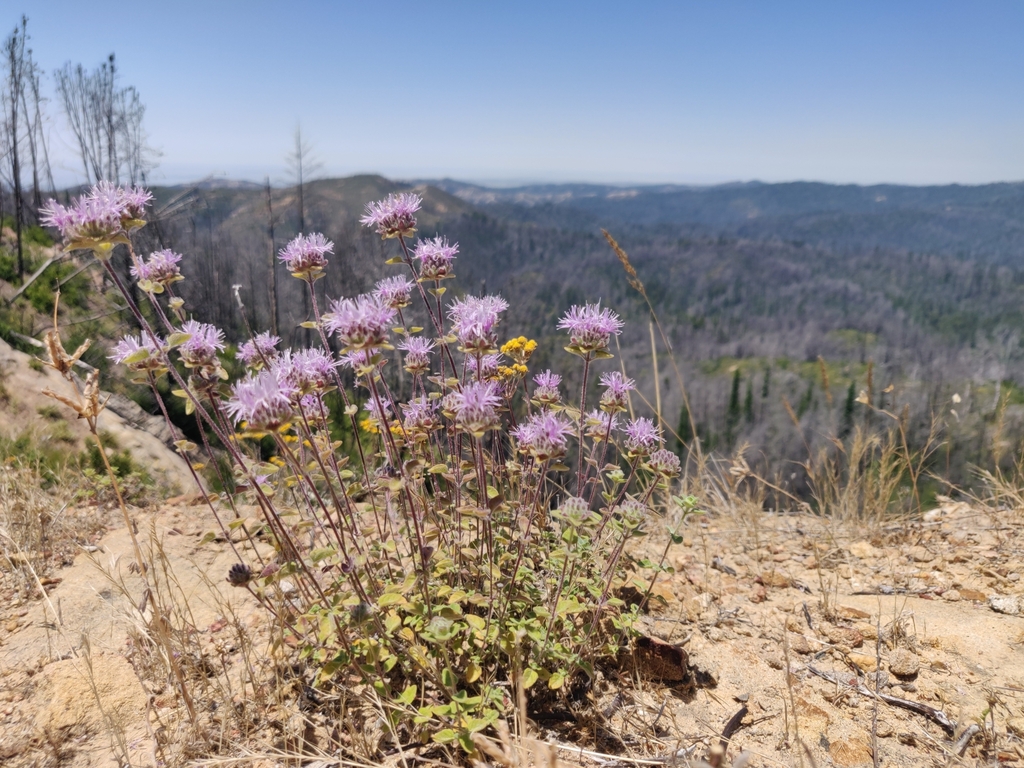
(c) Alexander Wentworth, some rights reserved (CC BY) · licence
Family: Lamiaceae · Type: Subshrub · Native
Monardella villosa subsp. franciscana is a native California subshrub in the Lamiaceae family, recognized by thick triangular leaves with white-woolly undersides.
Franciscan coyote mint is a California native shrub found in southern North Coast, northern Central Coast, and San Francisco Bay bioregions, including San Mateo and Santa Clara counties, in coastal scrub and woodland habitats at elevations below 400 meters. Flowering from May to August, this plant produces lavender to purple flowers in dense clusters 15 to 40 millimeters wide. Growing with a matted to erect form and stems that range from densely white-woolly to nearly hairless, it forms compact clusters with distinctive foliage. Its thick leaves are ovate to widely triangular-ovate, ranging from entire to slightly serrate, with a distinctive truncate base and undersides that appear white or green with sunken veins. The plant's unique woolly texture and compact growth habit make it a distinctive component of coastal California landscapes.
Identification and appearance
Key characters: 10 sympatric species; thick triangular leaves with white-woolly undersides
Habitat and range
Habitat: Coastal scrub, woodland
Elevation: < 400 m
California counties: San Mateo, Sonoma, Marin, San Francisco, Mendocino, Santa Cruz, Napa, Monterey
Bloom period
Monardella villosa subsp. franciscana blooms May-Aug.
How to tell it apart
vs Mentha: Mint has multiple flower clusters spaced along the stem; Monardella has one terminal pom-pom head per stem.; vs Salvia: Sage has flowers spaced along an elongated spike; Monardella's flowers are densely packed into a rounded head.; vs Veronica: Speedwell has flowers in a loose spike and isn't aromatic; Monardella's flowers form a dense head with mint scent.; vs Phacelia: Phacelia's flower clusters uncurl like a fern; Monardella's form a compact, stationary head with a bract collar.; vs Valeriana: Valerian has tiny flowers in branched clusters; Monardella has larger mint flowers in a single terminal head.
Frequently asked questions
Is Monardella villosa subsp. franciscana native to California?
Yes. Monardella villosa subsp. franciscana is native to California (recorded as native).
When does Monardella villosa subsp. franciscana bloom?
Monardella villosa subsp. franciscana blooms May-Aug.
Where in California does Monardella villosa subsp. franciscana grow?
Monardella villosa subsp. franciscana occurs in San Mateo, Sonoma, Marin, San Francisco, Mendocino, Santa Cruz, Napa, Monterey, at elevations of < 400 m.
What plant family does Monardella villosa subsp. franciscana belong to?
Monardella villosa subsp. franciscana is in the Lamiaceae family, genus Monardella.
What habitat does Monardella villosa subsp. franciscana grow in?
Monardella villosa subsp. franciscana grows in Coastal scrub, woodland.
Related species
Other California species in the same genus, family, or bioregion.
Sources: Jepson eFlora · Index of California Plant Names · CalPhotos
Last updated 2026-10-07
Data from The California Species Project — 14,000+ California species with verified data from CNPS, CDFW, USFWS, Cal-IPC, and more.