Monolopia congdonii
San joaquin woollythreads, San Joaquin Woollythreads
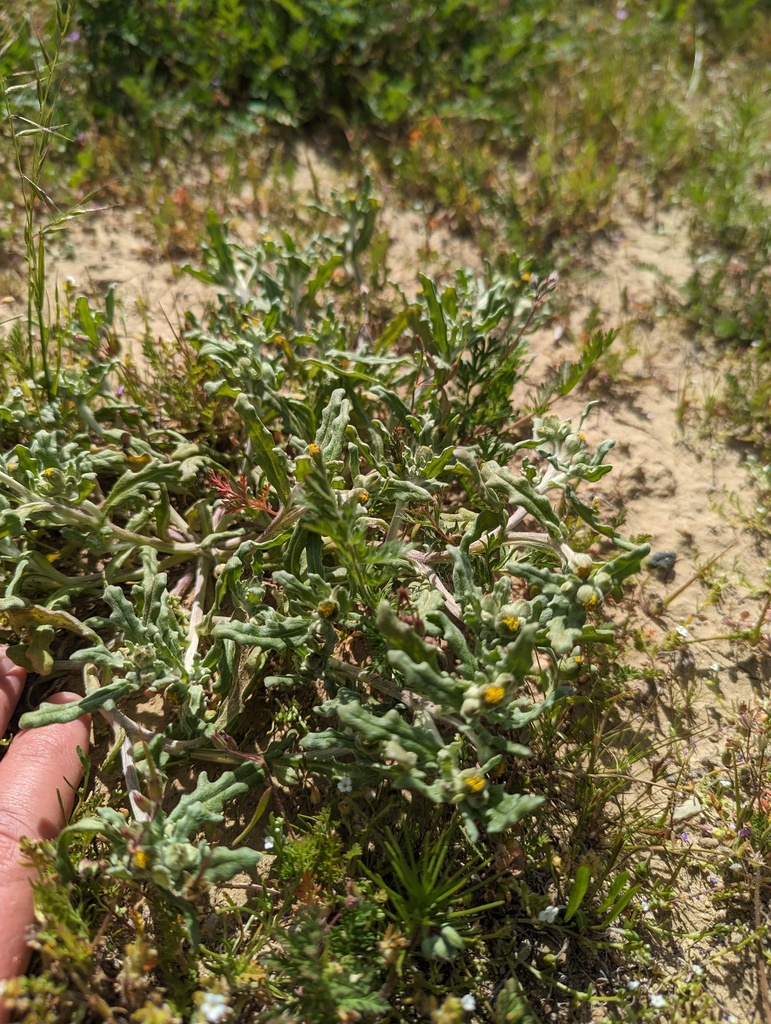
no rights reserved · CC0
Family: Asteraceae · Type: Herb · Native
Conservation status: CNPS 1B.2 · Endangered
Monolopia congdonii (San joaquin woollythreads) is a native California herb in the Asteraceae family, recognized by tiny rays and decumbent habit.
San joaquin woollythreads is a rare (CNPS 1B.2) California native annual found in the southern San Joaquin Valley grasslands on sandy soils at elevations of 90 to 700 meters. Flowering from February to May, this plant produces white to cream-colored flowers in small heads with delicate, reflexed phyllaries. Growing with decumbent to ascending branched stems generally 10 to 30 centimeters tall, it spreads in low, open clusters across dry grassland terrain. Its leaves are variably shaped, typically small and somewhat narrow, distributed along the stems with increasing sparseness toward the branch tips. The fruit is compressed, two-angled, and fringed with 2 to 7 small scales, reflecting its adaptation to dry, exposed habitats.
Identification and appearance
Key characters: 2 sympatric species; diagnostic tiny rays and decumbent habit
Habitat and range
Habitat: Grassland, sandy soils
Elevation: 90-700 m
California counties: San Luis Obispo, Fresno, Kings, Kern, San Benito, Santa Barbara
Bloom period
Monolopia congdonii blooms Feb-May.
Conservation status
CNPS 1B.2 · Endangered
How to tell it apart
vs Lasthenia: Check ray petal backs - Monolopia has a tiny opposite lobe; Lasthenia rays lack this feature.; vs Eriophyllum: Monolopia lacks dense woolly coating; Eriophyllum is covered in white to gray wool.; vs Leptosyne: Monolopia is small annual with opposite ray lobes; Leptosyne is tall with simple rays and thread-like leaves.; vs Layia: Check ray petal backs - Monolopia has opposite lobe; Layia often has white-tipped rays without lobes.; vs Glebionis: Monolopia has tiny opposite ray lobes; Glebionis has fern-like cut leaves and simple rays.
Frequently asked questions
Is Monolopia congdonii native to California?
Yes. Monolopia congdonii is native to California (recorded as native).
When does Monolopia congdonii bloom?
Monolopia congdonii blooms Feb-May.
Where in California does Monolopia congdonii grow?
Monolopia congdonii occurs in San Luis Obispo, Fresno, Kings, Kern, San Benito, Santa Barbara, at elevations of 90-700 m.
What plant family does Monolopia congdonii belong to?
Monolopia congdonii is in the Asteraceae family, genus Monolopia.
Is Monolopia congdonii rare or endangered?
Monolopia congdonii carries California Rare Plant Rank 1B.2, state rank S2.
Related species
Other California species in the same genus, family, or bioregion.
Sources: Jepson eFlora · CNPS Rare Plant Inventory · Index of California Plant Names · CalPhotos · CDFW CNDDB
Last updated 2026-10-07
Data from The California Species Project — 14,000+ California species with verified data from CNPS, CDFW, USFWS, Cal-IPC, and more.