Monolopia lanceolata
Common hillside daisy, Common Hillside Daisy
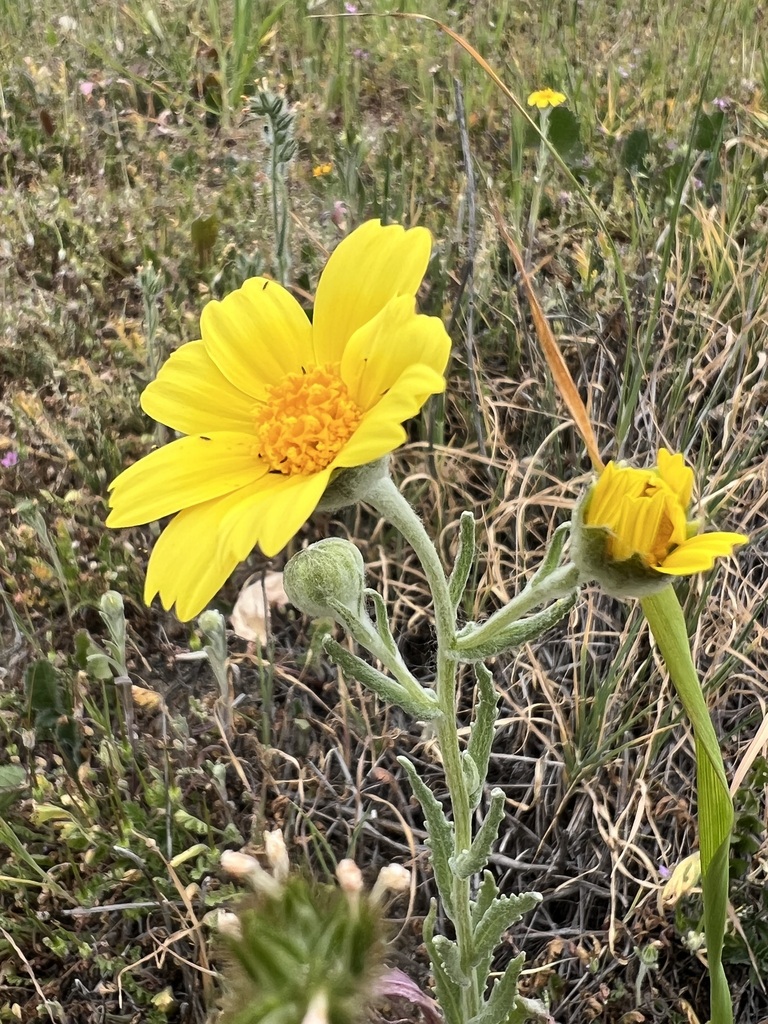
no rights reserved · CC0
Family: Asteraceae · Type: Herb · Native
Monolopia lanceolata (Common hillside daisy) is a native California herb in the Asteraceae family, recognized by long rays and free/partially fused phyllaries.
Common hillside daisy is a California native annual found in southern Sierra Nevada foothills, Tehachapi, San Joaquin Valley, south Coast Ranges, central coastal Southern California, western Transverse Ranges, San Gabriel Mountains, northwestern Peninsular Ranges, and western edge of Mojave Desert in grasslands, clay soils, open chaparral, and woodland at elevations of 50 to 1,600 meters. Flowering from February to June, this plant produces white to yellow ray flowers 10 to 20 millimeters long with three-lobed tips, arranged in radiate heads with distinctive involucres 6 to 10 millimeters wide. Growing with erect stems that are simple or branched throughout, with ascending branches and heights varying across its range. Its leaves vary across the plant, with stems featuring elliptic-oblanceolate phyllaries that are either free or partially fused. The fruit is a compressed, four-angled disk fruit 2 to 4 millimeters long, covered in strigose hairs.
Identification and appearance
Key characters: 4 sympatric species; diagnostic long rays and free/partially fused phyllaries
Habitat and range
Habitat: Grassland, bare clay, open chaparral, woodland
Elevation: 50-1600 m
Bloom period
Monolopia lanceolata blooms Feb-Jun.
How to tell it apart
vs Lasthenia: Check ray petal backs - Monolopia has a tiny opposite lobe; Lasthenia rays lack this feature.; vs Eriophyllum: Monolopia lacks dense woolly coating; Eriophyllum is covered in white to gray wool.; vs Leptosyne: Monolopia is small annual with opposite ray lobes; Leptosyne is tall with simple rays and thread-like leaves.; vs Layia: Check ray petal backs - Monolopia has opposite lobe; Layia often has white-tipped rays without lobes.; vs Glebionis: Monolopia has tiny opposite ray lobes; Glebionis has fern-like cut leaves and simple rays.
Frequently asked questions
Is Monolopia lanceolata native to California?
Yes. Monolopia lanceolata is native to California (recorded as native).
When does Monolopia lanceolata bloom?
Monolopia lanceolata blooms Feb-Jun.
What plant family does Monolopia lanceolata belong to?
Monolopia lanceolata is in the Asteraceae family, genus Monolopia.
What habitat does Monolopia lanceolata grow in?
Monolopia lanceolata grows in Grassland, bare clay, open chaparral, woodland.
Related species
Other California species in the same genus, family, or bioregion.
Sources: Jepson eFlora · Index of California Plant Names · CalPhotos
Last updated 2026-10-07
Data from The California Species Project — 14,000+ California species with verified data from CNPS, CDFW, USFWS, Cal-IPC, and more.