Montia chamissoi
Toad lily, Toad Lily
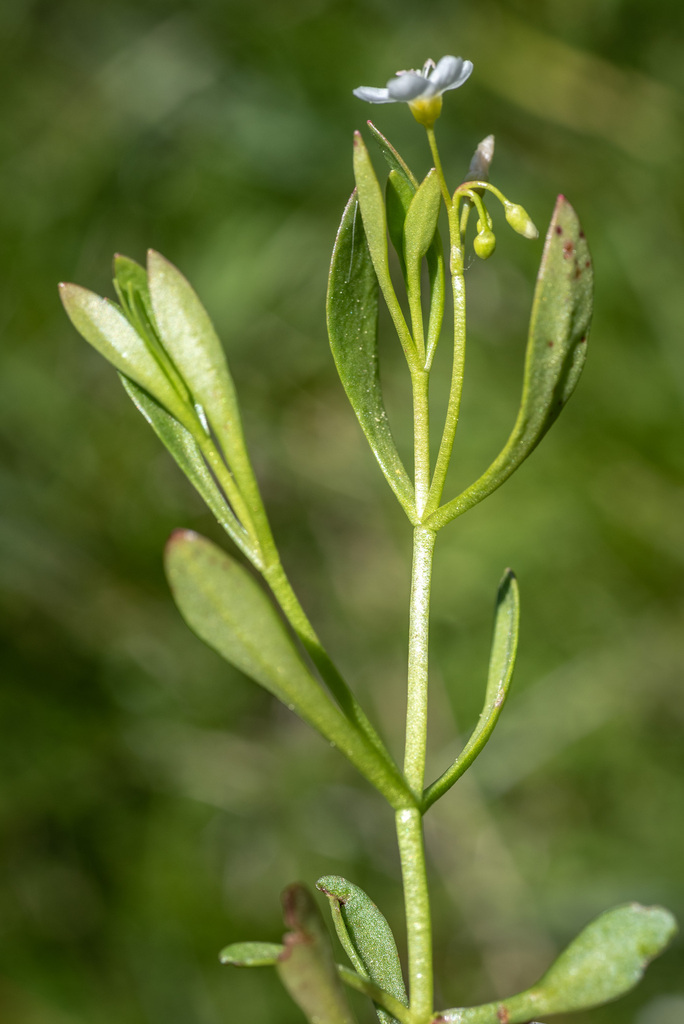
(c) Tim Messick, some rights reserved (CC BY), uploaded by Tim Messick · licence
Family: Montiaceae · Type: Herb · Native
Montia chamissoi (Toad lily) is a native California herb in the Montiaceae family, recognized by perennial habit, pink bulblets, higher elevation, and larger petals.
Toad lily is a California native perennial found in the Klamath Ranges, northern Coast Ranges, Cascade Range, Sierra Nevada, Transverse Ranges, Peninsular Ranges, and Great Basin in wet meadows, seeps, and sandy or loamy soil at elevations of 1,100 to 3,700 meters. Flowering from June to August, this plant produces delicate pink or white flowers 5 to 9 millimeters long. Growing with prostrate to erect stems 2 to 30 centimeters tall, it forms tufted or matted colonies with leafy stolons and pink overwintering bulblets. Its opposite leaves are oblanceolate, measuring 5 to 50 millimeters long, often creating dense ground cover. The plant produces small spherical fruits 1 to 1.5 millimeters long, with low rounded seed tubercles.
Identification and appearance
Key characters: 6 sympatric species; distinguished by perennial habit, pink bulblets, higher elevation, and larger petals
Habitat and range
Habitat: Wet, sandy or loamy soil, seeps, wet meadows
Elevation: 1100-3700 m
California counties: San Bernardino, Ventura, Tulare, Inyo, Mono, Tehama, Fresno, Calaveras, Glenn, Kern, Lassen, Madera, Mariposa, Mendocino, Modoc, Nevada, Placer, Plumas, Riverside, San Diego, Shasta, Siskiyou, Trinity, Tuolumne, Butte, Alpine, El Dorado, Sierra, Amador, Lake, Humboldt
Outside California: to Alaska, Montana, Colorado, New Mexico, also central Canada, north-central United States
Bloom period
Montia chamissoi blooms Jun-Aug.
How to tell it apart
vs Claytonia: Montia has multiple alternate stem leaves and one-sided flowers; Claytonia has exactly 2 opposite or fused stem leaves.; vs Lewisia: Montia has thin stems with alternate leaves in wet areas; Lewisia forms tight succulent rosettes on rocks.; vs Hesperochiron: Montia has small clustered flowers on stems; Hesperochiron has large solitary flowers from basal rosettes.; vs Galium: Montia has alternate succulent leaves and white flowers; Galium has whorled thin leaves and square stems.; vs Cistanthe: Montia has white/pink flowers with multiple stem leaves; Cistanthe has 5 petals with yellow anthers only on coast.
Frequently asked questions
Is Montia chamissoi native to California?
Yes. Montia chamissoi is native to California (recorded as native).
When does Montia chamissoi bloom?
Montia chamissoi blooms Jun-Aug.
Where in California does Montia chamissoi grow?
Montia chamissoi occurs in San Bernardino, Ventura, Tulare, Inyo, Mono, Tehama, Fresno, Calaveras and other counties, at elevations of 1100-3700 m.
What plant family does Montia chamissoi belong to?
Montia chamissoi is in the Montiaceae family, genus Montia.
What habitat does Montia chamissoi grow in?
Montia chamissoi grows in Wet, sandy or loamy soil, seeps, wet meadows.
Related species
Other California species in the same genus, family, or bioregion.
Sources: Jepson eFlora · Index of California Plant Names · CalPhotos
Last updated 2026-10-07
Data from The California Species Project — 14,000+ California species with verified data from CNPS, CDFW, USFWS, Cal-IPC, and more.