Montia fontana
Water chickweed, blinks, Blinks
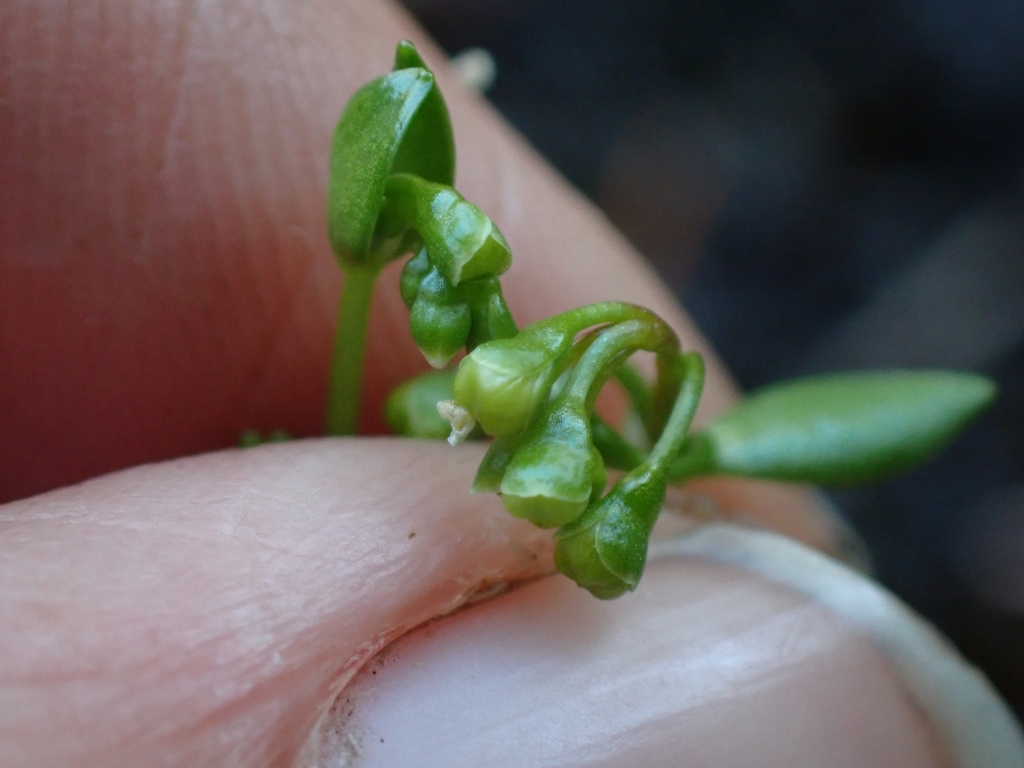
no rights reserved, uploaded by Ellyne Geurts · CC0
Family: Montiaceae · Type: Herb · Native
Montia fontana (Water chickweed) is a native California herb in the Montiaceae family, recognized by widespread distribution, aquatic habit, very small petals, opposite leaves.
Water chickweed is a California native annual found in California Floristic Province and Great Basin regions in ponds, streams, vernal pools, and seeps at elevations below 3,200 meters. Flowering from February to July, this plant produces small white flowers less than 2 millimeters long. Growing prostrate to erect with stems 1 to 30 centimeters tall, the plant often forms dense tufted or matted clusters that root at lower nodes. Its opposite leaves are linear to widely oblanceolate, 3 to 20 millimeters long with tapered bases and acute to obtuse tips. The tiny seeds feature distinctive acute tubercles, giving the plant a unique textural quality.
Identification and appearance
Key characters: 6 sympatric species; distinguished by widespread distribution, aquatic habit, very small petals, opposite leaves
Habitat and range
Habitat: Common. Ponds, streams, vernal pools, seeps
Elevation: < 3200 m
California counties: San Diego, Riverside, San Bernardino, Los Angeles, Tulare, Santa Cruz, Butte, Modoc, Contra Costa, Humboldt, Inyo, Kern, Lake, Madera, Marin, Monterey, Placer, Sacramento, San Luis Obispo, San Mateo, Santa Barbara, Santa Clara, Shasta, Siskiyou, Sonoma, Stanislaus, Sutter, Tehama, El Dorado, Fresno, Alameda, Amador, Lassen, Napa, Plumas, San Benito, San Francisco, Trinity, Yuba, Calaveras, Mariposa, Mendocino, Nevada, Tuolumne, Glenn, San Joaquin, Merced, Del Norte, Mono, Alpine, Solano, Sierra, Colusa, Ventura, Yolo
Outside California: to Alaska, eastern North America, +- worldwide. Highly variable
Bloom period
Montia fontana blooms Feb-Jul.
How to tell it apart
vs Claytonia: Montia has multiple alternate stem leaves and one-sided flowers; Claytonia has exactly 2 opposite or fused stem leaves.; vs Lewisia: Montia has thin stems with alternate leaves in wet areas; Lewisia forms tight succulent rosettes on rocks.; vs Hesperochiron: Montia has small clustered flowers on stems; Hesperochiron has large solitary flowers from basal rosettes.; vs Galium: Montia has alternate succulent leaves and white flowers; Galium has whorled thin leaves and square stems.; vs Cistanthe: Montia has white/pink flowers with multiple stem leaves; Cistanthe has 5 petals with yellow anthers only on coast.
Frequently asked questions
Is Montia fontana native to California?
Yes. Montia fontana is native to California (recorded as native).
When does Montia fontana bloom?
Montia fontana blooms Feb-Jul.
Where in California does Montia fontana grow?
Montia fontana occurs in San Diego, Riverside, San Bernardino, Los Angeles, Tulare, Santa Cruz, Butte, Modoc and other counties, at elevations of < 3200 m.
What plant family does Montia fontana belong to?
Montia fontana is in the Montiaceae family, genus Montia.
What habitat does Montia fontana grow in?
Montia fontana grows in Common. Ponds, streams, vernal pools, seeps.
Related species
Other California species in the same genus, family, or bioregion.
Sources: Jepson eFlora · Index of California Plant Names · CalPhotos
Last updated 2026-10-07
Data from The California Species Project — 14,000+ California species with verified data from CNPS, CDFW, USFWS, Cal-IPC, and more.