Montia parvifolia
Littleleaf minerslettuce
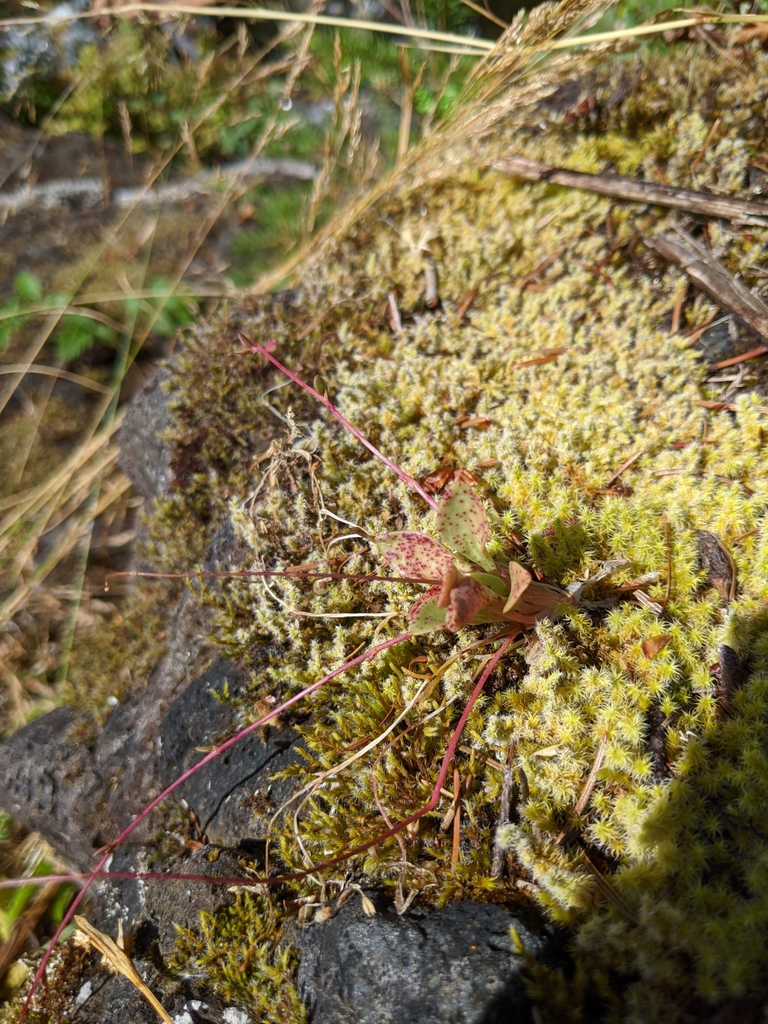
(c) Lauren, some rights reserved (CC BY) · licence
Family: Montiaceae · Type: Herb · Native
Montia parvifolia (Littleleaf minerslettuce) is a native California herb in the Montiaceae family, recognized by perennial creeping habit, detached bulblets, largest flowers, fleshy basal leaves.
Littleleaf minerslettuce is a California native perennial found in northwestern California, the Cascade Range, Sierra Nevada, central coastal California, and San Francisco Bay Area in moist, rocky slopes, cliffs, creek banks, and forest habitats at elevations below 2,600 meters. Flowering from May to July, this plant produces delicate pink or white flowers in small terminal clusters of 1 to 12 blossoms. Growing with creeping, branched stolons 5 to 40 centimeters tall that form dense, matted patches, the stems become erect with age and are densely leafy. Its basal leaves are fleshy, ranging from narrowly oblanceolate to widely ovate and 15 to 60 millimeters long, with smaller alternate leaves along the stolons that often have easily detached bulblets in their axils. The fruit is small, measuring 2 to 3 millimeters long with seeds approximately 1 to 1.5 millimeters in size.
Identification and appearance
Key characters: 6 sympatric species; distinguished by perennial creeping habit, detached bulblets, largest flowers, fleshy basal leaves
Habitat and range
Habitat: Moist, rocky slopes, cliffs, creek banks, forest
Elevation: < 2600 m
California counties: Sierra, Santa Cruz, Amador, Humboldt, Butte, Del Norte, Fresno, Mariposa, Mendocino, Nevada, Placer, San Mateo, Siskiyou, Trinity, Tulare, El Dorado, Marin, Alpine, Calaveras, Madera, Shasta, Tuolumne, Yolo, Monterey, Plumas, Tehama, Sonoma, Santa Clara, San Benito
Outside California: to Alaska, Montana, Utah
Bloom period
Montia parvifolia blooms May-Jul.
How to tell it apart
vs Claytonia: Montia has multiple alternate stem leaves and one-sided flowers; Claytonia has exactly 2 opposite or fused stem leaves.; vs Lewisia: Montia has thin stems with alternate leaves in wet areas; Lewisia forms tight succulent rosettes on rocks.; vs Hesperochiron: Montia has small clustered flowers on stems; Hesperochiron has large solitary flowers from basal rosettes.; vs Galium: Montia has alternate succulent leaves and white flowers; Galium has whorled thin leaves and square stems.; vs Cistanthe: Montia has white/pink flowers with multiple stem leaves; Cistanthe has 5 petals with yellow anthers only on coast.
Frequently asked questions
Is Montia parvifolia native to California?
Yes. Montia parvifolia is native to California (recorded as native).
When does Montia parvifolia bloom?
Montia parvifolia blooms May-Jul.
Where in California does Montia parvifolia grow?
Montia parvifolia occurs in Sierra, Santa Cruz, Amador, Humboldt, Butte, Del Norte, Fresno, Mariposa and other counties, at elevations of < 2600 m.
What plant family does Montia parvifolia belong to?
Montia parvifolia is in the Montiaceae family, genus Montia.
What habitat does Montia parvifolia grow in?
Montia parvifolia grows in Moist, rocky slopes, cliffs, creek banks, forest.
Related species
Other California species in the same genus, family, or bioregion.
Sources: Jepson eFlora · Index of California Plant Names · CalPhotos
Last updated 2026-10-07
Data from The California Species Project — 14,000+ California species with verified data from CNPS, CDFW, USFWS, Cal-IPC, and more.