Morella californica
Wax myrtle, Wax Myrtle
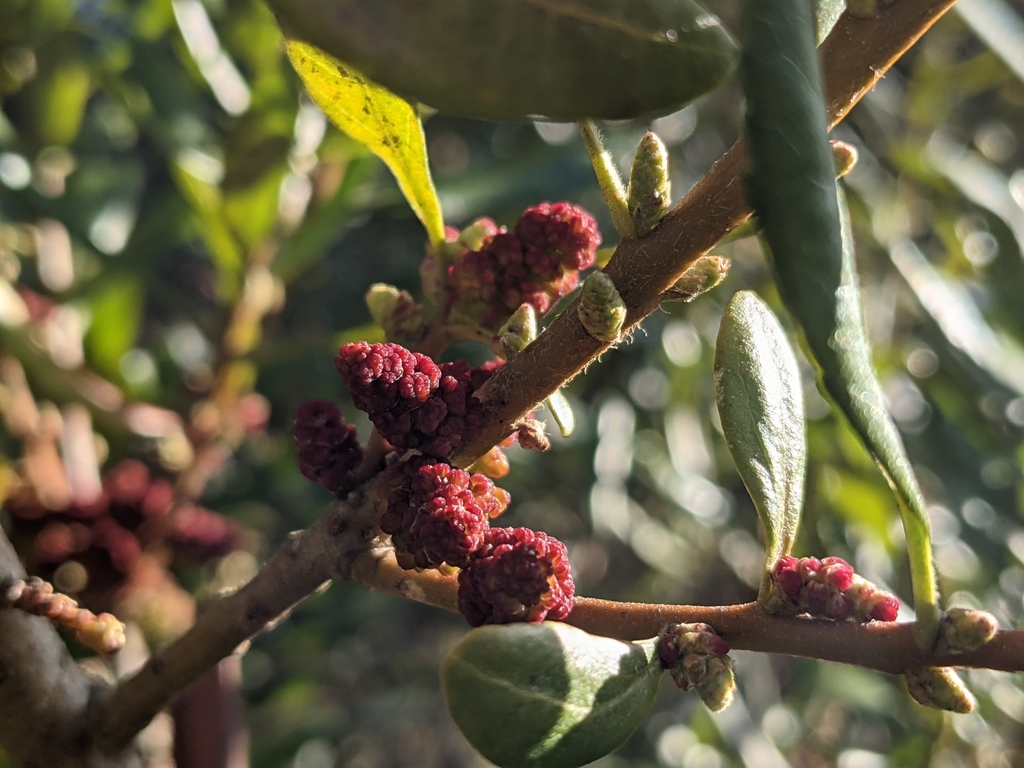
no rights reserved · CC0
Family: Myricaceae · Type: Shrub / Tree · Native
Morella californica (Wax myrtle) is a native California shrub / tree in the Myricaceae family, recognized by Pacific coastal endemic representing the only member of Myricaceae native to California.
Wax myrtle is a California native shrub found in coastal bioregions including northern California Coast, western Klamath Ranges, North Coast Ranges, Central Coast, western San Francisco Bay, and southern California Coast in coastal dunes, scrub, closed-cone pine forests, and redwood forests at elevations up to 500 meters. Flowering from March to April, this plant produces small whitish or greenish flowers in delicate clusters. Growing 2 to 10 meters tall with an upright, multi-stemmed form, it develops a dense, rounded growth habit with narrow lance-elliptic leaves that have sharply pointed tips. Its leaves are generally narrow and elongated, appearing bright green and somewhat glossy, with a distinctive sharp point at the end. The plant produces small fruits approximately 4 to 6.5 millimeters in diameter, clustered in small groups on its pistillate inflorescences.
Identification and appearance
Key characters: Pacific coastal endemic representing the only member of Myricaceae native to California
Habitat and range
Habitat: Coastal dunes and scrub, closed-cone pine, redwood forest
Elevation: < 150 m near coast, < 500+ m inland
California counties: Sonoma, Marin, Mendocino, Monterey, Santa Cruz, San Luis Obispo, Humboldt, San Mateo, Santa Barbara, Del Norte, Santa Clara, San Francisco, Los Angeles, Ventura, Alameda, San Benito, Merced
Outside California: to British Columbia
Bloom period
Morella californica blooms Mar-Apr.
How to tell it apart
vs Heteromeles: Toyon has toothed leaf edges and red berries; Morella has smooth edges and waxy gray berries; vs Salix: Willow leaves are dull and narrow; Morella leaves are shiny and broader; vs Acacia: Acacia has compound leaves or phyllodes; Morella has simple glossy leaves; vs Rhododendron: Rhododendron leaves curl under at edges; Morella leaves lie flat; vs Melaleuca: Bottlebrush has brush-like flower spikes; Morella has inconspicuous flowers and waxy berries
Frequently asked questions
Is Morella californica native to California?
Yes. Morella californica is native to California (recorded as native).
When does Morella californica bloom?
Morella californica blooms Mar-Apr.
Where in California does Morella californica grow?
Morella californica occurs in Sonoma, Marin, Mendocino, Monterey, Santa Cruz, San Luis Obispo, Humboldt, San Mateo and other counties, at elevations of < 150 m near coast, < 500+ m inland.
What plant family does Morella californica belong to?
Morella californica is in the Myricaceae family, genus Morella.
What habitat does Morella californica grow in?
Morella californica grows in Coastal dunes and scrub, closed-cone pine, redwood forest.
Related species
Other California species in the same genus, family, or bioregion.
Sources: Jepson eFlora · Index of California Plant Names · CalPhotos
Last updated 2026-10-07
Data from The California Species Project — 14,000+ California species with verified data from CNPS, CDFW, USFWS, Cal-IPC, and more.