Mucronea perfoliata
Perfoliate spineflower
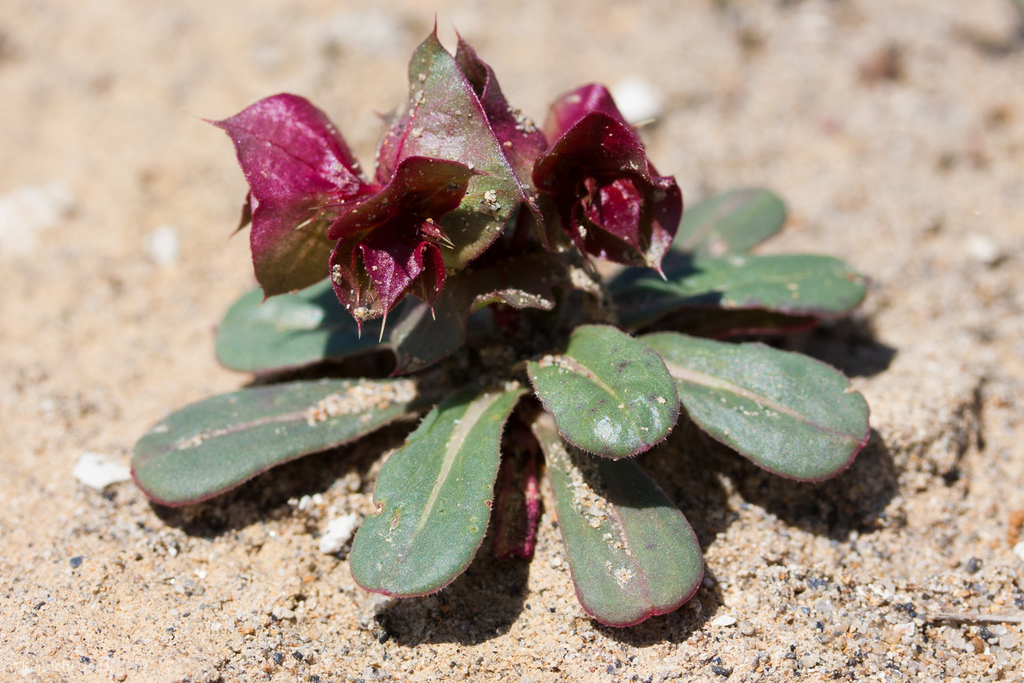
(c) Ken-ichi Ueda, some rights reserved (CC BY) · licence
Family: Polygonaceae · Type: Herb · Native
Mucronea perfoliata (Perfoliate spineflower) is a native California herb in the Polygonaceae family, recognized by . Key features: 4-angled, ribbed, transversely ridged involucres that are swollen basally.
Perfoliate spineflower is a California native annual found in southern Sierra Nevada foothills, Tehachapi, San Joaquin Valley, southern Coast Ranges, northern Western Transverse Ranges, and western Mojave Desert in sandy or gravelly habitats at elevations of 100 to 1,600 meters. Flowering from March to July, this plant produces tiny white to pale pink flowers clustered in delicate, swollen involucres with four distinct angles. Growing with sprawling stems spreading up to 5 meters in diameter and reaching 20 to 30 centimeters tall, it forms a low, open mat-like structure. Its leaves are relatively broad, with blades 2 to 5 centimeters long and 3 to 12 millimeters wide, providing a distinctive perfoliate appearance. The fruit is small, measuring 2 to 3 millimeters in length, with nine stamens contributing to its intricate floral structure.
Identification and appearance
Key characters: 1 sympatric species. Key features: 4-angled, ribbed, transversely ridged involucres that are swollen basally
Habitat and range
Habitat: Common. Sand or gravel
Elevation: 100-1600 m
California counties: Kern, San Luis Obispo, Los Angeles, Santa Barbara, Fresno, San Bernardino, San Benito, Ventura, Kings, Monterey, Stanislaus, Merced, Inyo, Riverside
Bloom period
Mucronea perfoliata blooms Mar-Jul.
How to tell it apart
vs Chorizanthe: Mucronea has multiple flowers per cup and obvious bracts; Chorizanthe typically has 1 flower per cup and less obvious bracts.; vs Centrostegia: Mucronea has no basal spines; Centrostegia has 3 prominent basal spines.; vs Oxytheca: Mucronea has obvious bracts below the flower cups; Oxytheca lacks conspicuous bracts.; vs Dodecahema: Mucronea has no basal spines; Dodecahema has 6 prominent basal spines.; vs Systenotheca: Mucronea has hairy flowers and obvious bracts; Systenotheca has smooth flowers and hidden bracts.
Frequently asked questions
Is Mucronea perfoliata native to California?
Yes. Mucronea perfoliata is native to California (recorded as native).
When does Mucronea perfoliata bloom?
Mucronea perfoliata blooms Mar-Jul.
Where in California does Mucronea perfoliata grow?
Mucronea perfoliata occurs in Kern, San Luis Obispo, Los Angeles, Santa Barbara, Fresno, San Bernardino, San Benito, Ventura and other counties, at elevations of 100-1600 m.
What plant family does Mucronea perfoliata belong to?
Mucronea perfoliata is in the Polygonaceae family, genus Mucronea.
What habitat does Mucronea perfoliata grow in?
Mucronea perfoliata grows in Common. Sand or gravel.
Related species
Other California species in the same genus, family, or bioregion.
Sources: Jepson eFlora · Index of California Plant Names · CalPhotos
Last updated 2026-10-07
Data from The California Species Project — 14,000+ California species with verified data from CNPS, CDFW, USFWS, Cal-IPC, and more.