Muehlenbeckia complexa
Maidenhair vine
(c) Jon Sullivan, some rights reserved (CC BY) · licence
Family: Polygonaceae · Type: Vine · Not Native
Muehlenbeckia complexa (Maidenhair vine) is a non-native California vine in the Polygonaceae family, recognized by . Key features: wiry twisted stems, small rounded leaves, coastal distribution.
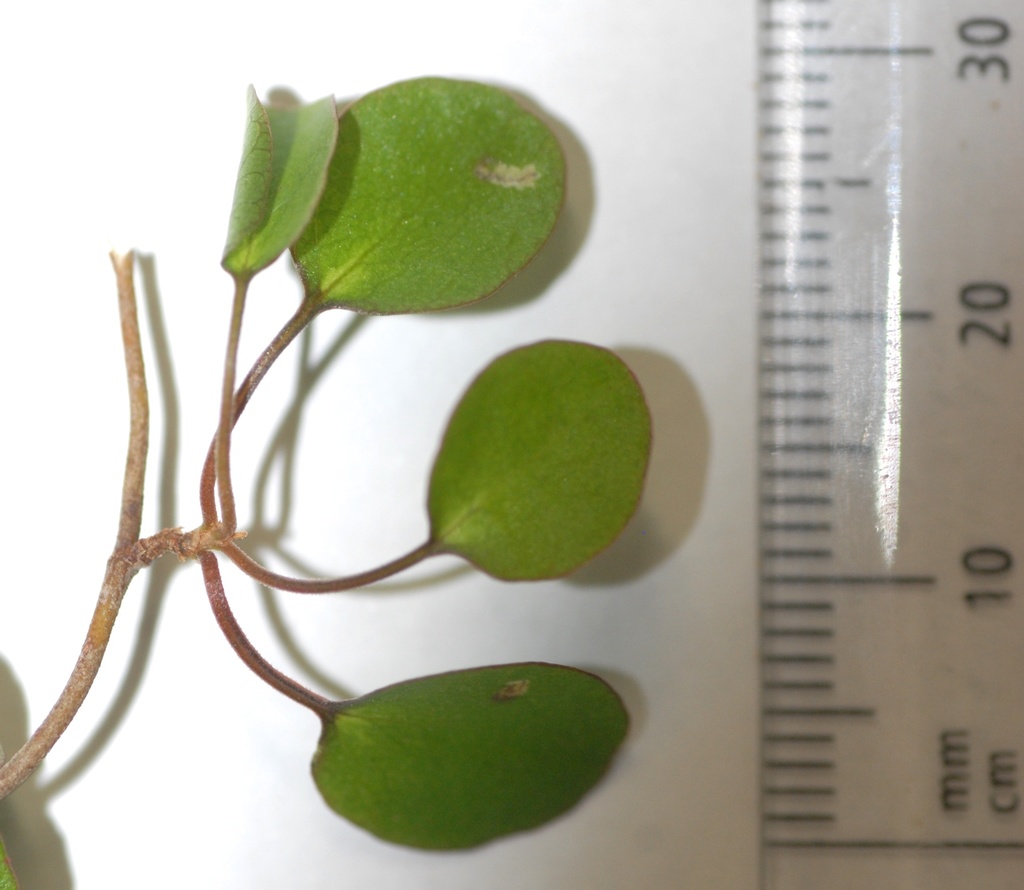
Maidenhair vine is a naturalized shrub found in coastal California regions including the North Coast and Central Coast in disturbed areas, coastal bluffs, and sandy and rocky places at elevations below 500 meters. Flowering from July to September, this plant produces small yellow-green flowers 2 to 5 millimeters long. Growing as a straggling or climbing shrub up to 5 meters tall, it forms dense tangles with wiry, twisted dark-brown or reddish stems. Its leathery leaves are relatively small, measuring 0.5 to 2 centimeters long with rounded or slightly pointed tips and a nearly smooth surface. The fruit is a shiny, smooth, three-angled brown-black structure 3 to 4 millimeters long that is either hidden within or slightly protruding from the plant.
Identification and appearance
Key characters: Geographically isolated. Key features: wiry twisted stems, small rounded leaves, coastal distribution
Habitat and range
Habitat: Disturbed areas, coastal bluffs, sandy and rocky places
Elevation: < 500 m
California counties: Santa Cruz, San Francisco, Los Angeles, Alameda, Mendocino, Marin, Santa Barbara, Monterey, Humboldt, Santa Clara
Outside California: native to New Zealand
Bloom period
Muehlenbeckia complexa blooms Jul-Sep.
How to tell it apart
vs Coprosma: Muehlenbeckia has wiry climbing stems; Coprosma forms upright shrubs with opposite leaves.; vs Rhamnus: Muehlenbeckia has tiny flowers and fleshy fruits; Rhamnus has small but distinct petaled flowers.; vs Adiantum: Muehlenbeckia is a woody vine; Adiantum is a fern with delicate fan-shaped leaflets.; vs Oxyria: Muehlenbeckia is a woody vine; Oxyria is a non-woody herb with kidney-shaped basal leaves.; vs Bistorta: Muehlenbeckia is a woody vine; Bistorta is an upright herb with dense flower spikes.
Frequently asked questions
Is Muehlenbeckia complexa native to California?
No. Muehlenbeckia complexa is not native to California (recorded as not native).
When does Muehlenbeckia complexa bloom?
Muehlenbeckia complexa blooms Jul-Sep.
Where in California does Muehlenbeckia complexa grow?
Muehlenbeckia complexa occurs in Santa Cruz, San Francisco, Los Angeles, Alameda, Mendocino, Marin, Santa Barbara, Monterey and other counties, at elevations of < 500 m.
What plant family does Muehlenbeckia complexa belong to?
Muehlenbeckia complexa is in the Polygonaceae family, genus Muehlenbeckia.
What habitat does Muehlenbeckia complexa grow in?
Muehlenbeckia complexa grows in Disturbed areas, coastal bluffs, sandy and rocky places.
Related species
Other California species in the same genus, family, or bioregion.
Sources: Jepson eFlora · Index of California Plant Names · CalPhotos
Last updated 2026-10-07
Data from The California Species Project — 14,000+ California species with verified data from CNPS, CDFW, USFWS, Cal-IPC, and more.