Muhlenbergia alopecuroides
Wolftail
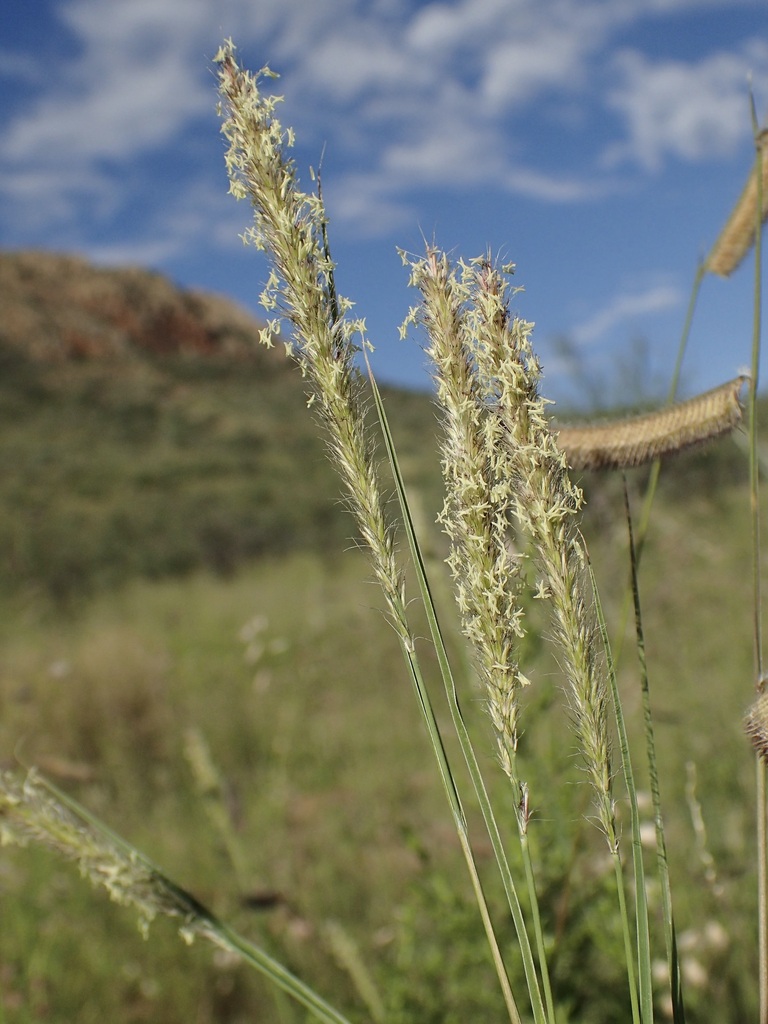
(c) Sue Carnahan, some rights reserved (CC BY) · licence
Family: Poaceae · Type: Perennial · Native
Conservation status: CNPS 2B.2
Muhlenbergia alopecuroides (Wolftail) is a native California perennial in the Poaceae family, recognized by distinctive paired spikelets and white leaf markings.
Wolftail is a rare (CNPS 2B.2) California native perennial grass found in the eastern Desert Mountains, specifically the New York Mountains, on rocky slopes and mesas at approximately 500 meters elevation. Flowering from July to October, this plant produces yellow-anthered spikelets in dense, spike-like inflorescences 4 to 10 centimeters long. Growing with slender stems 30 to 60 centimeters tall, it has distinctive flat leaf blades 4 to 12 centimeters long, with white midribs and margins. Its leaves feature an unusual awn-like extension at the tip, 3 to 10 millimeters long, and have a ligule 2 to 12 millimeters long. The plant produces intricate paired spikelets with unequal glumes, each with delicate awns 1 to 5 millimeters long.
Identification and appearance
Key characters: 10 sympatric species; distinctive paired spikelets and white leaf markings
Habitat and range
Habitat: Rocky slopes and mesas
Elevation: +- 500 m.
Outside California: southwestern United States, Mexico, also northwestern Argentina, Bolivia
Bloom period
Muhlenbergia alopecuroides blooms Jul-Oct.
Conservation status
CNPS 2B.2
How to tell it apart
vs Cenchrus: Cenchrus has spiny burs enclosing seed clusters; Muhlenbergia has open panicles without spines.; vs Nassella: Nassella has prominent bent awns; Muhlenbergia awns are straight or absent.; vs Festuca: Festuca has multiple-flowered spikelets; Muhlenbergia typically has single-flowered spikelets in open panicles.; vs Carex: Carex (sedges) has triangular stems and separate male/female flowers; Muhlenbergia has round stems.; vs Juncus: Juncus (rushes) has tiny brown chaffy flowers in clusters; Muhlenbergia has typical grass spikelets.
Frequently asked questions
Is Muhlenbergia alopecuroides native to California?
Yes. Muhlenbergia alopecuroides is native to California (recorded as native).
When does Muhlenbergia alopecuroides bloom?
Muhlenbergia alopecuroides blooms Jul-Oct.
What plant family does Muhlenbergia alopecuroides belong to?
Muhlenbergia alopecuroides is in the Poaceae family, genus Muhlenbergia.
Is Muhlenbergia alopecuroides rare or endangered?
Muhlenbergia alopecuroides carries California Rare Plant Rank 2B.2, state rank S1?.
What habitat does Muhlenbergia alopecuroides grow in?
Muhlenbergia alopecuroides grows in Rocky slopes and mesas.
Related species
Other California species in the same genus, family, or bioregion.
Sources: Jepson eFlora · CalPhotos
Last updated 2026-04-09
Data from The California Species Project — 14,000+ California species with verified data from CNPS, CDFW, USFWS, Cal-IPC, and more.