Muhlenbergia asperifolia
Scratch grass
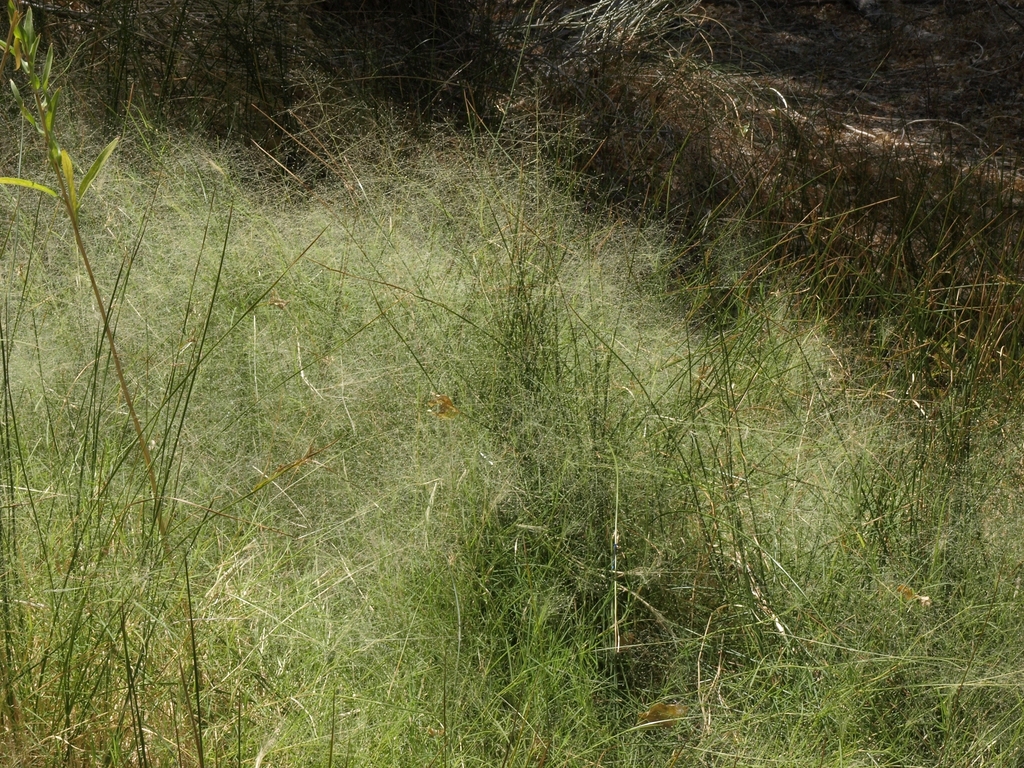
(c) Jim Morefield, some rights reserved (CC BY), uploaded by Jim Morefield · licence
Family: Poaceae · Type: Grass · Native
Muhlenbergia asperifolia (Scratch grass) is a native California grass in the Poaceae family, recognized by distinctive open inflorescence and alkaline habitat.
Scratch grass is a California native perennial found in moist, often alkaline meadows, seeps, and hot springs at elevations of 120 to 2,150 meters. Flowering from July to October, this grass produces delicate purple-tinged flower clusters in open, spreading panicles 6 to 17 centimeters long. Growing with decumbent to erect stems 10 to 60 centimeters tall, it spreads via shiny, scaly rhizomes that form loose, intricate patches. Its leaves are fine and narrow, 2 to 6 centimeters long and 1 to 2.8 millimeters wide, typically flat or slightly folded with truncate, minutely ciliate ligules. The plant forms distinctive spreading branches with small, acute spikelets bearing purple anthers, giving it a delicate, textured appearance in meadow environments.
Identification and appearance
Key characters: 18 sympatric species; distinctive open inflorescence and alkaline habitat
Habitat and range
Habitat: Moist, often alkaline meadows, seeps, hot springs
Elevation: 120-2150 m
California counties: San Bernardino, Kern, Riverside, Lassen, Inyo, Tulare, Mono, Ventura, Santa Barbara, Fresno, Modoc, San Diego, Los Angeles, San Benito, Orange, Siskiyou, Nevada, San Luis Obispo, Alpine, Butte, Merced, Plumas, San Joaquin, Shasta, Stanislaus, Lake, Colusa, Monterey, Tuolumne, Mariposa
Outside California: western North America, southern South America
Bloom period
Muhlenbergia asperifolia blooms Jul-Oct.
How to tell it apart
vs Cenchrus: Cenchrus has spiny burs enclosing seed clusters; Muhlenbergia has open panicles without spines.; vs Nassella: Nassella has prominent bent awns; Muhlenbergia awns are straight or absent.; vs Festuca: Festuca has multiple-flowered spikelets; Muhlenbergia typically has single-flowered spikelets in open panicles.; vs Carex: Carex (sedges) has triangular stems and separate male/female flowers; Muhlenbergia has round stems.; vs Juncus: Juncus (rushes) has tiny brown chaffy flowers in clusters; Muhlenbergia has typical grass spikelets.
Frequently asked questions
Is Muhlenbergia asperifolia native to California?
Yes. Muhlenbergia asperifolia is native to California (recorded as native).
When does Muhlenbergia asperifolia bloom?
Muhlenbergia asperifolia blooms Jul-Oct.
Where in California does Muhlenbergia asperifolia grow?
Muhlenbergia asperifolia occurs in San Bernardino, Kern, Riverside, Lassen, Inyo, Tulare, Mono, Ventura and other counties, at elevations of 120-2150 m.
What plant family does Muhlenbergia asperifolia belong to?
Muhlenbergia asperifolia is in the Poaceae family, genus Muhlenbergia.
What habitat does Muhlenbergia asperifolia grow in?
Muhlenbergia asperifolia grows in Moist, often alkaline meadows, seeps, hot springs.
Related species
Other California species in the same genus, family, or bioregion.
Sources: Jepson eFlora · Index of California Plant Names · CalPhotos
Last updated 2026-10-07
Data from The California Species Project — 14,000+ California species with verified data from CNPS, CDFW, USFWS, Cal-IPC, and more.