Myoporum laetum
Myoporum, ngaio tree, Ngaio Tree
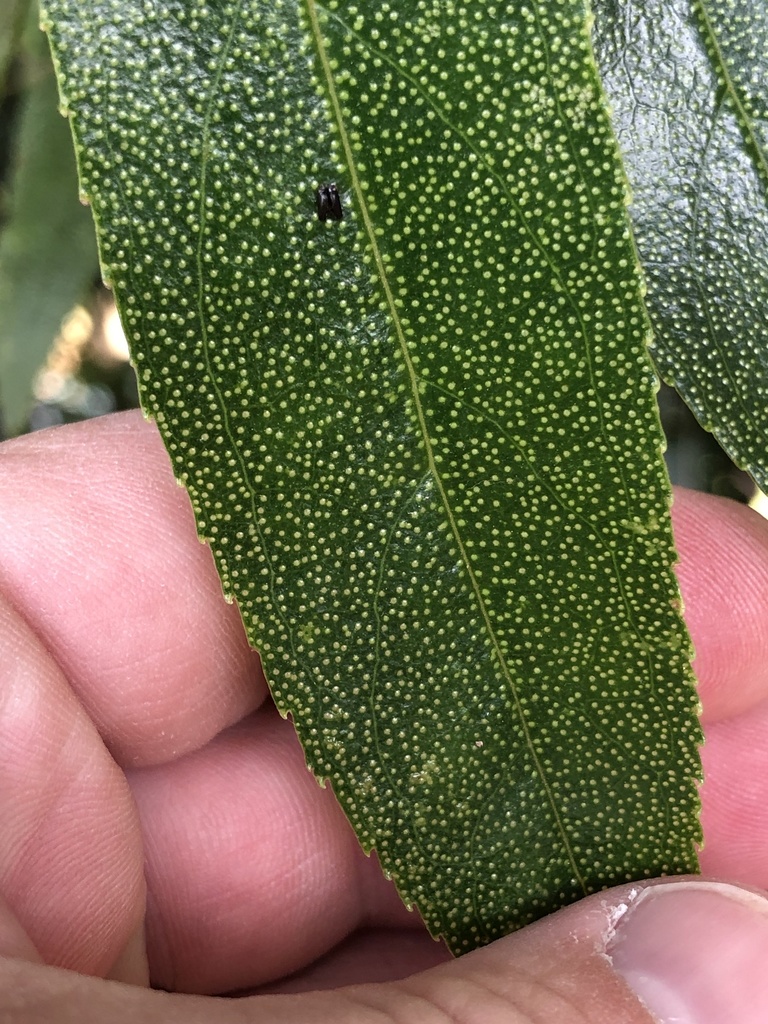
(c) Nathan Odgers, some rights reserved (CC BY), uploaded by Nathan Odgers · licence
Family: Scrophulariaceae · Type: Shrub / Tree · Not Native
Conservation status: Cal-IPC Yes
Myoporum laetum (Myoporum) is a non-native California shrub / tree in the Scrophulariaceae family, recognized by Native to New Zealand, naturalized in coastal California - represents a Southern Hemisphere genus establishing in Mediterranean climate.
Myoporum is a naturalized shrub found along the central and southern California coast, Channel Islands, and reported in northern coastal areas, growing in open grassland, scrub, and riparian habitats at elevations below 460 meters. Flowering in early spring, this plant produces white flowers with distinctive purple spots, approximately 10 millimeters in diameter and bell-shaped with long inner hairs. Growing 3 to 10 meters tall with a broadly spreading, much-branched form, the shrub has bronze-green twig tips and young leaves that are sticky and attractive. Its leaves are bright green, generally lanceolate, less than 10 centimeters long, and finely serrate toward the leaf tips, with a somewhat fleshy texture. The fruit is a fleshy, ovoid structure 5 to 10 millimeters long, ranging from pale to dark red-purple in color.
Identification and appearance
Key characters: Native to New Zealand, naturalized in coastal California - represents a Southern Hemisphere genus establishing in Mediterranean climate
Habitat and range
Habitat: Open areas in grassland, scrub, riparian habitats, generally coastal
Elevation: < 460 m
California counties: Ventura, Orange, San Francisco, Santa Barbara, Los Angeles, San Diego, Riverside, Alameda, San Luis Obispo, San Mateo, Contra Costa, Monterey, Santa Clara
Outside California: native to New Zealand
Bloom period
Myoporum laetum blooms Early spring.
Conservation status
Cal-IPC Yes
How to tell it apart
vs Bacopa: Myoporum is a woody shrub while Bacopa is a small creeping herb of wet places.; vs Houstonia: Myoporum forms woody coastal shrubs with gland-dotted leaves; Houstonia is a tiny herbaceous plant.; vs Batis: Myoporum has showy white purple-spotted flowers; Batis has inconspicuous flowers and grows in salt marshes.; vs Salvia: Myoporum flowers have 5 stamens and purple spots; Salvia has 2 stamens and square stems.; vs Heliotropium: Myoporum is a woody shrub with spotted petals; Heliotropium is an herb with unspotted coiled flower clusters.
Frequently asked questions
Is Myoporum laetum native to California?
No. Myoporum laetum is not native to California (recorded as not native).
When does Myoporum laetum bloom?
Myoporum laetum blooms Early spring.
Where in California does Myoporum laetum grow?
Myoporum laetum occurs in Ventura, Orange, San Francisco, Santa Barbara, Los Angeles, San Diego, Riverside, Alameda and other counties, at elevations of < 460 m.
What plant family does Myoporum laetum belong to?
Myoporum laetum is in the Scrophulariaceae family, genus Myoporum.
Is Myoporum laetum invasive in California?
Myoporum laetum is listed by Cal-IPC with an invasiveness rating of Yes.
Related species
Other California species in the same genus, family, or bioregion.
Sources: Jepson eFlora · Index of California Plant Names · CalPhotos
Last updated 2026-10-07
Data from The California Species Project — 14,000+ California species with verified data from CNPS, CDFW, USFWS, Cal-IPC, and more.