Myosotis discolor
Changing forget-me-not
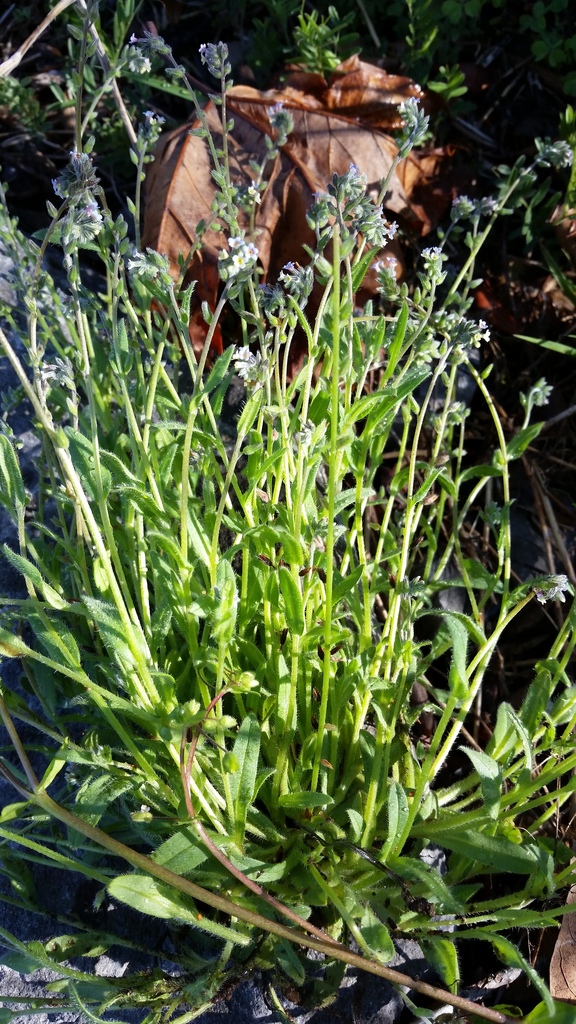
(c) Zihao Wang, some rights reserved (CC BY) · licence
Family: Boraginaceae · Type: Herb · Not Native
Myosotis discolor (Changing forget-me-not) is a non-native California herb in the Boraginaceae family, recognized by unique color-changing flowers (yellow to blue) diagnostic.
Changing forget-me-not is a naturalized annual found in northwestern California, the Cascade Range, northern Sierra Nevada, central Sierra Nevada forest, Sacramento Valley, Central Coast, San Francisco Bay Area, Peninsular Ranges, and Modoc Plateau in roadsides, moist ground, and wet meadows at elevations below 1,650 meters. Flowering from April to July, this plant produces distinctive yellow flowers that turn blue, with wide funnel-shaped blossoms around 1 to 3 millimeters in diameter. Growing with slender stems 10 to 50 centimeters tall, it branches irregularly and appears somewhat hairy. Its leaves are sparse, ranging from oblanceolate at the base to linear or oblong on the stem, generally 1 to 4 centimeters long and 2 to 8 millimeters wide. The fruit consists of small dark brown or nearly black nutlets that are shorter than the plant's style.
Identification and appearance
Key characters: 5 sympatric species; unique color-changing flowers (yellow to blue) diagnostic
Habitat and range
Habitat: Roadsides, moist ground, wet meadows
Elevation: < 1650 m
California counties: Plumas, Shasta, Sonoma, Mendocino, Siskiyou, Butte, Lassen, Mariposa, El Dorado, Sacramento, Nevada, San Mateo, Lake, Yuba, Sierra, Humboldt, Marin, Trinity, Calaveras, San Diego, Tuolumne, Alpine, Santa Cruz, Monterey
Outside California: to eastern North America, native to Europe
Bloom period
Myosotis discolor blooms Apr-Jul.
How to tell it apart
vs Hackelia: Myosotis has smooth seeds; Hackelia seeds have hooked barbs that grab clothing.; vs Plagiobothrys: Myosotis flowers are bright blue with flat, round faces; Plagiobothrys flowers are white and more tubular.; vs Adelinia: Myosotis has bright blue flowers with yellow eyes; Adelinia flowers are typically white.; vs Cynoglossum: Myosotis has smooth seeds; Cynoglossum has barbed seeds forming dense burrs.; vs Cryptantha: Myosotis has flat blue flowers with yellow centers; Cryptantha has tiny white tubular flowers.
Frequently asked questions
Is Myosotis discolor native to California?
No. Myosotis discolor is not native to California (recorded as not native).
When does Myosotis discolor bloom?
Myosotis discolor blooms Apr-Jul.
Where in California does Myosotis discolor grow?
Myosotis discolor occurs in Plumas, Shasta, Sonoma, Mendocino, Siskiyou, Butte, Lassen, Mariposa and other counties, at elevations of < 1650 m.
What plant family does Myosotis discolor belong to?
Myosotis discolor is in the Boraginaceae family, genus Myosotis.
What habitat does Myosotis discolor grow in?
Myosotis discolor grows in Roadsides, moist ground, wet meadows.
Related species
Other California species in the same genus, family, or bioregion.
Sources: Jepson eFlora · Index of California Plant Names · CalPhotos
Last updated 2026-10-07
Data from The California Species Project — 14,000+ California species with verified data from CNPS, CDFW, USFWS, Cal-IPC, and more.