Myosurus sessilis
Tiny mouse tail
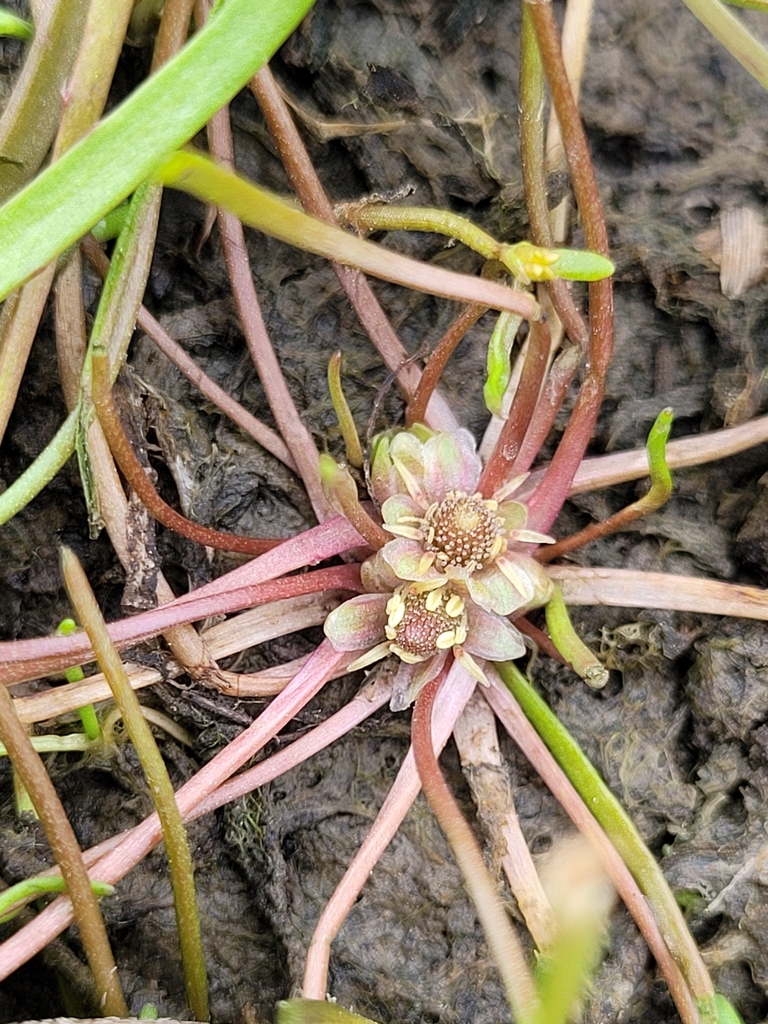
(c) Konshau Duman, some rights reserved (CC BY) · licence
Family: Ranunculaceae · Type: Herb · Native
Myosurus sessilis (Tiny mouse tail) is a native California herb in the Ranunculaceae family, recognized by clearly distinguished by tiny size and sessile inflorescence.
Tiny mouse tail is a California native annual found in the Great Valley bioregion in vernal pools and alkali flats at elevations of 3 to 1,600 meters. Flowering from March to May, this diminutive plant produces tiny white to pale yellow flowers with delicate, nearly invisible structures. Growing extremely small, typically 0.8 to 2.5 centimeters tall with minimal stem development, it forms compact, ground-hugging clusters. Its leaves are subtle and nestled close to the ground, creating a miniature landscape of intricate botanical detail. The fruit develops in narrow, rhomboid shapes with a tiny diverging beak, forming an aggregate structure up to 25 millimeters long.
Identification and appearance
Key characters: 1 sympatric species; clearly distinguished by tiny size and sessile inflorescence
Habitat and range
Habitat: Vernal pools, alkali flats
Elevation: 3-1600 m
California counties: San Benito, Colusa, Yolo, Contra Costa, Tulare, Fresno, Butte, Tehama, Glenn, Merced, Alameda, Siskiyou, Stanislaus, Solano, San Luis Obispo, San Joaquin
Outside California: Oregon
Bloom period
Myosurus sessilis blooms Mar-May.
How to tell it apart
vs Triglochin: Myosurus has distinctive elongated cone-shaped fruiting heads; Triglochin has slender spikes of scale-like flowers.; vs Typha: Myosurus is a tiny annual inches tall; Typha is a robust perennial several feet tall with brown flower heads.; vs Sparganium: Myosurus has cone-shaped receptacles on single stems; Sparganium has round, burr-like heads in branched clusters.; vs Juncus: Myosurus is an annual with elongated fruiting cones; Juncus is perennial with round capsules in branched clusters.
Frequently asked questions
Is Myosurus sessilis native to California?
Yes. Myosurus sessilis is native to California (recorded as native).
When does Myosurus sessilis bloom?
Myosurus sessilis blooms Mar-May.
Where in California does Myosurus sessilis grow?
Myosurus sessilis occurs in San Benito, Colusa, Yolo, Contra Costa, Tulare, Fresno, Butte, Tehama and other counties, at elevations of 3-1600 m.
What plant family does Myosurus sessilis belong to?
Myosurus sessilis is in the Ranunculaceae family, genus Myosurus.
What habitat does Myosurus sessilis grow in?
Myosurus sessilis grows in Vernal pools, alkali flats.
Related species
Other California species in the same genus, family, or bioregion.
- Myosurus sp. — Mousetail
- Myosurus apetalus — Bristly mousetail
- Myosurus apetalus var. borealis — Bristly mousetail
- Myosurus apetalus var. montanus — Bristly mousetail
- Myosurus cupulatus — Arizona mousetail
- Myosurus minimus — Common mouse tail
- Ranunculaceae sp. — Buttercup family
- Ranunculus acris — Acrid buttercup
- Ranunculus alismifolius — Alisma leaved buttercup
Sources: Jepson eFlora · Index of California Plant Names · CalPhotos
Last updated 2026-10-07
Data from The California Species Project — 14,000+ California species with verified data from CNPS, CDFW, USFWS, Cal-IPC, and more.