Myriopteris covillei
Coville's lip fern, Coville's Lip Fern
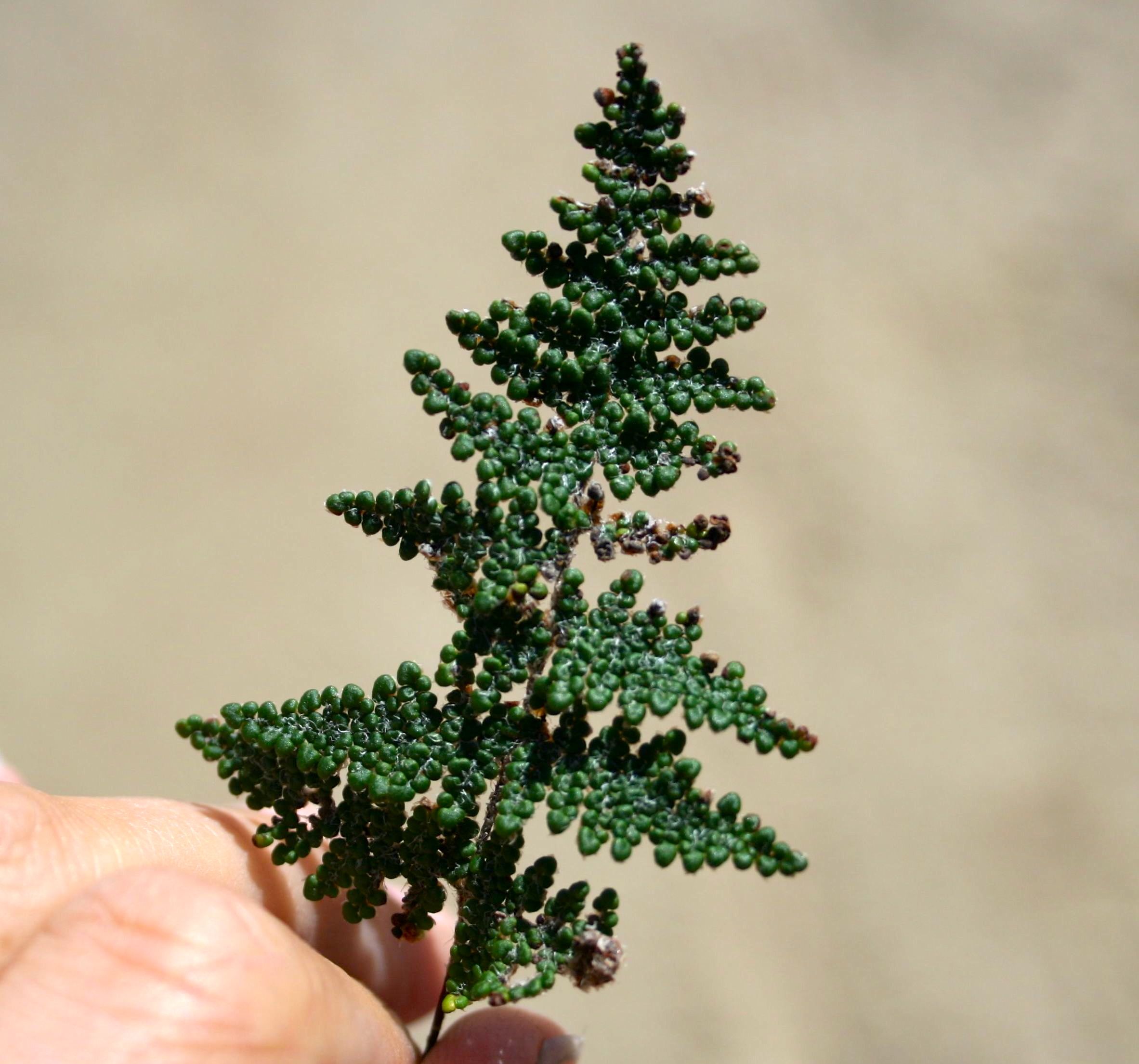
Photo by Chez Brungraber
Family: Pteridaceae · Type: Herb · Native
Myriopteris covillei (Coville's lip fern) is a native California herb in the Pteridaceae family, recognized by dark rhizome scales and large covering scales.
Coville's lip fern is a California native perennial found in the Coast Ranges, Sierra Nevada, Sutter Buttes, San Francisco Bay Area, southern Coast Ranges, eastern southern Coast, Transverse Ranges, Peninsular Ranges, northeastern Sierra Nevada, western Mojave Desert, desert mountains, and western desert regions in rock crevices and rock bases from 600 to 2,400 meters elevation. Its dark green fronds are 8 to 22 centimeters long with intricate, highly dissected leaflets that create a delicate, lacy appearance. Growing with a short-creeping rhizome, the fern develops stems with distinctive dark brown or black scales, some featuring narrow light brown margins. Its leaves are complex, with 3 to 4 levels of pinnate divisions, featuring small, nearly round segments densely covered with overlapping scales that obscure the leaf surface. The fern thrives in both sunny and shaded environments, with fronds characterized by white to red-brown scales and a unique, compact growth structure.
Identification and appearance
Key characters: 9 sympatric species; key features are dark rhizome scales and large covering scales
Habitat and range
Habitat: Crevices, bases of rocks, sun or shade
Elevation: 600-2400 m
California counties: Imperial, Kern, Plumas, Contra Costa, San Bernardino, San Luis Obispo, San Diego, Monterey, Mariposa, Inyo, Santa Barbara, Riverside, Ventura, Tulare, Los Angeles
Outside California: to Utah, Arizona, Baja California
How to tell it apart
vs Achillea: Myriopteris is a fern with spore cases underneath; Achillea is a flowering plant with flat-topped flower clusters.; vs Cheilanthes: These are the same - Cheilanthes is the old name for what's now called Myriopteris.; vs Notholaena: Myriopteris has fuzzy hairs or scales underneath; Notholaena has a smooth waxy powder coating.; vs Pellaea: Myriopteris undersides feel fuzzy or scaly; Pellaea undersides are smooth and leathery.; vs Pentagramma: Myriopteris has fuzzy scales or hairs; Pentagramma undersides are smooth with golden/silver coating or bare.
Frequently asked questions
Is Myriopteris covillei native to California?
Yes. Myriopteris covillei is native to California (recorded as native).
Where in California does Myriopteris covillei grow?
Myriopteris covillei occurs in Imperial, Kern, Plumas, Contra Costa, San Bernardino, San Luis Obispo, San Diego, Monterey and other counties, at elevations of 600-2400 m.
What plant family does Myriopteris covillei belong to?
Myriopteris covillei is in the Pteridaceae family, genus Myriopteris.
What habitat does Myriopteris covillei grow in?
Myriopteris covillei grows in Crevices, bases of rocks, sun or shade.
Related species
Other California species in the same genus, family, or bioregion.
Sources: Jepson eFlora · Index of California Plant Names · CalPhotos
Last updated 2026-10-07
Data from The California Species Project — 14,000+ California species with verified data from CNPS, CDFW, USFWS, Cal-IPC, and more.