Nama demissa var. demissa
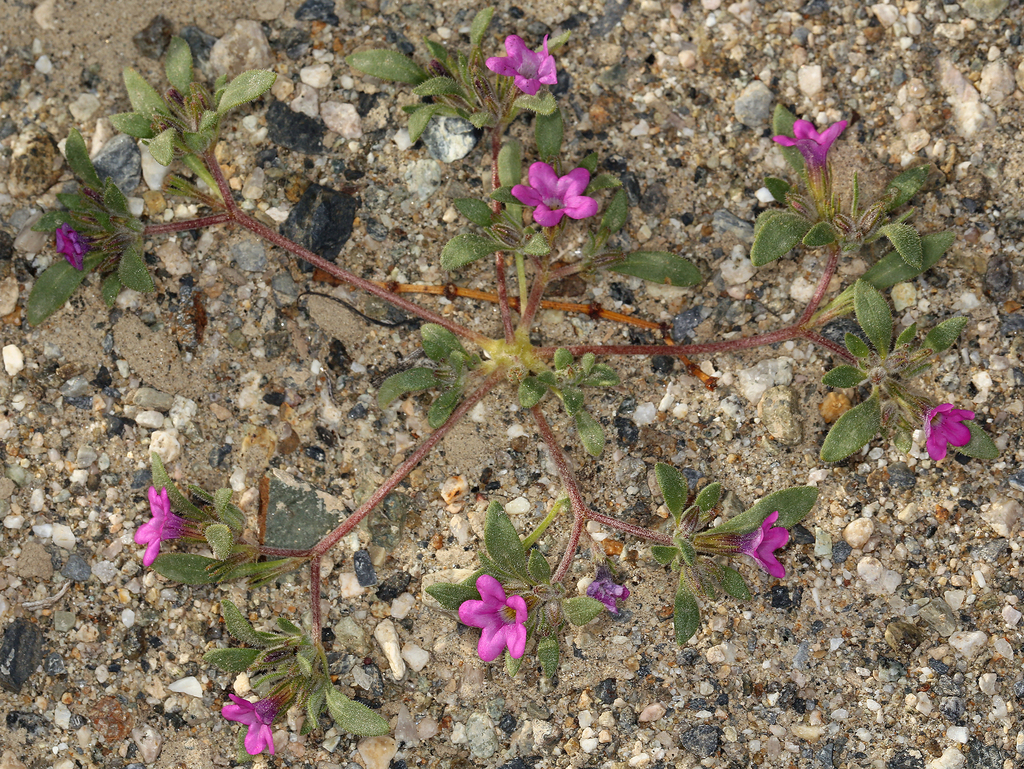
Photo: parent species Nama demissa · (c) Steve Matson, some rights reserved (CC BY) · licence
Family: Namaceae · Type: Perennial · Native
Nama demissa var. demissa is a native California perennial in the Namaceae family, recognized by green color and fine hairs.
Nama demissa is a California native perennial found in southern Sierra Nevada, Tehachapi, San Gabriel, San Bernardino, eastern Peninsular Ranges, Sierra Nevada East, and Deserts in sandy or gravelly habitats at elevations of 70 to 1,780 meters. Flowering from March to May, this plant produces blue-purple to rose-pink flowers with a corolla 7 to 14 millimeters long and limb 5 to 9 millimeters in diameter. Growing with fine-strigose green stems, it forms low-spreading clumps with delicate linear to spoon-shaped leaves 1 to 4 centimeters long. Its leaves are sessile, appearing pale green with fine hairs less than 1 millimeter long. The small fruits are approximately 3 to 4 millimeters long, containing elliptic-ovoid seeds.
Identification and appearance
Key characters: 10 sympatric species; distinguished by green color and fine hairs
Habitat and range
Habitat: Sandy or gravelly flats, slopes
Elevation: 70-1780(2040) m
California counties: San Bernardino, Los Angeles, Kern, Inyo, Mono, San Diego, Tulare, Imperial, Riverside
Outside California: Nevada, Arizona, Mexico
Bloom period
Nama demissa var. demissa blooms Mar-May.
How to tell it apart
vs Diplacus: Nama has purple to blue tubular flowers with unequal stamens; Diplacus has 2-lipped snapdragon-like flowers often yellow or orange.; vs Phacelia: Nama has stamens at different heights in the flower tube; Phacelia has all stamens attached at the same level.; vs Gilia: Nama is a low mat-forming plant with small purple flowers; Gilia is typically more upright with flowers in round heads.; vs Calibrachoa: Nama has small tubular flowers in clusters; Calibrachoa has large showy petunia-like flowers with wide flaring petals.; vs Erodium: Nama has purple tubular flowers; Erodium has pink 5-petaled flowers and distinctive long beak-like fruits.
Frequently asked questions
Is Nama demissa var. demissa native to California?
Yes. Nama demissa var. demissa is native to California (recorded as native).
When does Nama demissa var. demissa bloom?
Nama demissa var. demissa blooms Mar-May.
Where in California does Nama demissa var. demissa grow?
Nama demissa var. demissa occurs in San Bernardino, Los Angeles, Kern, Inyo, Mono, San Diego, Tulare, Imperial and other counties, at elevations of 70-1780(2040) m.
What plant family does Nama demissa var. demissa belong to?
Nama demissa var. demissa is in the Namaceae family, genus Nama.
What habitat does Nama demissa var. demissa grow in?
Nama demissa var. demissa grows in Sandy or gravelly flats, slopes.
Related species
Other California species in the same genus, family, or bioregion.
Sources: Jepson eFlora · Index of California Plant Names · CalPhotos
Last updated 2026-09-30
Data from The California Species Project — 14,000+ California species with verified data from CNPS, CDFW, USFWS, Cal-IPC, and more.