Nasturtium officinale
Water cress, Water Cress
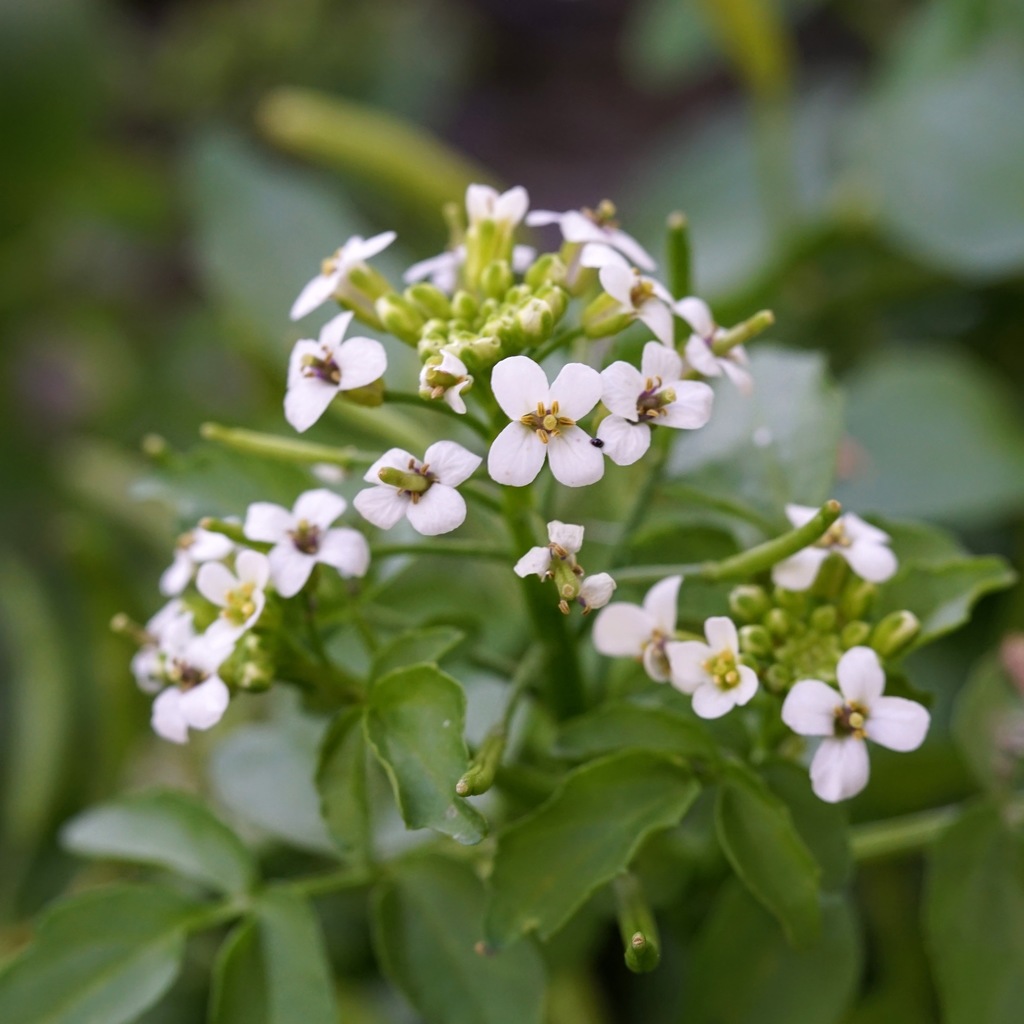
(c) Andrew Tree, some rights reserved (CC BY), uploaded by Andrew Tree · licence
Family: Brassicaceae · Type: Herb · Native
Nasturtium officinale (Water cress) is a native California herb in the Brassicaceae family, recognized by key differences are lack of pubescence, leaflet shape/number, and shorter straight fruits.
Water cress is a California native perennial found in the California Floristic Province, northern Sierra Nevada, White and Inyo Mountains, and Desert Mountains in streams, springs, marshes, lake margins, and swamps at elevations up to 3,000 meters. Flowering from March to November, this plant produces delicate white flowers 2.8 to 4.5 millimeters long with white petals. Growing with erect to decumbent branched stems 10 to 110 centimeters tall, it spreads across wet habitats with a somewhat glabrous appearance. Its compound leaves feature 3 to 9 leaflets, ranging from round to ovate or lanceolate, each 1 to 4 centimeters long with dentate or entire margins. The fruits develop as elongated pods 1 to 1.8 centimeters long, containing 36 to 60 small seeds.
Identification and appearance
Key characters: 1 sympatric species; key differences are lack of pubescence, leaflet shape/number, and shorter straight fruits
Habitat and range
Habitat: Streams, springs, marshes, lake margins, swamps
Elevation: < 3000 m
California counties: Placer, Ventura, Orange, San Diego, San Bernardino, Los Angeles, San Luis Obispo, Alameda, Butte, Del Norte, Fresno, Inyo, Kern, Madera, Mono, Monterey, Riverside, Santa Clara, Santa Cruz, Siskiyou, Solano, Tulare, Santa Barbara, El Dorado, Glenn, Lake, Marin, San Francisco, San Mateo, Shasta, Sonoma, Mariposa, Mendocino, Napa, Humboldt, Trinity, Calaveras, Tuolumne, Amador, Nevada, Plumas, Sierra, Sutter, Lassen, Contra Costa, Sacramento, Modoc, San Benito, Yuba, Stanislaus, Alpine, Tehama
Outside California: temperate worldwide
Bloom period
Nasturtium officinale blooms Mar-Nov.
How to tell it apart
vs Cardamine: Nasturtium roots from stem nodes in water; Cardamine grows in moist soil without aquatic rooting stems.; vs Tropaeolum: Nasturtium is aquatic with compound leaves; garden nasturtium (Tropaeolum) is terrestrial with round shield-shaped leaves.; vs Lobularia: Nasturtium has compound leaves with separate leaflets; sweet alyssum has simple undivided leaves.; vs Helosciadium: Nasturtium has 4-petaled mustard flowers; Helosciadium has 5-petaled umbel flowers.; vs Callitriche: Nasturtium has compound leaves and 4-petaled flowers; water starwort has simple opposite leaves and tiny flowers.
Frequently asked questions
Is Nasturtium officinale native to California?
Yes. Nasturtium officinale is native to California (recorded as native).
When does Nasturtium officinale bloom?
Nasturtium officinale blooms Mar-Nov.
Where in California does Nasturtium officinale grow?
Nasturtium officinale occurs in Placer, Ventura, Orange, San Diego, San Bernardino, Los Angeles, San Luis Obispo, Alameda and other counties, at elevations of < 3000 m.
What plant family does Nasturtium officinale belong to?
Nasturtium officinale is in the Brassicaceae family, genus Nasturtium.
What habitat does Nasturtium officinale grow in?
Nasturtium officinale grows in Streams, springs, marshes, lake margins, swamps.
Related species
Other California species in the same genus, family, or bioregion.
Sources: Jepson eFlora · Index of California Plant Names · CalPhotos
Last updated 2026-10-07
Data from The California Species Project — 14,000+ California species with verified data from CNPS, CDFW, USFWS, Cal-IPC, and more.