Navarretia atractyloides
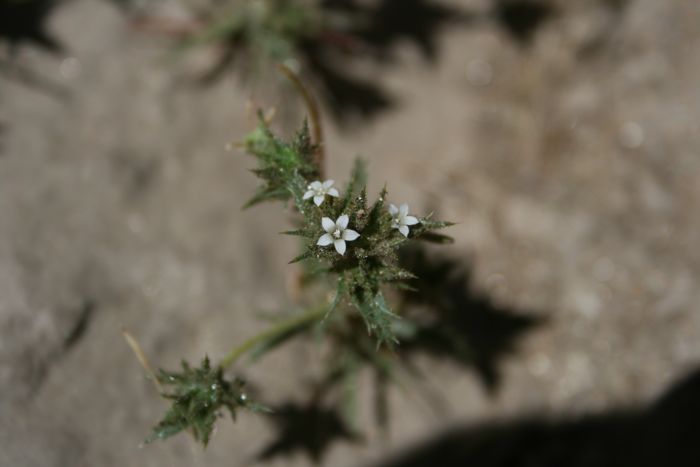
Photo by Chez Brungraber
Family: Polemoniaceae · Type: Herb · Native
Navarretia atractyloides is a native California herb in the Polemoniaceae family, recognized by gland-dotted bracts and included corolla.
Navarretia atractyloides is a California native annual herb found in the Klamath Ranges, northern Coast Ranges, Cascade Range, central Sierra Nevada, southern Sierra Nevada, central western California, Channel Islands, Transverse Ranges, Peninsular Ranges, and Mojave Desert in open, rocky or sandy areas at elevations below 2,500 meters. Flowering from May to July, this plant produces purple to white flowers in compact clusters with red-veined corollas 8 to 9 millimeters long. Growing with erect stems 5 to 29 centimeters tall, branching above with ascending branches and covered in glandular hairs. Its distinctive leaves are strap-shaped to lanceolate with pinnate lobes, featuring spreading basal lobes and unequal ascending upper lobes. The plant's inflorescence bracts are gland-dotted with recurved tips that have three unequal, somewhat separated lobes.
Identification and appearance
Key characters: 52 sympatric species; key features are gland-dotted bracts and included corolla
Habitat and range
Habitat: Open, rocky or sandy areas
Elevation: < 2500 m
California counties: San Luis Obispo, San Diego, Los Angeles, Riverside, San Bernardino, Santa Barbara, Monterey, Ventura, Orange, Mendocino, Trinity, Santa Cruz, Humboldt, Lake, Santa Clara, Shasta, Siskiyou, Fresno, San Benito, Tulare, Napa, Contra Costa, San Mateo, Madera, Colusa, Yolo
Outside California: Oregon, Baja California
Bloom period
Navarretia atractyloides blooms May-Jul.
How to tell it apart
vs Leptosiphon: Navarretia has spiny, thistle-like flower heads; Leptosiphon has open flower clusters without spines.; vs Gilia: Navarretia has very short glandular hairs; Gilia has white cobwebby or bent hairs.; vs Eriastrum: Navarretia flower heads are spiny but not woolly; Eriastrum heads are densely woolly-white.; vs Saltugilia: Wet the seeds - Navarretia seeds become gelatinous; Saltugilia seeds stay dry.; vs Eryngium: Navarretia has tubular flowers in heads; Eryngium has tiny separate flowers and divided leaves.
Frequently asked questions
Is Navarretia atractyloides native to California?
Yes. Navarretia atractyloides is native to California (recorded as native).
When does Navarretia atractyloides bloom?
Navarretia atractyloides blooms May-Jul.
Where in California does Navarretia atractyloides grow?
Navarretia atractyloides occurs in San Luis Obispo, San Diego, Los Angeles, Riverside, San Bernardino, Santa Barbara, Monterey, Ventura and other counties, at elevations of < 2500 m.
What plant family does Navarretia atractyloides belong to?
Navarretia atractyloides is in the Polemoniaceae family, genus Navarretia.
What habitat does Navarretia atractyloides grow in?
Navarretia atractyloides grows in Open, rocky or sandy areas.
Related species
Other California species in the same genus, family, or bioregion.
Sources: Jepson eFlora · Index of California Plant Names · CalPhotos
Last updated 2026-10-07
Data from The California Species Project — 14,000+ California species with verified data from CNPS, CDFW, USFWS, Cal-IPC, and more.