Navarretia leucocephala subsp. leucocephala
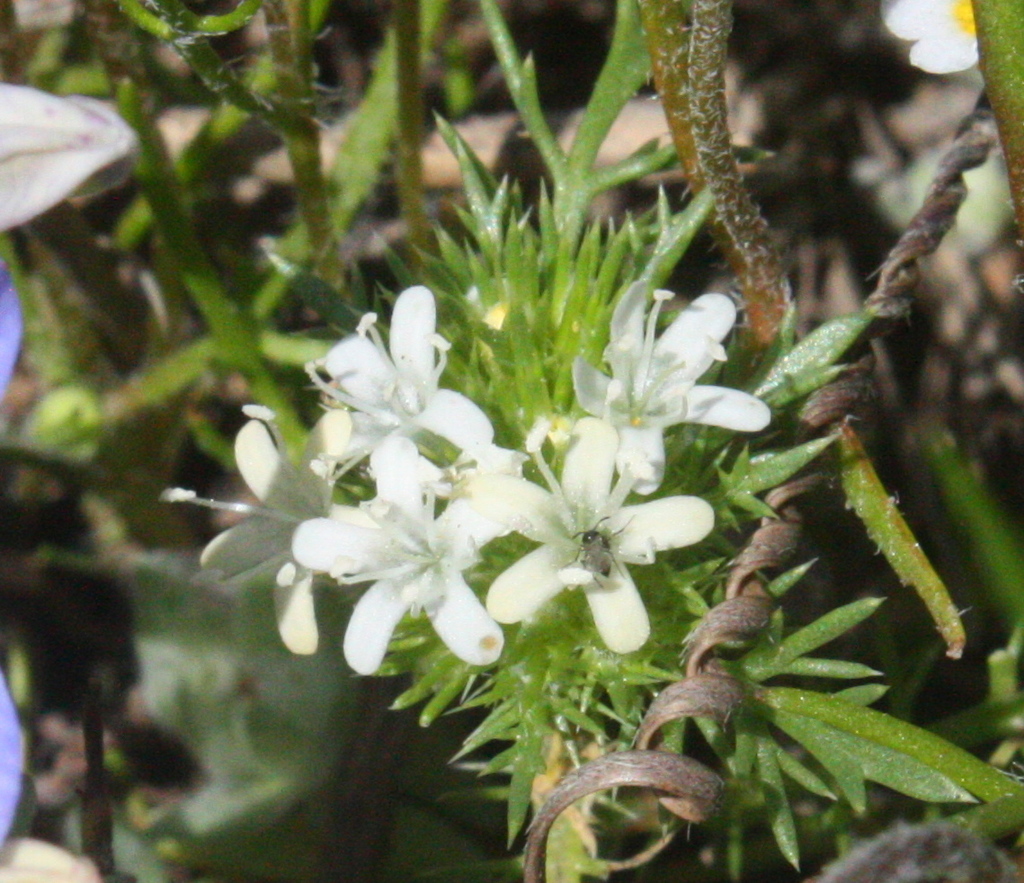
Photo: parent species Navarretia leucocephala · no rights reserved · CC0
Family: Polemoniaceae · Type: Herb · Native
Navarretia leucocephala subsp. leucocephala is a native California herb in the Polemoniaceae family, recognized by larger size and exserted corolla tube distinguish from subsp. bakeri.
Navarretia leucocephala is a California native annual found in the northern Coast Ranges, Cascade Range, Sierra Nevada, Great Valley, and Modoc Plateau in vernal pools at elevations below 2,100 meters. Flowering from April to May, this delicate plant produces white flowers with narrowly ovate corolla lobes in compact heads with distinctive elongated bracts more than twice the head length. Growing with slender stems 2 to 22 centimeters tall, it has an intricate branching structure with inflorescence lobes dividing into three to four branches. Its leaves and flower structures are characterized by intricate, finely divided formations that help the plant thrive in seasonal wetland environments. The plant's white flowers feature an exserted corolla tube and style, creating a distinctive appearance in the ephemeral landscape of vernal pools.
Identification and appearance
Key characters: 40 sympatric species; larger size and exserted corolla tube distinguish from subsp. bakeri
Habitat and range
Habitat: Vernal pools
Elevation: < 2100 m
California counties: Sutter, Butte, Tehama, Placer, Yolo, Yuba, Shasta, Sacramento, Colusa, San Joaquin, Glenn, Stanislaus, Plumas, Modoc, Merced, Lassen, Solano, Napa, Fresno, Siskiyou, Mendocino, Amador, Calaveras
Outside California: Oregon
Bloom period
Navarretia leucocephala subsp. leucocephala blooms Apr-May.
How to tell it apart
vs Leptosiphon: Navarretia has spiny, thistle-like flower heads; Leptosiphon has open flower clusters without spines.; vs Gilia: Navarretia has very short glandular hairs; Gilia has white cobwebby or bent hairs.; vs Eriastrum: Navarretia flower heads are spiny but not woolly; Eriastrum heads are densely woolly-white.; vs Saltugilia: Wet the seeds - Navarretia seeds become gelatinous; Saltugilia seeds stay dry.; vs Eryngium: Navarretia has tubular flowers in heads; Eryngium has tiny separate flowers and divided leaves.
Frequently asked questions
Is Navarretia leucocephala subsp. leucocephala native to California?
Yes. Navarretia leucocephala subsp. leucocephala is native to California (recorded as native).
When does Navarretia leucocephala subsp. leucocephala bloom?
Navarretia leucocephala subsp. leucocephala blooms Apr-May.
Where in California does Navarretia leucocephala subsp. leucocephala grow?
Navarretia leucocephala subsp. leucocephala occurs in Sutter, Butte, Tehama, Placer, Yolo, Yuba, Shasta, Sacramento and other counties, at elevations of < 2100 m.
What plant family does Navarretia leucocephala subsp. leucocephala belong to?
Navarretia leucocephala subsp. leucocephala is in the Polemoniaceae family, genus Navarretia.
What habitat does Navarretia leucocephala subsp. leucocephala grow in?
Navarretia leucocephala subsp. leucocephala grows in Vernal pools.
Related species
Other California species in the same genus, family, or bioregion.
Sources: Jepson eFlora · Index of California Plant Names · CalPhotos
Last updated 2026-10-07
Data from The California Species Project — 14,000+ California species with verified data from CNPS, CDFW, USFWS, Cal-IPC, and more.