Navarretia pubescens
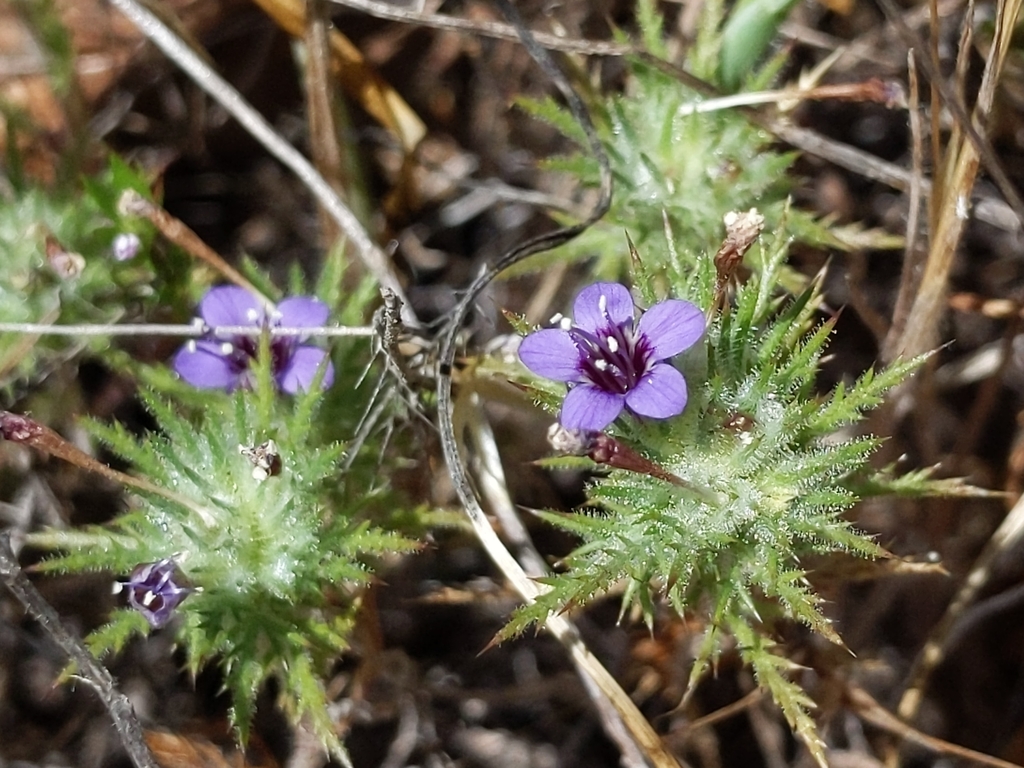
(c) Ken-ichi Ueda, some rights reserved (CC BY) · licence
Family: Polemoniaceae · Type: Herb · Native
Navarretia pubescens is a native California herb in the Polemoniaceae family, recognized by two-toned red-purple and blue-purple flowers.
Navarretia pubescens is a California native annual found in northern California bioregions including the North Coast Ranges, Cascade Ranges, Sierra Nevada Foothills, central Sierra Nevada, Sacramento Valley, San Francisco Bay Area, and southern Coast Ranges in open slopes, gravel, and clay habitats at elevations below 1,850 meters. Flowering from May to July, this plant produces bright blue-purple flowers with red-purple throats in delicate, glandular-hairy inflorescences. Growing with erect stems 14 to 33 centimeters tall, ranging from tan to red-brown with ascending branches and densely clustered linear leaf lobes. Its leaves are intricately 2-pinnate-lobed, with lower leaves glabrous and upper leaves puberulent, featuring linear lobes that are often many-toothed. The flower's distinctive corolla reaches 10 to 16 millimeters long, with stamens and style extending beyond the calyx.
Identification and appearance
Key characters: 50 sympatric species; distinguished by two-toned red-purple and blue-purple flowers
Habitat and range
Habitat: Open, slopes, gravel, clay
Elevation: < 1850 m
California counties: Kern, Sutter, Butte, Tuolumne, Mariposa, Mendocino, Glenn, Lake, Tulare, Fresno, Madera, Tehama, Humboldt, Napa, Yuba, Stanislaus, El Dorado, Sacramento, Merced, Santa Clara, Contra Costa, Siskiyou, Monterey, Sonoma, Yolo, Alpine, Amador, Calaveras, Colusa, Marin, Placer, Plumas, San Joaquin, San Luis Obispo, Nevada, Santa Barbara, Solano, Shasta, Alameda, Los Angeles, Ventura
Outside California: southern Oregon
Bloom period
Navarretia pubescens blooms May-Jul.
How to tell it apart
vs Leptosiphon: Navarretia has spiny, thistle-like flower heads; Leptosiphon has open flower clusters without spines.; vs Gilia: Navarretia has very short glandular hairs; Gilia has white cobwebby or bent hairs.; vs Eriastrum: Navarretia flower heads are spiny but not woolly; Eriastrum heads are densely woolly-white.; vs Saltugilia: Wet the seeds - Navarretia seeds become gelatinous; Saltugilia seeds stay dry.; vs Eryngium: Navarretia has tubular flowers in heads; Eryngium has tiny separate flowers and divided leaves.
Frequently asked questions
Is Navarretia pubescens native to California?
Yes. Navarretia pubescens is native to California (recorded as native).
When does Navarretia pubescens bloom?
Navarretia pubescens blooms May-Jul.
Where in California does Navarretia pubescens grow?
Navarretia pubescens occurs in Kern, Sutter, Butte, Tuolumne, Mariposa, Mendocino, Glenn, Lake and other counties, at elevations of < 1850 m.
What plant family does Navarretia pubescens belong to?
Navarretia pubescens is in the Polemoniaceae family, genus Navarretia.
What habitat does Navarretia pubescens grow in?
Navarretia pubescens grows in Open, slopes, gravel, clay.
Related species
Other California species in the same genus, family, or bioregion.
Sources: Jepson eFlora · Index of California Plant Names · CalPhotos
Last updated 2026-10-07
Data from The California Species Project — 14,000+ California species with verified data from CNPS, CDFW, USFWS, Cal-IPC, and more.