Nemacladus secundiflorus var. robbinsii
Robbins' nemacladus
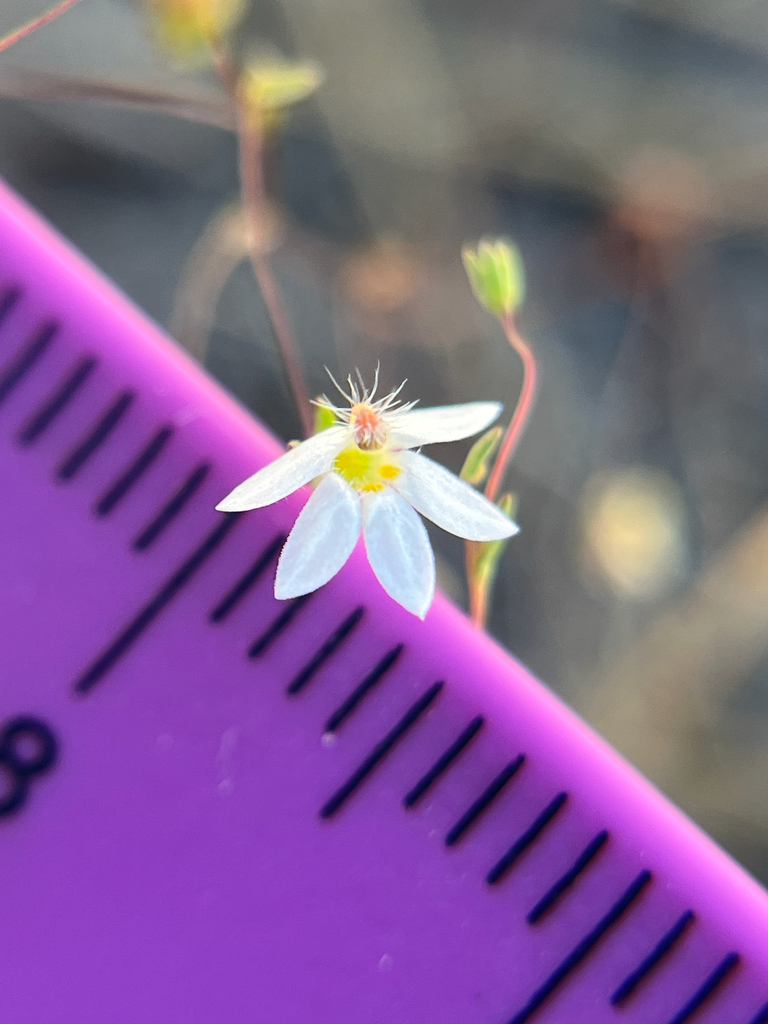
Photo: parent species Nemacladus secundiflorus · no rights reserved · CC0
Family: Campanulaceae · Type: Annual · Native
Conservation status: CNPS 1B.2
Nemacladus secundiflorus var. robbinsii (Robbins' nemacladus) is a native California annual in the Campanulaceae family, recognized by 14 sympatric - small flowers with tiny anthers vs. large flowers in var. secundiflorus.
Robbins' nemacladus is a rare (CNPS 1B.2) California native annual found in southern Sierra Nevada, south Coast Ranges, and Western Transverse Ranges on dry, gravelly slopes at elevations of 350 to 1,700 meters. Flowering from April to May, this delicate plant produces pale lavender or white flowers with distinctive spreading and reflexed corolla lobes. Growing with slender stems and tiny elliptic leaves just 2 to 3 millimeters long, it forms loosely one-sided inflorescences with small lance-ovate bracts. Its minute flowers feature narrow triangular sepals and a diminutive cylindric corolla tube, with petals measuring less than half a millimeter long. The plant's intricate, small-scale architecture makes it a subtle but remarkable component of its dry, rocky habitat.
Identification and appearance
Key characters: 14 sympatric - small flowers with tiny anthers vs. large flowers in var. secundiflorus
Habitat and range
Habitat: Dry, gravelly slopes
Elevation: 350-1700 m
California counties: San Luis Obispo, San Benito, Santa Barbara, Ventura, Monterey, Kern, Los Angeles
Bloom period
Nemacladus secundiflorus var. robbinsii blooms Apr-May.
Conservation status
CNPS 1B.2
How to tell it apart
vs Hesperolinon: Hesperolinon has 5 separate styles and round petals; Nemacladus has fused stamens and irregular flowers.; vs Legenere: Legenere has white flowers in wet areas; Nemacladus has colored flowers in dry desert habitats.; vs Porterella: Porterella grows in wet areas; Nemacladus is a desert specialist of dry sandy soils.; vs Lobelia: Lobelia grows in wet areas with ridged lower lips; Nemacladus thrives in dry deserts.; vs Downingia: Downingia grows in vernal pools; Nemacladus grows in dry desert sands and gravels.
Frequently asked questions
Is Nemacladus secundiflorus var. robbinsii native to California?
Yes. Nemacladus secundiflorus var. robbinsii is native to California (recorded as native).
When does Nemacladus secundiflorus var. robbinsii bloom?
Nemacladus secundiflorus var. robbinsii blooms Apr-May.
Where in California does Nemacladus secundiflorus var. robbinsii grow?
Nemacladus secundiflorus var. robbinsii occurs in San Luis Obispo, San Benito, Santa Barbara, Ventura, Monterey, Kern, Los Angeles, at elevations of 350-1700 m.
What plant family does Nemacladus secundiflorus var. robbinsii belong to?
Nemacladus secundiflorus var. robbinsii is in the Campanulaceae family, genus Nemacladus.
Is Nemacladus secundiflorus var. robbinsii rare or endangered?
Nemacladus secundiflorus var. robbinsii carries California Rare Plant Rank 1B.2, state rank S2.
Related species
Other California species in the same genus, family, or bioregion.
- Nemacladus secundiflorus var. secundiflorus — Large-flowered nemacladus
- Nemacladus sigmoideus — Inyo threadplant
- Nemacladus sp. — Threadplant
- Nemacladus tenuis — Small-flowered desert threadsplant
- Nemacladus tenuis var. aliformis — Winged desert threadplant
- Nemacladus tenuis var. tenuis — Desert nemacladus
Sources: Jepson eFlora · CNPS Rare Plant Inventory · Index of California Plant Names · CalPhotos · CDFW CNDDB
Last updated 2026-09-30
Data from The California Species Project — 14,000+ California species with verified data from CNPS, CDFW, USFWS, Cal-IPC, and more.