Nemophila menziesii var. menziesii
Baby blue eyes
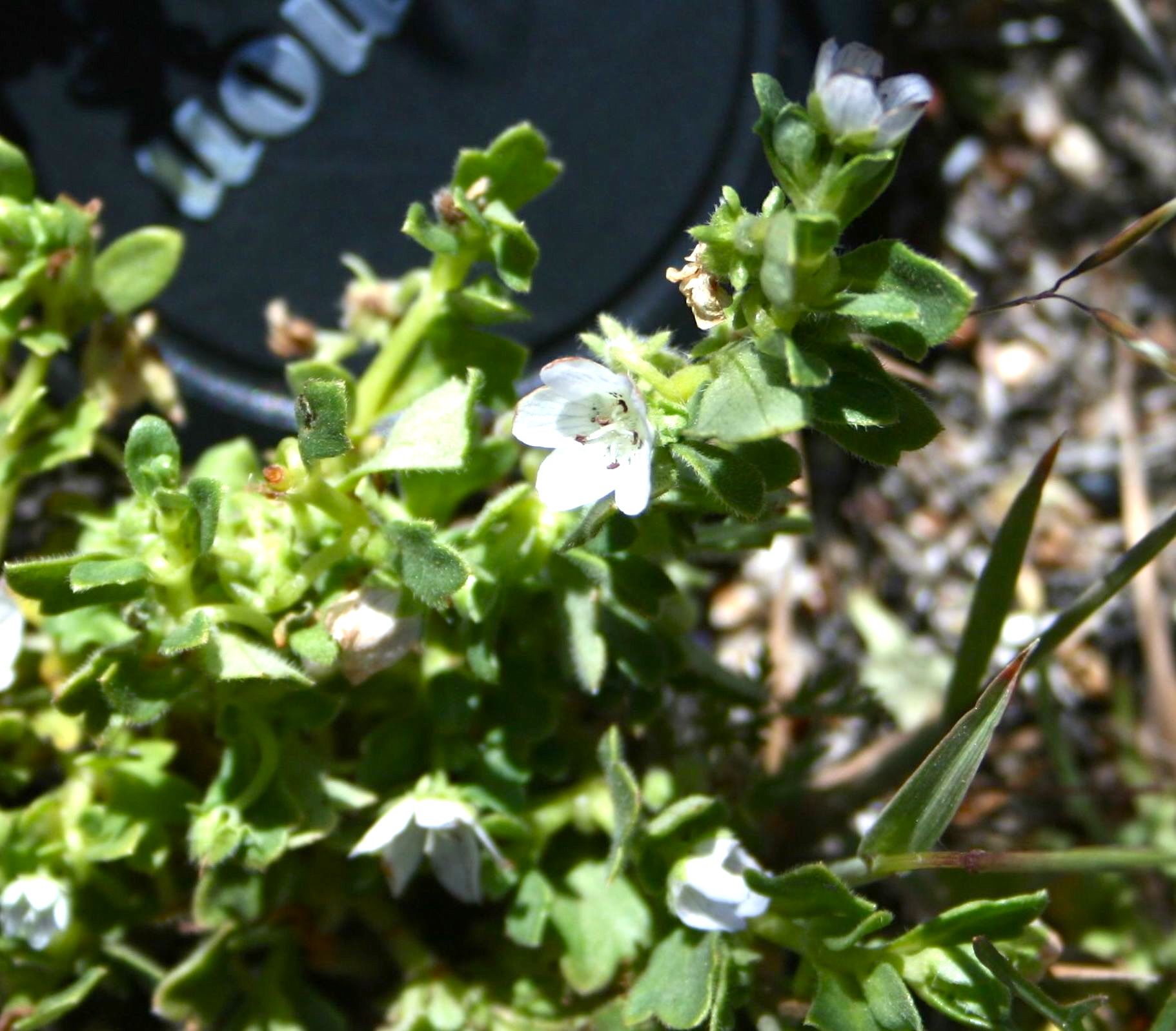
Photo by Chez Brungraber
Family: Hydrophyllaceae · Type: Herb · Native
Nemophila menziesii var. menziesii (Baby blue eyes) is a native California herb in the Hydrophyllaceae family, recognized by largest blue flowers with white centers.
Baby blue eyes is a native annual found in California Floristic Province and Mojave Desert bioregions in meadows, grasslands, chaparral, woodlands, and desert washes at elevations of 15 to 1,600 meters. Flowering from February to May, this delicate plant produces bright blue flowers with white centers, typically 10 to 40 millimeters wide, often featuring distinctive black dots at the center. Growing with slender stems up to 30 centimeters tall, it spreads in low, sprawling clusters across open landscapes. Its lower leaves are intricately divided into 6 to 13 lobes, with upper leaves having fewer, more narrow tooth-like segments. The small, intricate flowers and finely divided leaves make this a charming and delicate wildflower of California's diverse landscapes.
Identification and appearance
Key characters: 11 sympatric species; largest blue flowers with white centers
Habitat and range
Habitat: Meadows, grassland, chaparral, woodland, slopes, desert washes
Elevation: 15-1600 m
California counties: Los Angeles, Amador, Kern, San Bernardino, Riverside, San Diego, Monterey, Madera, Tulare, Santa Cruz, San Luis Obispo, Lake, Santa Clara, San Benito, Napa, Santa Barbara, San Mateo, Marin, Placer, Humboldt, Glenn, San Francisco, Sonoma, Alameda, Sacramento, Butte, Tuolumne, Fresno, Mendocino, Tehama, San Joaquin, Trinity, Calaveras, Mariposa, Contra Costa, Solano, El Dorado, Nevada, Merced, Yuba, Colusa, Ventura, Imperial, Yolo, Orange
Bloom period
Nemophila menziesii var. menziesii blooms Feb-May.
How to tell it apart
vs Phacelia: Nemophila has symmetrical bowl-shaped flowers; Phacelia has flowers in one-sided coiled clusters.; vs Pholistoma: Nemophila fruits feel soft and velvety; Pholistoma fruits are covered in stiff, rough bristles.; vs Veronica: Nemophila has 5-petaled flowers and soft fruits; Veronica has 4-petaled flowers and flat heart-shaped capsules.; vs Linum: Nemophila has lobed leaves and 5 stamens; Linum has narrow entire leaves and typically 5 stamens alternate with teeth.; vs Eucrypta: Nemophila has showy flowers 5mm+ wide; Eucrypta has tiny flowers under 4mm in dense branched clusters.
Frequently asked questions
Is Nemophila menziesii var. menziesii native to California?
Yes. Nemophila menziesii var. menziesii is native to California (recorded as native).
When does Nemophila menziesii var. menziesii bloom?
Nemophila menziesii var. menziesii blooms Feb-May.
Where in California does Nemophila menziesii var. menziesii grow?
Nemophila menziesii var. menziesii occurs in Los Angeles, Amador, Kern, San Bernardino, Riverside, San Diego, Monterey, Madera and other counties, at elevations of 15-1600 m.
What plant family does Nemophila menziesii var. menziesii belong to?
Nemophila menziesii var. menziesii is in the Hydrophyllaceae family, genus Nemophila.
What habitat does Nemophila menziesii var. menziesii grow in?
Nemophila menziesii var. menziesii grows in Meadows, grassland, chaparral, woodland, slopes, desert washes.
Related species
Other California species in the same genus, family, or bioregion.
- Nemophila parviflora — Small flowered nemophila
- Nemophila parviflora var. austiniae — Rebecca austin's nemophila
- Nemophila parviflora var. parviflora — Small flowered nemophila
- Nemophila parviflora var. quercifolia — Oak-leaved nemophila
- Nemophila pedunculata — Littlefoot nemophila
- Nemophila pulchella — Eastwood's baby blue eyes
Sources: Jepson eFlora · Index of California Plant Names · CalPhotos
Last updated 2026-10-07
Data from The California Species Project — 14,000+ California species with verified data from CNPS, CDFW, USFWS, Cal-IPC, and more.