Neokochia americana
Green Molly
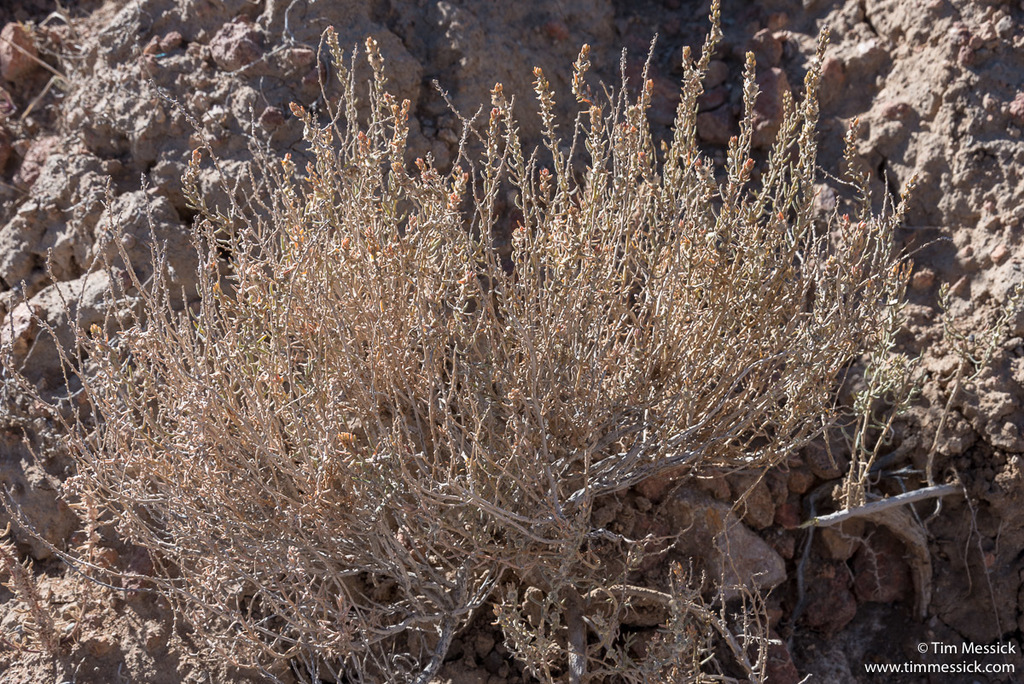
(c) Tim Messick, some rights reserved (CC BY), uploaded by Tim Messick · licence
Family: Chenopodiaceae · Type: Subshrub · Native
Neokochia americana (Green Molly) is a native California subshrub in the Chenopodiaceae family.
Green molly is a California native shrub found in the Great Basin and Mojave Desert bioregions on alkaline soils, dry lake margins, and flats at elevations of 600 to 2,200 meters. Flowering from May to August, this plant produces white flowers with fan-shaped wings in small axillary clusters. Growing as a root-sprouting subshrub 8 to 40 centimeters tall, it emerges with multiple stems from the base, ascending to erect and typically covered in fine white woolly hair. Its leaves are fleshy, overlapping, and roughly cylindrical to flat, measuring 5 to 20 millimeters long and 1 to 2 millimeters wide. The fruit is less than 4 millimeters wide, with calyx lobes generally white and woolly.
Identification and appearance
Key characters: 1 sympatric species (N. californica). Key differentiators: elevation range, leaf arrangement (overlapping vs well-spaced), plant height
Habitat and range
Habitat: Alkaline soils, flats, dry lake margins
Elevation: 600-2200 m
California counties: Modoc, San Bernardino, Inyo, Fresno, Mono, Lassen, Los Angeles
Outside California: to Washington, Montana, Texas
Bloom period
Neokochia americana blooms May-Aug.
Frequently asked questions
Is Neokochia americana native to California?
Yes. Neokochia americana is native to California (recorded as native).
When does Neokochia americana bloom?
Neokochia americana blooms May-Aug.
Where in California does Neokochia americana grow?
Neokochia americana occurs in Modoc, San Bernardino, Inyo, Fresno, Mono, Lassen, Los Angeles, at elevations of 600-2200 m.
What plant family does Neokochia americana belong to?
Neokochia americana is in the Chenopodiaceae family, genus Neokochia.
What habitat does Neokochia americana grow in?
Neokochia americana grows in Alkaline soils, flats, dry lake margins.
Related species
Other California species in the same genus, family, or bioregion.
Sources: Jepson eFlora · CalPhotos
Last updated 2026-10-07
Data from The California Species Project — 14,000+ California species with verified data from CNPS, CDFW, USFWS, Cal-IPC, and more.