Nicotiana acuminata var. multiflora
Manyflower tobacco
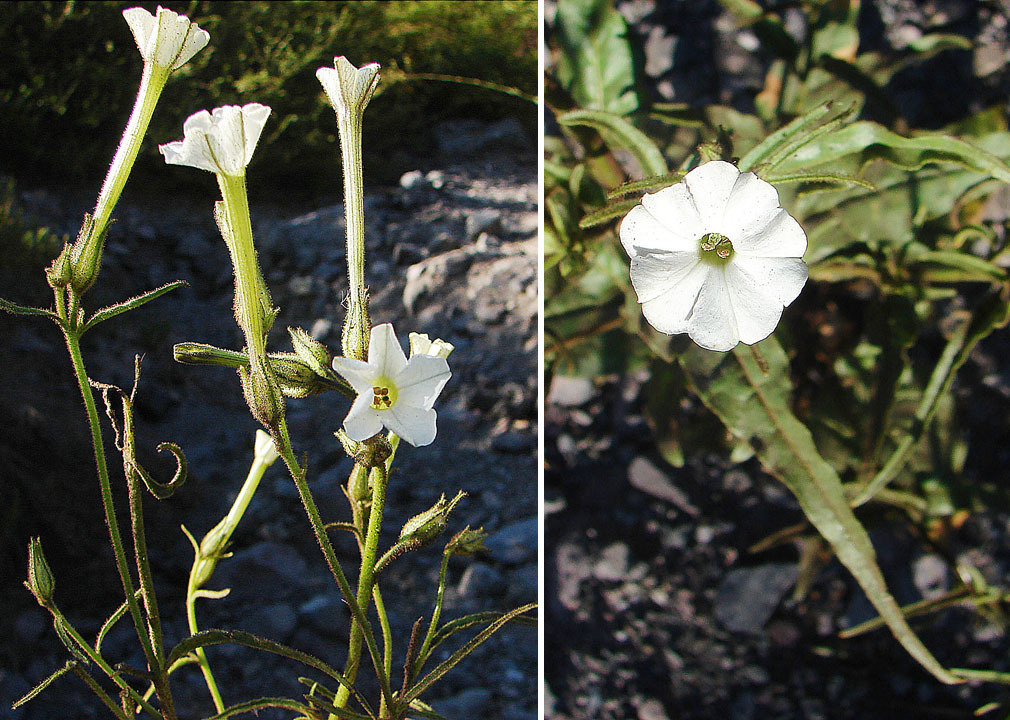
(c) Dick Culbert, some rights reserved (CC BY) · licence
Family: Solanaceae · Type: Herb · Not Native
Nicotiana acuminata var. multiflora (Manyflower tobacco) is a non-native California herb in the Solanaceae family, recognized by exceptionally large corolla measurements.
Manyflower tobacco is a naturalized annual herb found in California's Foothill Piedmont and North Coast Ranges in open, sandy or gravelly areas at elevations below 1,600 meters. Flowering from May to October, this plant produces white to greenish-purple flowers in large, showy corollas 25 to 100 millimeters long with widely rounded lobes. Growing 50 to 150 centimeters tall with densely glandular-hairy stems, it has a distinctive branching habit. Its leaves vary from ovate basal leaves to narrower, reduced cauline leaves along the stem, with blades ranging from 5 to 25 centimeters long. The fruit is a small capsule 10 to 12 millimeters in length, containing tiny seeds less than a millimeter long.
Identification and appearance
Key characters: 5 sympatric species; key features are exceptionally large corolla measurements
Habitat and range
Habitat: Open, sandy or gravelly areas
Elevation: < 1600 m
California counties: Ventura, San Bernardino, Tulare, Colusa, Riverside, Los Angeles, El Dorado, Calaveras, San Joaquin, Amador, Sonoma, Marin, Modoc, Contra Costa, Napa, Butte, Sacramento, Sutter, Sierra, Plumas, Alameda, Lassen, San Luis Obispo, Madera, Shasta, Stanislaus, Merced, Tuolumne, Santa Clara, Placer, Santa Cruz, San Benito, Siskiyou, Mendocino, San Mateo, San Diego, Lake, Mariposa, Yolo, Inyo
Outside California: to Washington, Nevada, native to South America
Bloom period
Nicotiana acuminata var. multiflora blooms May-Oct.
How to tell it apart
vs Mirabilis: Nicotiana has tubular flowers with visible petals; Mirabilis has petal-like sepals with no true petals.; vs Oxalis: Nicotiana has tubular nightshade flowers; Oxalis has clover-like leaves and 5-petaled flowers.; vs Phytolacca: Nicotiana has tubular flowers in terminal clusters; Phytolacca has tiny flowers in drooping spikes and purple berries.; vs Solanum: Nicotiana has flowers in branched terminal clusters; Solanum has flowers with prominent yellow anther cone.; vs Encelia: Nicotiana has tubular nightshade flowers; Encelia has yellow daisy-like composite flowers.
Frequently asked questions
Is Nicotiana acuminata var. multiflora native to California?
No. Nicotiana acuminata var. multiflora is not native to California (recorded as not native).
When does Nicotiana acuminata var. multiflora bloom?
Nicotiana acuminata var. multiflora blooms May-Oct.
Where in California does Nicotiana acuminata var. multiflora grow?
Nicotiana acuminata var. multiflora occurs in Ventura, San Bernardino, Tulare, Colusa, Riverside, Los Angeles, El Dorado, Calaveras and other counties, at elevations of < 1600 m.
What plant family does Nicotiana acuminata var. multiflora belong to?
Nicotiana acuminata var. multiflora is in the Solanaceae family, genus Nicotiana.
What habitat does Nicotiana acuminata var. multiflora grow in?
Nicotiana acuminata var. multiflora grows in Open, sandy or gravelly areas.
Related species
Other California species in the same genus, family, or bioregion.
Sources: Jepson eFlora · Index of California Plant Names · CalPhotos
Last updated 2026-10-07
Data from The California Species Project — 14,000+ California species with verified data from CNPS, CDFW, USFWS, Cal-IPC, and more.