Nicotiana glauca
Tree tobacco
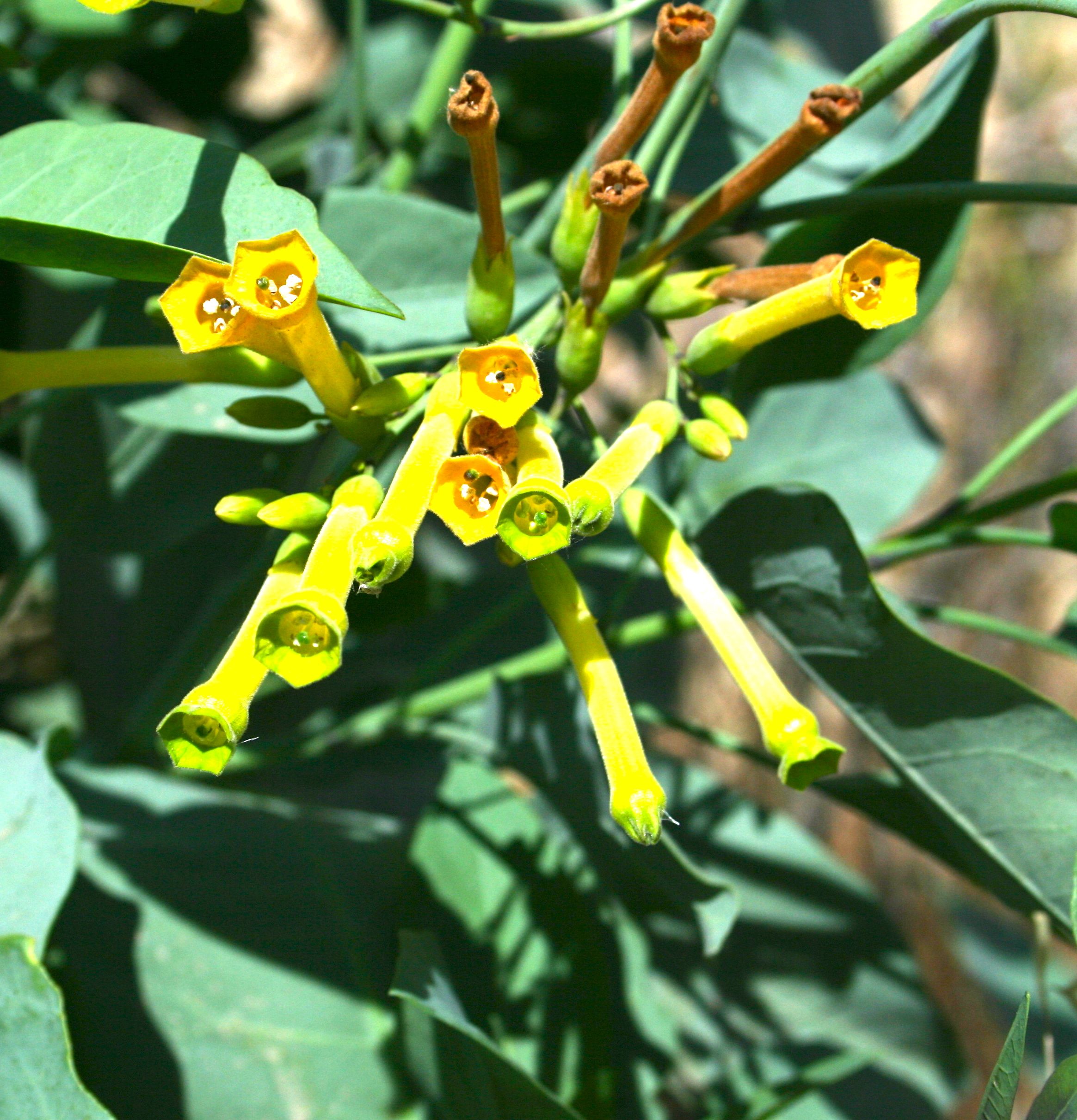
Photo by Chez Brungraber
Family: Solanaceae · Type: Shrub / Tree · Not Native
Conservation status: Cal-IPC Yes
Nicotiana glauca (Tree tobacco) is a non-native California shrub / tree in the Solanaceae family, recognized by woody growth form and yellow flowers.
Tree tobacco is a naturalized shrub found in northern coastal interior California, central Sierra Nevada foothills, Central Valley, central western California, southwestern California, and desert regions in open, disturbed flats or slopes at elevations below 1,100 meters. Flowering from April to August, this plant produces yellow to greenish-yellow flowers with a distinctive tubular shape approximately 30 to 45 millimeters long, featuring a pentagonal limb 6 to 8 millimeters in diameter. Growing as a glaucous shrub or small tree with soft wood, it can reach heights of 5 to 21 centimeters tall with smooth, glabrous stems. Its large leaves are predominantly ovate, petioled, and measuring 5 to 21 centimeters long, creating a distinctive blue-green appearance. The fruit is small, ranging from 7 to 15 millimeters in length, with tiny seeds measuring just 0.5 millimeters.
Identification and appearance
Key characters: 6 sympatric species; key features are woody growth form and yellow flowers
Habitat and range
Habitat: Open, disturbed flats or slopes
Elevation: < 1100 m
California counties: Los Angeles, San Bernardino, Riverside, Orange, Ventura, Santa Barbara, Kern, San Luis Obispo, San Diego, Colusa, Alameda, Yolo, Imperial, Contra Costa, Fresno, Santa Cruz, Santa Clara, San Benito, Solano, San Joaquin, Inyo, Merced, Calaveras, Humboldt, Marin, San Mateo, Sutter, Butte, San Francisco, Monterey, Stanislaus, Tulare, Sacramento, Yuba, Lake, Mariposa, El Dorado, Madera, Napa, Mendocino
Outside California: to southern United States, Mexico, Africa, Mediterranean, native to South America
Bloom period
Nicotiana glauca blooms Apr-Aug.
Conservation status
Cal-IPC Yes
How to tell it apart
vs Mirabilis: Nicotiana has tubular flowers with visible petals; Mirabilis has petal-like sepals with no true petals.; vs Oxalis: Nicotiana has tubular nightshade flowers; Oxalis has clover-like leaves and 5-petaled flowers.; vs Phytolacca: Nicotiana has tubular flowers in terminal clusters; Phytolacca has tiny flowers in drooping spikes and purple berries.; vs Solanum: Nicotiana has flowers in branched terminal clusters; Solanum has flowers with prominent yellow anther cone.; vs Encelia: Nicotiana has tubular nightshade flowers; Encelia has yellow daisy-like composite flowers.
Frequently asked questions
Is Nicotiana glauca native to California?
No. Nicotiana glauca is not native to California (recorded as not native).
When does Nicotiana glauca bloom?
Nicotiana glauca blooms Apr-Aug.
Where in California does Nicotiana glauca grow?
Nicotiana glauca occurs in Los Angeles, San Bernardino, Riverside, Orange, Ventura, Santa Barbara, Kern, San Luis Obispo and other counties, at elevations of < 1100 m.
What plant family does Nicotiana glauca belong to?
Nicotiana glauca is in the Solanaceae family, genus Nicotiana.
Is Nicotiana glauca invasive in California?
Nicotiana glauca is listed by Cal-IPC with an invasiveness rating of Yes.
Related species
Other California species in the same genus, family, or bioregion.
Sources: Jepson eFlora · Index of California Plant Names · CalPhotos
Last updated 2026-10-07
Data from The California Species Project — 14,000+ California species with verified data from CNPS, CDFW, USFWS, Cal-IPC, and more.