Nolina bigelovii
Bigelow's nolina
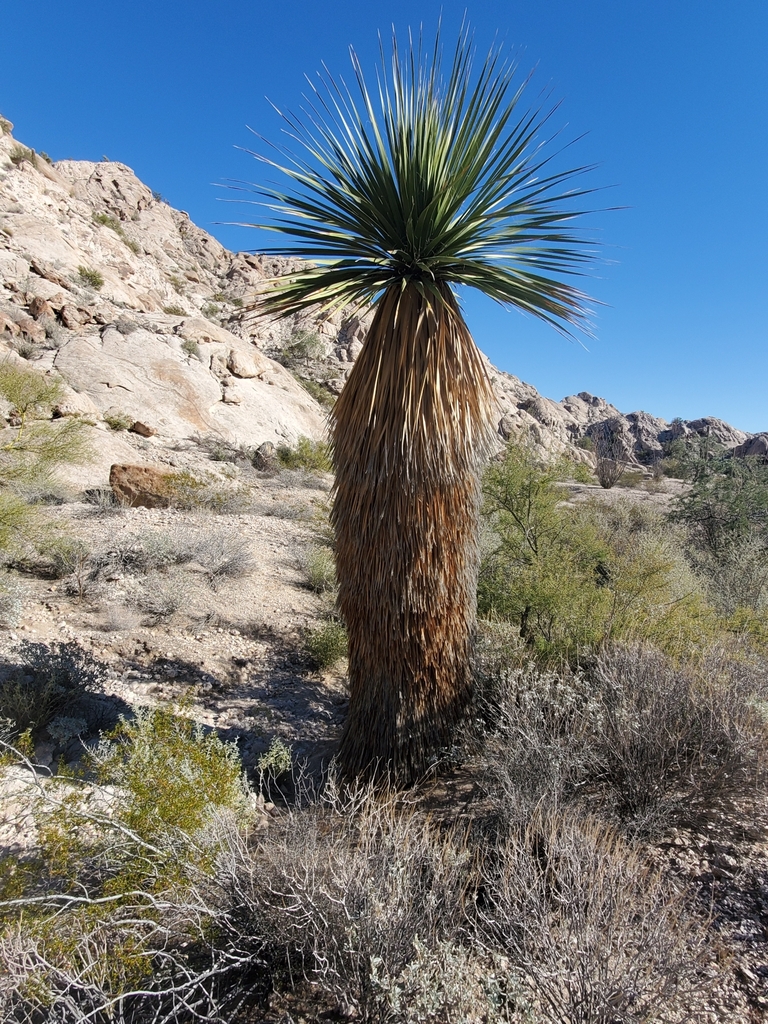
(c) Bob Miller, some rights reserved (CC BY) · licence
Family: Ruscaceae · Type: Shrub / Tree · Native
Nolina bigelovii (Bigelow's nolina) is a native California shrub / tree in the Ruscaceae family, recognized by (N. parryi); key differences in leaf glaucousness, seed color, scape diameter.
Bigelow's nolina is a California native perennial found in southeastern Peninsular Ranges, southern Mojave Desert, Mojave Mountains, and Sonoran Desert regions on rocky slopes and ridges at elevations of 300 to 1,500 meters. Flowering from May to June, this plant produces pale greenish-white flowers in large, branching inflorescences up to 13 to 37 meters tall. Growing with erect stems 1 to 2.5 meters tall, it forms dense rosettes of 34 to 160 bluish-green leaves that are 15 to 45 millimeters wide. Its leaves have a distinctive base 5 to 11 centimeters wide with minutely serrated margins that become fibrous and shredding with age. In maturity, the plant produces small gray-white seeds approximately 2.5 to 3.5 millimeters long.
Identification and appearance
Key characters: 1 sympatric species (N. parryi); key differences in leaf glaucousness, seed color, scape diameter
Habitat and range
Habitat: Rocky slopes, ridges
Elevation: 300-1500 m
California counties: San Bernardino, Imperial, Riverside, San Diego
Outside California: southern Nevada, western Arizona, northwestern Mexico
Bloom period
Nolina bigelovii blooms May-Jun.
How to tell it apart
vs Hesperoyucca: Nolina leaves are flexible and grass-like; Hesperoyucca leaves are rigid bayonets with sharp spine tips.; vs Yucca: Nolina has narrow flexible leaves and small clustered flowers; Yucca has stiff spine-tipped leaves and large bell flowers.; vs Dasylirion: Nolina leaves have smooth margins; Dasylirion leaves have small teeth along the edges.; vs Dietes: Nolina has tiny cream flowers in dense clusters; Dietes has large white iris flowers with yellow markings.; vs Lomandra: Nolina grows as large shrub clumps; Lomandra forms smaller grass-like tufts.
Frequently asked questions
Is Nolina bigelovii native to California?
Yes. Nolina bigelovii is native to California (recorded as native).
When does Nolina bigelovii bloom?
Nolina bigelovii blooms May-Jun.
Where in California does Nolina bigelovii grow?
Nolina bigelovii occurs in San Bernardino, Imperial, Riverside, San Diego, at elevations of 300-1500 m.
What plant family does Nolina bigelovii belong to?
Nolina bigelovii is in the Ruscaceae family, genus Nolina.
What habitat does Nolina bigelovii grow in?
Nolina bigelovii grows in Rocky slopes, ridges.
Related species
Other California species in the same genus, family, or bioregion.
Sources: Jepson eFlora · Index of California Plant Names · CalPhotos
Last updated 2026-10-07
Data from The California Species Project — 14,000+ California species with verified data from CNPS, CDFW, USFWS, Cal-IPC, and more.