Nolina interrata
Dehesa nolina, Dehesa Nolina
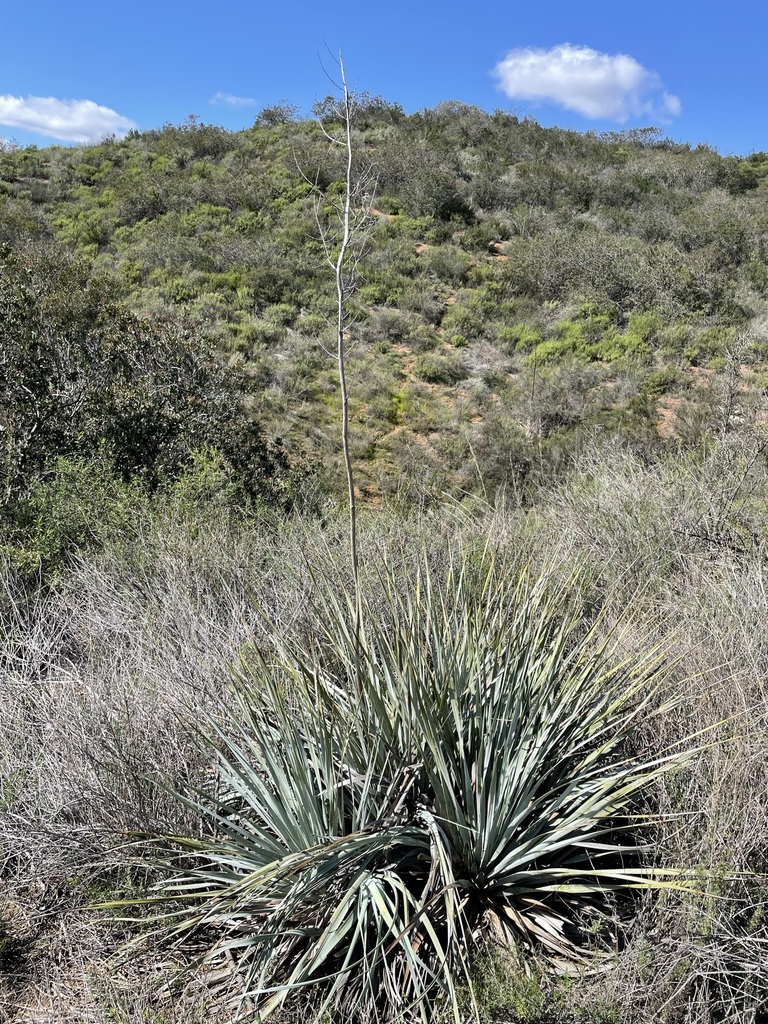
(c) Matt Berger, some rights reserved (CC BY) · licence
Family: Ruscaceae · Type: Shrub · Native
Conservation status: CNPS 1B.1
Nolina interrata (Dehesa nolina) is a native California shrub in the Ruscaceae family, recognized by unique underground branching stem system and largest seeds (4-6 mm).
Dehesa nolina is a rare (CNPS 1B.1) California native perennial found in southwestern San Diego County in foothills on gabbro soils at elevations of 200 to 700 meters. Flowering from June to July, this plant produces pale flowers in tall inflorescences rising 5 to 16 decimeters high. Growing in dense rosettes with multiple underground horizontal stems, it forms robust clusters with 10 to 45 leaves per rosette. Its leaves are notably broad, 12 to 35 millimeters wide, with a glaucous blue-green color and minutely serrated margins, emerging from a base 2 to 6 centimeters wide. The plant produces small red-brown seeds approximately 4 to 6 millimeters in size.
Identification and appearance
Key characters: Geographically isolated; unique underground branching stem system and largest seeds (4-6 mm)
Habitat and range
Habitat: Foothills on gabbro soils
Elevation: 200-700 m
Outside California: northwestern Baja California
Bloom period
Nolina interrata blooms Jun-Jul.
Conservation status
CNPS 1B.1
How to tell it apart
vs Hesperoyucca: Nolina leaves are flexible and grass-like; Hesperoyucca leaves are rigid bayonets with sharp spine tips.; vs Yucca: Nolina has narrow flexible leaves and small clustered flowers; Yucca has stiff spine-tipped leaves and large bell flowers.; vs Dasylirion: Nolina leaves have smooth margins; Dasylirion leaves have small teeth along the edges.; vs Dietes: Nolina has tiny cream flowers in dense clusters; Dietes has large white iris flowers with yellow markings.; vs Lomandra: Nolina grows as large shrub clumps; Lomandra forms smaller grass-like tufts.
Frequently asked questions
Is Nolina interrata native to California?
Yes. Nolina interrata is native to California (recorded as native).
When does Nolina interrata bloom?
Nolina interrata blooms Jun-Jul.
What plant family does Nolina interrata belong to?
Nolina interrata is in the Ruscaceae family, genus Nolina.
Is Nolina interrata rare or endangered?
Nolina interrata carries California Rare Plant Rank 1B.1, state rank S1S2.
What habitat does Nolina interrata grow in?
Nolina interrata grows in Foothills on gabbro soils.
Related species
Other California species in the same genus, family, or bioregion.
Sources: Jepson eFlora · CalPhotos · CDFW CNDDB
Last updated 2026-10-07
Data from The California Species Project — 14,000+ California species with verified data from CNPS, CDFW, USFWS, Cal-IPC, and more.