Nolina parryi
Parry's beargrass
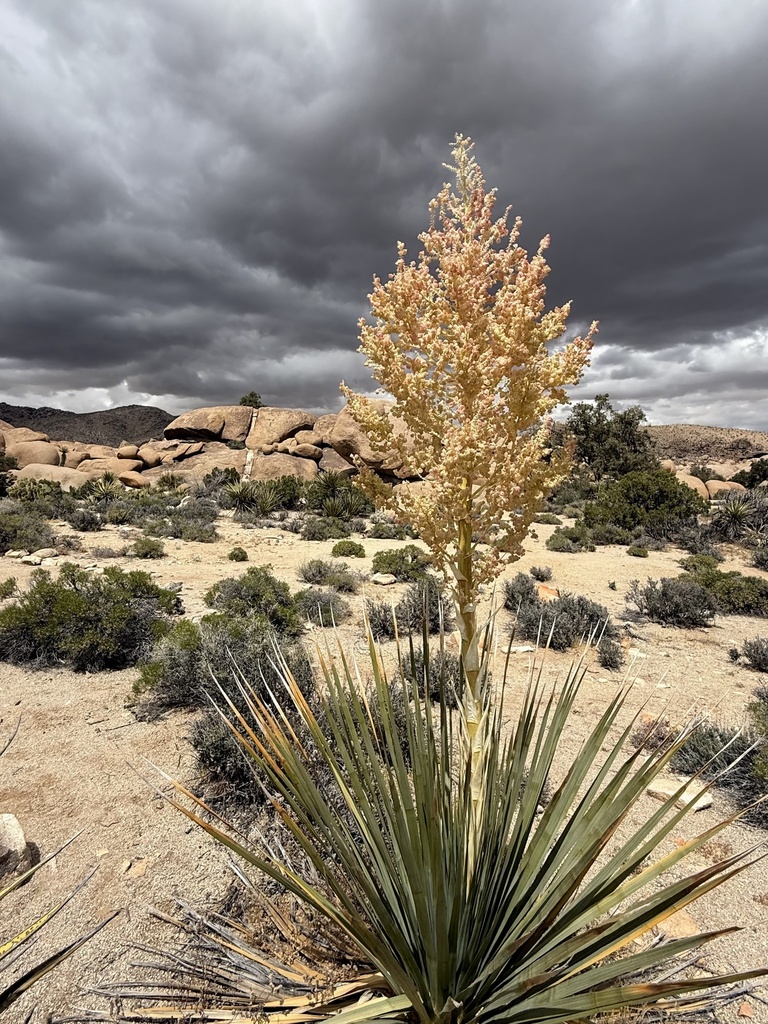
no rights reserved · CC0
Family: Ruscaceae · Type: Shrub / Tree · Native
Nolina parryi (Parry's beargrass) is a native California shrub / tree in the Ruscaceae family, recognized by non-glaucous leaves, seed color, elevation range, and habitat.
Parry's beargrass is a California native perennial found in southern Sierra Nevada Foothills, southern Sierra Nevada, eastern San Bernardino Mountains, eastern Peninsula Ranges, and desert regions in pinyon and juniper woodland on rocky desert slopes at elevations of 900 to 2,100 meters. Flowering from May to June, this plant produces white flowers in a massive inflorescence up to 3.8 meters tall with a thick stem 26 to 90 millimeters in diameter at the base. Growing with an extensive rosette of 65 to 200 leaves, it forms a dramatic clump with erect, unbranched or slightly branched stems rising 3 to 2.1 meters tall. Its leaves are generally green, 20 to 40 millimeters wide, with a base 5 to 16.5 centimeters wide and finely minute-serrate margins. The plant produces small red-brown seeds 3 to 4 millimeters long, characteristic of this distinctive desert grassland species.
Identification and appearance
Key characters: 2 sympatric species; distinguished by non-glaucous leaves, seed color, elevation range, and habitat
Habitat and range
Habitat: Pinyon/juniper woodland, rocky desert slopes
Elevation: 900-2100 m
California counties: San Bernardino, Riverside, San Diego, Kern, Orange, Tulare, Ventura, Inyo
Bloom period
Nolina parryi blooms May-Jun.
How to tell it apart
vs Hesperoyucca: Nolina leaves are flexible and grass-like; Hesperoyucca leaves are rigid bayonets with sharp spine tips.; vs Yucca: Nolina has narrow flexible leaves and small clustered flowers; Yucca has stiff spine-tipped leaves and large bell flowers.; vs Dasylirion: Nolina leaves have smooth margins; Dasylirion leaves have small teeth along the edges.; vs Dietes: Nolina has tiny cream flowers in dense clusters; Dietes has large white iris flowers with yellow markings.; vs Lomandra: Nolina grows as large shrub clumps; Lomandra forms smaller grass-like tufts.
Frequently asked questions
Is Nolina parryi native to California?
Yes. Nolina parryi is native to California (recorded as native).
When does Nolina parryi bloom?
Nolina parryi blooms May-Jun.
Where in California does Nolina parryi grow?
Nolina parryi occurs in San Bernardino, Riverside, San Diego, Kern, Orange, Tulare, Ventura, Inyo, at elevations of 900-2100 m.
What plant family does Nolina parryi belong to?
Nolina parryi is in the Ruscaceae family, genus Nolina.
What habitat does Nolina parryi grow in?
Nolina parryi grows in Pinyon/juniper woodland, rocky desert slopes.
Related species
Other California species in the same genus, family, or bioregion.
Sources: Jepson eFlora · Index of California Plant Names · CalPhotos
Last updated 2026-10-07
Data from The California Species Project — 14,000+ California species with verified data from CNPS, CDFW, USFWS, Cal-IPC, and more.