Oemleria cerasiformis
Indian plum
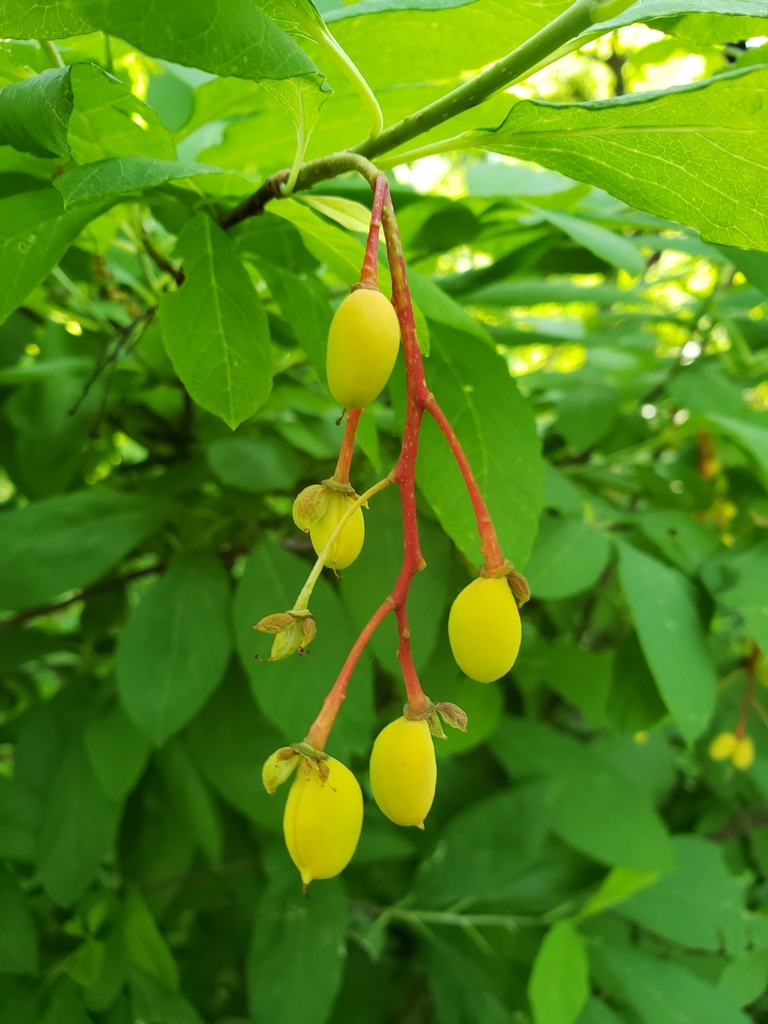
(c) Gavin Slater, some rights reserved (CC BY) · licence
Family: Rosaceae · Type: Shrub / Tree · Native
Oemleria cerasiformis (Indian plum) is a native California shrub / tree in the Rosaceae family, recognized by Monotypic Pacific Northwest genus representing ancient lineage within Rosaceae, adapted to cool temperate forest conditions.
Indian plum is a California native shrub found in northwestern California, western Cascade Range, western Sierra Nevada, Sutter Buttes, southern-central San Joaquin Valley, western Central Western, and southwestern Transverse Ranges in chaparral, canyons, streambanks, and woodland habitats at elevations up to 1,850 meters. Flowering from February to April, this plant produces fragrant white flowers in small pendulous racemes 3 to 10 centimeters long. Growing as a small shrub or tree 1 to 6 meters tall, it forms multiple stems with distinctive deciduous branching. Its simple leaves are elliptic to narrow-obovate, 5 to 13 centimeters long, with margins slightly rolled under and undersides paler than the upper surface. The plant bears blue-black, bean-shaped drupes 5 to 15 millimeters long that develop after flowering.
Identification and appearance
Key characters: Monotypic Pacific Northwest genus representing ancient lineage within Rosaceae, adapted to cool temperate forest conditions
Habitat and range
Habitat: Chaparral, canyons, streambanks, lowland wet to dry open woodland, coast to shaded conifer forest
Elevation: < 1850 m
California counties: Sonoma, Amador, Lake, Mendocino, Fresno, Tulare, Del Norte, Humboldt, Santa Barbara, San Luis Obispo, Santa Clara, Monterey, Alameda, San Francisco, Contra Costa, San Mateo, Marin, Santa Cruz, Calaveras, El Dorado, Inyo, Mariposa, Napa, Glenn, Shasta, Siskiyou, Trinity, Colusa, Butte, San Benito, Tehama, Solano, Sutter, Placer, Nevada, Yolo
Outside California: to southern British Columbia
Bloom period
Oemleria cerasiformis blooms Feb-Apr.
How to tell it apart
vs Frangula: Oemleria has drooping white flower clusters; Frangula has upright tiny yellowish flowers in leaf axils.; vs Lonicera: Oemleria has regular 5-petaled flowers in drooping racemes; honeysuckles have tubular 2-lipped flowers.; vs Prunus: Oemleria produces 2-6 small drupes per flower; Prunus produces one larger drupe per flower.; vs Heteromeles: Oemleria has drooping racemes and simple leaves; toyon has upright clusters and toothed compound-appearing leaves.; vs Aesculus: Oemleria has simple leaves and drooping clusters; buckeye has palmately compound leaves and upright spikes.
Frequently asked questions
Is Oemleria cerasiformis native to California?
Yes. Oemleria cerasiformis is native to California (recorded as native).
When does Oemleria cerasiformis bloom?
Oemleria cerasiformis blooms Feb-Apr.
Where in California does Oemleria cerasiformis grow?
Oemleria cerasiformis occurs in Sonoma, Amador, Lake, Mendocino, Fresno, Tulare, Del Norte, Humboldt and other counties, at elevations of < 1850 m.
What plant family does Oemleria cerasiformis belong to?
Oemleria cerasiformis is in the Rosaceae family, genus Oemleria.
What habitat does Oemleria cerasiformis grow in?
Oemleria cerasiformis grows in Chaparral, canyons, streambanks, lowland wet to dry open woodland, coast to shaded conifer forest.
Related species
Other California species in the same genus, family, or bioregion.
Sources: Jepson eFlora · Index of California Plant Names · CalPhotos
Last updated 2026-10-07
Data from The California Species Project — 14,000+ California species with verified data from CNPS, CDFW, USFWS, Cal-IPC, and more.