Oenothera biennis
Common evening-primrose
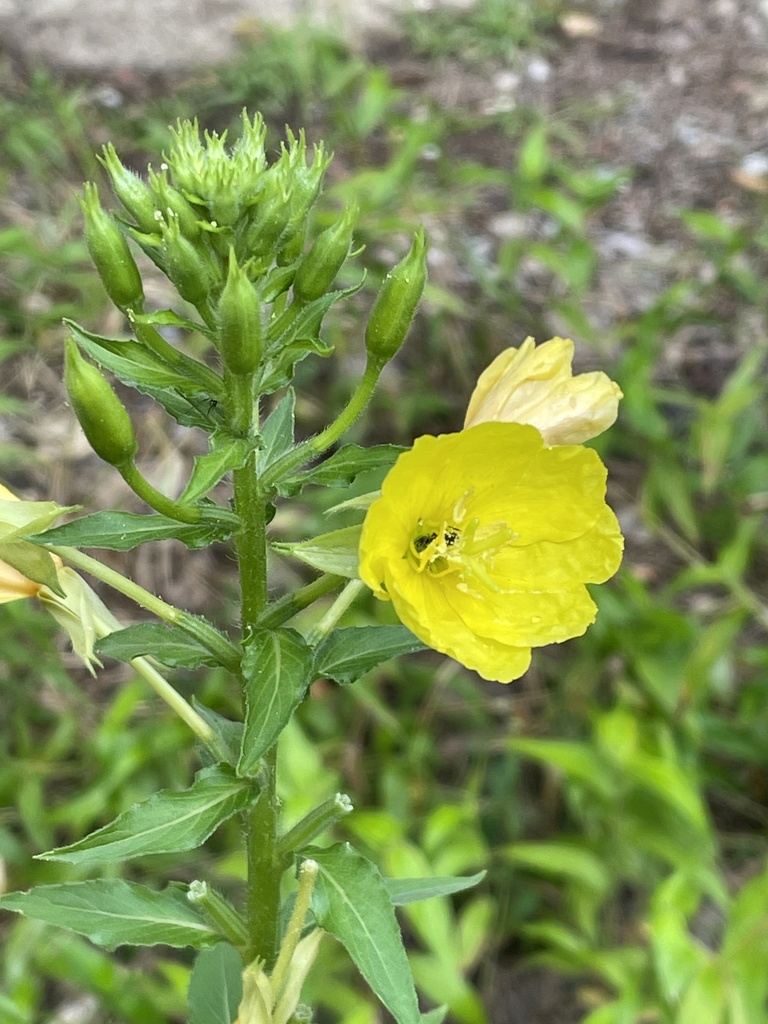
(c) Tom Pollard, some rights reserved (CC BY), uploaded by Tom Pollard · licence
Family: Onagraceae · Type: Herb · Not Native
Oenothera biennis (Common evening-primrose) is a non-native California herb in the Onagraceae family, recognized by habitat, growth form, and fruit shape.
Common evening-primrose is a naturalized biennial found in northwestern, central western, and southwestern California in disturbed places at elevations generally below 300 meters. Flowering from June to September, this plant produces bright yellow flowers that fade to a duller orange, with each blossom reaching 10 to 25 millimeters long. Growing with erect stems 30 to 200 centimeters tall that have glandular hairs and a distinctive rosette form, it spreads with spreading, strigose growth habit. Its cauline leaves are 5 to 20 centimeters long, oblanceolate to elliptic, with margins that are nearly entire to dentate and sometimes slightly lobed toward the base. The fruit is a cylindrical capsule 20 to 40 millimeters long, containing small, irregularly pitted seeds.
Identification and appearance
Key characters: 17 sympatric species; key features are habitat, growth form, and fruit shape
Habitat and range
Habitat: Disturbed places
Elevation: generally < 300 m
California counties: Riverside, San Bernardino, Sutter, El Dorado, Sacramento, Contra Costa, Los Angeles, San Luis Obispo, Mariposa
Outside California: native to central and eastern North America, +- weedy worldwide
Bloom period
Oenothera biennis blooms Jun-Sep.
How to tell it apart
vs Camissoniopsis: Oenothera has a 4-lobed cross-shaped stigma; Camissoniopsis has a round stigma and four-angled fruits.; vs Clarkia: Oenothera has 4-lobed stigma and yellow flowers; Clarkia has round stigma and pink/purple flowers.; vs Rosa: Oenothera has 4 petals and capsule fruits; Rosa has 5+ petals and rose hips.; vs Convolvulus: Oenothera has separate petals; Convolvulus has fused trumpet-shaped flowers (morning glory family).; vs Taraxia: Oenothera has robust stems with 4-lobed stigma; Taraxia is stemless with flowers at ground level.
Frequently asked questions
Is Oenothera biennis native to California?
No. Oenothera biennis is not native to California (recorded as not native).
When does Oenothera biennis bloom?
Oenothera biennis blooms Jun-Sep.
Where in California does Oenothera biennis grow?
Oenothera biennis occurs in Riverside, San Bernardino, Sutter, El Dorado, Sacramento, Contra Costa, Los Angeles, San Luis Obispo and other counties, at elevations of generally < 300 m.
What plant family does Oenothera biennis belong to?
Oenothera biennis is in the Onagraceae family, genus Oenothera.
What habitat does Oenothera biennis grow in?
Oenothera biennis grows in Disturbed places.
Related species
Other California species in the same genus, family, or bioregion.
Sources: Jepson eFlora · Index of California Plant Names · CalPhotos
Last updated 2026-10-07
Data from The California Species Project — 14,000+ California species with verified data from CNPS, CDFW, USFWS, Cal-IPC, and more.