Oenothera deltoides subsp. howellii
Antioch dunes evening-primrose, Antioch Dunes Evening-Primrose
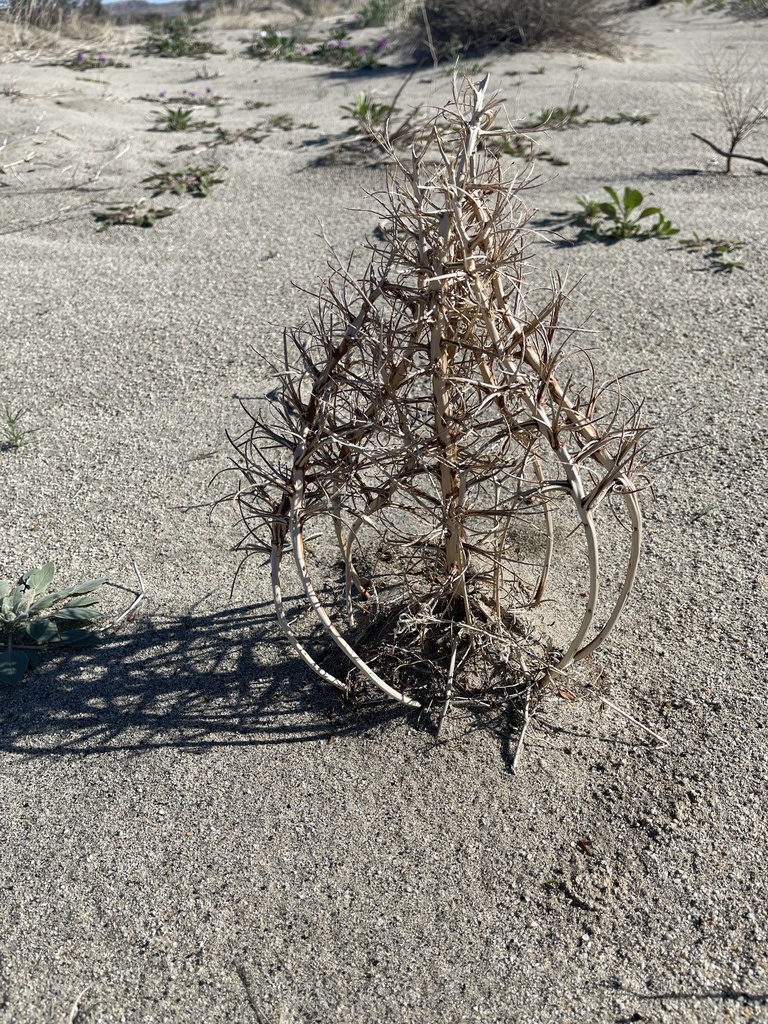
Photo: parent species Oenothera deltoides · no rights reserved · CC0
Family: Onagraceae · Type: Herb · Native
Conservation status: CNPS 1B.1 · Endangered
Oenothera deltoides subsp. howellii (Antioch dunes evening-primrose) is a native California herb in the Onagraceae family, recognized by 0 sympatric species.
Antioch dunes evening-primrose is a rare (CNPS 1B.1) California native perennial found in the Deltaic Sacramento-San Joaquin Valley region in Contra Costa County, specifically around Antioch, on sandy bluffs and dunes at elevations below 100 meters. Flowering from March to September, this plant produces large pale yellow flowers with delicate petals 20 to 40 millimeters long. Growing with gray-green stems 4 to 8 decimeters tall and branched throughout, it displays a distinctively sprawling habit with spreading wavy hairs. Its leaves are particularly distinctive, with distal leaves featuring wavy lobes and a grayish-green coloration. The fruit develops with a base 3 to 4 millimeters wide, contributing to this unique dune-dwelling plant's adaptation to its specialized habitat.
Identification and appearance
Key characters: Geographically isolated; 0 sympatric species
Habitat and range
Habitat: Sandy bluffs, dunes
Elevation: < 100 m
California counties: Contra Costa
Bloom period
Oenothera deltoides subsp. howellii blooms Mar-Sep.
Conservation status
CNPS 1B.1 · Endangered
How to tell it apart
vs Camissoniopsis: Oenothera has a 4-lobed cross-shaped stigma; Camissoniopsis has a round stigma and four-angled fruits.; vs Clarkia: Oenothera has 4-lobed stigma and yellow flowers; Clarkia has round stigma and pink/purple flowers.; vs Rosa: Oenothera has 4 petals and capsule fruits; Rosa has 5+ petals and rose hips.; vs Convolvulus: Oenothera has separate petals; Convolvulus has fused trumpet-shaped flowers (morning glory family).; vs Taraxia: Oenothera has robust stems with 4-lobed stigma; Taraxia is stemless with flowers at ground level.
Frequently asked questions
Is Oenothera deltoides subsp. howellii native to California?
Yes. Oenothera deltoides subsp. howellii is native to California (recorded as native).
When does Oenothera deltoides subsp. howellii bloom?
Oenothera deltoides subsp. howellii blooms Mar-Sep.
Where in California does Oenothera deltoides subsp. howellii grow?
Oenothera deltoides subsp. howellii occurs in Contra Costa, at elevations of < 100 m.
What plant family does Oenothera deltoides subsp. howellii belong to?
Oenothera deltoides subsp. howellii is in the Onagraceae family, genus Oenothera.
Is Oenothera deltoides subsp. howellii rare or endangered?
Oenothera deltoides subsp. howellii carries California Rare Plant Rank 1B.1, state rank S1.
Related species
Other California species in the same genus, family, or bioregion.
Sources: Jepson eFlora · CNPS Rare Plant Inventory · Index of California Plant Names · CalPhotos · CDFW CNDDB
Last updated 2026-10-07
Data from The California Species Project — 14,000+ California species with verified data from CNPS, CDFW, USFWS, Cal-IPC, and more.