Oenothera suffrutescens
Wild honeysuckle, linda tarde, Linda Tarde
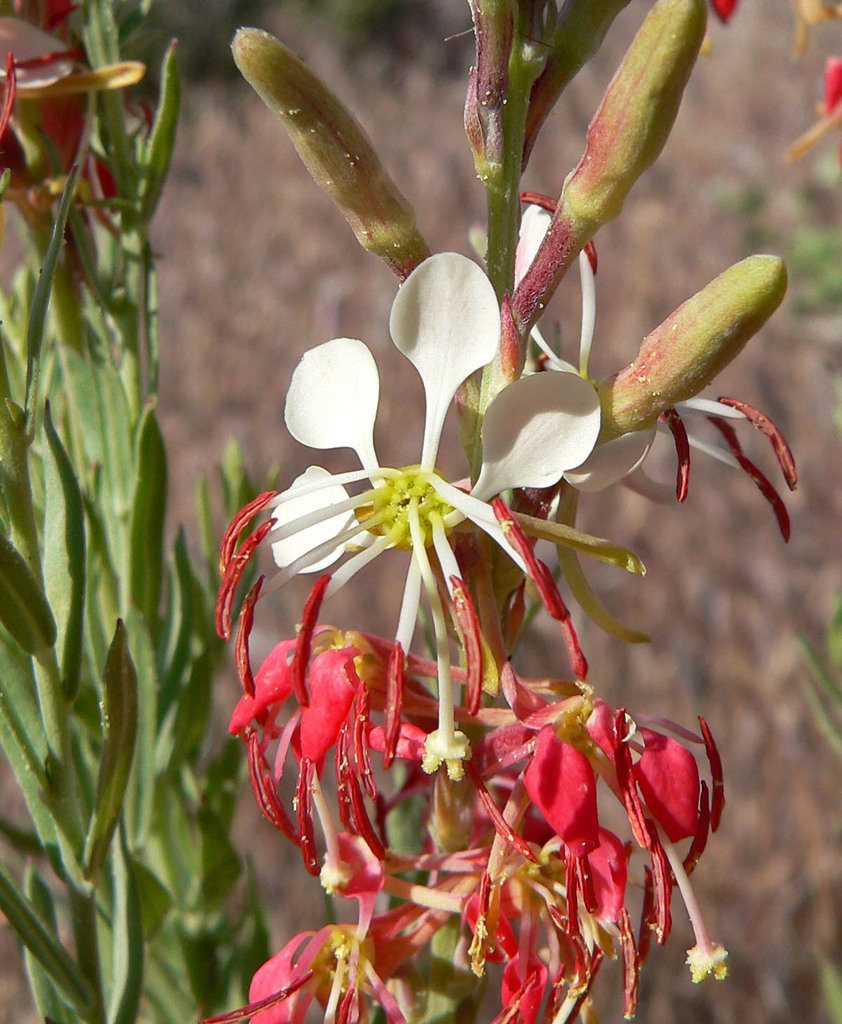
(c) Stan Shebs, some rights reserved (CC BY-SA) · licence
Family: Onagraceae · Type: Subshrub · Native
Oenothera suffrutescens (Wild honeysuckle) is a native California subshrub in the Onagraceae family, recognized by woody caudex, small petals, and short thick-based fruits.
Wild honeysuckle is a naturalized perennial found in southern Mojave Desert Mountains and surrounding lowlands, including Tehachapi and southwestern California, on dry limestone slopes in Joshua-tree and pinyon/juniper woodland at elevations of 900 to 1,600 meters. Flowering from April to June, this plant produces pale yellow to white flowers in slender stems with delicate, open blossoms. Growing with erect or spreading stems 10 to 120 centimeters tall, it has a woody, branched underground caudex with minute strigose hairs. Its narrow leaves range from 10 to 70 millimeters long, linear to narrow-elliptic, with entire or coarsely wavy-serrate edges. The fruit is an erect or spreading capsule 4 to 9 millimeters long with distinctive 4-angled sides.
Identification and appearance
Key characters: 17 sympatric species; key features are woody caudex, small petals, and short thick-based fruits
Habitat and range
Habitat: dry slopes, generally limestone, Joshua-tree or pinyon/juniper woodland
Elevation: 900-1600 m
California counties: San Bernardino, Inyo, San Diego, Orange, Ventura, Los Angeles, Santa Barbara, Riverside
Outside California: to western Canada, central United States, Mexico
Bloom period
Oenothera suffrutescens blooms Apr-Jun.
How to tell it apart
vs Camissoniopsis: Oenothera has a 4-lobed cross-shaped stigma; Camissoniopsis has a round stigma and four-angled fruits.; vs Clarkia: Oenothera has 4-lobed stigma and yellow flowers; Clarkia has round stigma and pink/purple flowers.; vs Rosa: Oenothera has 4 petals and capsule fruits; Rosa has 5+ petals and rose hips.; vs Convolvulus: Oenothera has separate petals; Convolvulus has fused trumpet-shaped flowers (morning glory family).; vs Taraxia: Oenothera has robust stems with 4-lobed stigma; Taraxia is stemless with flowers at ground level.
Frequently asked questions
Is Oenothera suffrutescens native to California?
Yes. Oenothera suffrutescens is native to California (recorded as native).
When does Oenothera suffrutescens bloom?
Oenothera suffrutescens blooms Apr-Jun.
Where in California does Oenothera suffrutescens grow?
Oenothera suffrutescens occurs in San Bernardino, Inyo, San Diego, Orange, Ventura, Los Angeles, Santa Barbara, Riverside, at elevations of 900-1600 m.
What plant family does Oenothera suffrutescens belong to?
Oenothera suffrutescens is in the Onagraceae family, genus Oenothera.
What habitat does Oenothera suffrutescens grow in?
Oenothera suffrutescens grows in dry slopes, generally limestone, Joshua-tree or pinyon/juniper woodland.
Related species
Other California species in the same genus, family, or bioregion.
Sources: Jepson eFlora · Index of California Plant Names · CalPhotos
Last updated 2026-10-07
Data from The California Species Project — 14,000+ California species with verified data from CNPS, CDFW, USFWS, Cal-IPC, and more.