Olea europaea
Olive
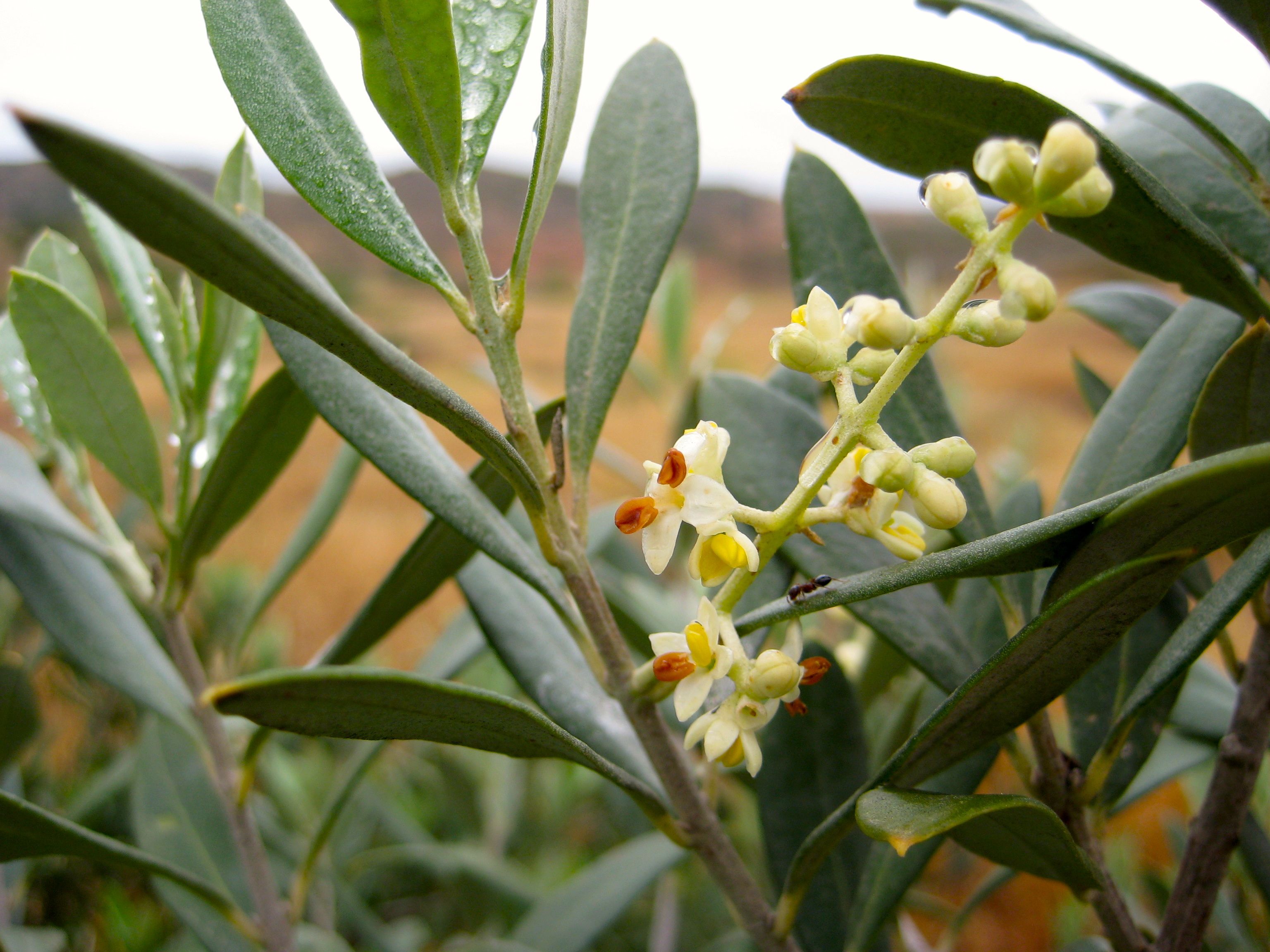
Photo by Chez Brungraber
Family: Oleaceae · Type: Shrub / Tree · Not Native
Conservation status: Cal-IPC Yes
Olea europaea (Olive) is a non-native California shrub / tree in the Oleaceae family, recognized by Introduced species, only member of this economically important genus to naturalize in CA.
Olive is a naturalized tree found in southern North Coast Ranges, Great Valley, Central Coast, San Francisco Bay Area, western South Coast Ranges, Southern California, and northern Channel Islands at elevations below 200 meters. Flowering from February to June, this tree produces small white flowers with 4 ovate-elliptical lobes arranged in narrow axillary raceme-like panicles. Growing to less than 10 meters tall with gnarled trunks and gray bark that becomes furrowed with age, it has distinctive narrowly elliptical leaves 20 to 70 millimeters long that are green on top and silver-scaly underneath. Its leaves have short petioles 2 to 7 millimeters long and a width of 6 to 16 millimeters, providing a distinctive silvery-green appearance. The fruit is an oily, green to black ovoid drupe 9 to 20 millimeters long, characteristic of cultivated olive trees.
Identification and appearance
Key characters: Introduced species, only member of this economically important genus to naturalize in CA
Habitat and range
Habitat: Generally waif, persisting from cultivation
Elevation: < 200 m
California counties: San Diego, Santa Barbara, Kern, Ventura, Santa Clara, San Bernardino, Los Angeles, Riverside, San Joaquin, Orange, Tulare, Butte, Sonoma, Marin, Sacramento, Contra Costa, Solano, Alameda, Tehama, Napa, San Mateo, San Luis Obispo, Yolo, Monterey
Outside California: native to western Asia
Bloom period
Olea europaea blooms Feb-Jun.
Conservation status
Cal-IPC Yes
How to tell it apart
vs Quercus: Olea has opposite leaves and four-petaled flowers; Quercus has alternate leaves and dangly catkins.; vs Salix: Olea leaves have silvery undersides and stay on year-round; Salix leaves green both sides, drop in fall.; vs Phillyrea: Olea flowers have four spreading petals; Phillyrea flowers have tiny petals forming narrow tubes.; vs Acacia: Olea has simple opposite leaves; Acacia has feathery compound leaves or flattened leaf-like stems.; vs Ceanothus: Olea has opposite leaves; Ceanothus has alternate leaves arranged spirally.
Frequently asked questions
Is Olea europaea native to California?
No. Olea europaea is not native to California (recorded as not native).
When does Olea europaea bloom?
Olea europaea blooms Feb-Jun.
Where in California does Olea europaea grow?
Olea europaea occurs in San Diego, Santa Barbara, Kern, Ventura, Santa Clara, San Bernardino, Los Angeles, Riverside and other counties, at elevations of < 200 m.
What plant family does Olea europaea belong to?
Olea europaea is in the Oleaceae family, genus Olea.
Is Olea europaea invasive in California?
Olea europaea is listed by Cal-IPC with an invasiveness rating of Yes.
Related species
Other California species in the same genus, family, or bioregion.
Sources: Jepson eFlora · Index of California Plant Names · CalPhotos
Last updated 2026-10-07
Data from The California Species Project — 14,000+ California species with verified data from CNPS, CDFW, USFWS, Cal-IPC, and more.