Onopordum acanthium subsp. acanthium
Scotch thistle, Scotch Thistle
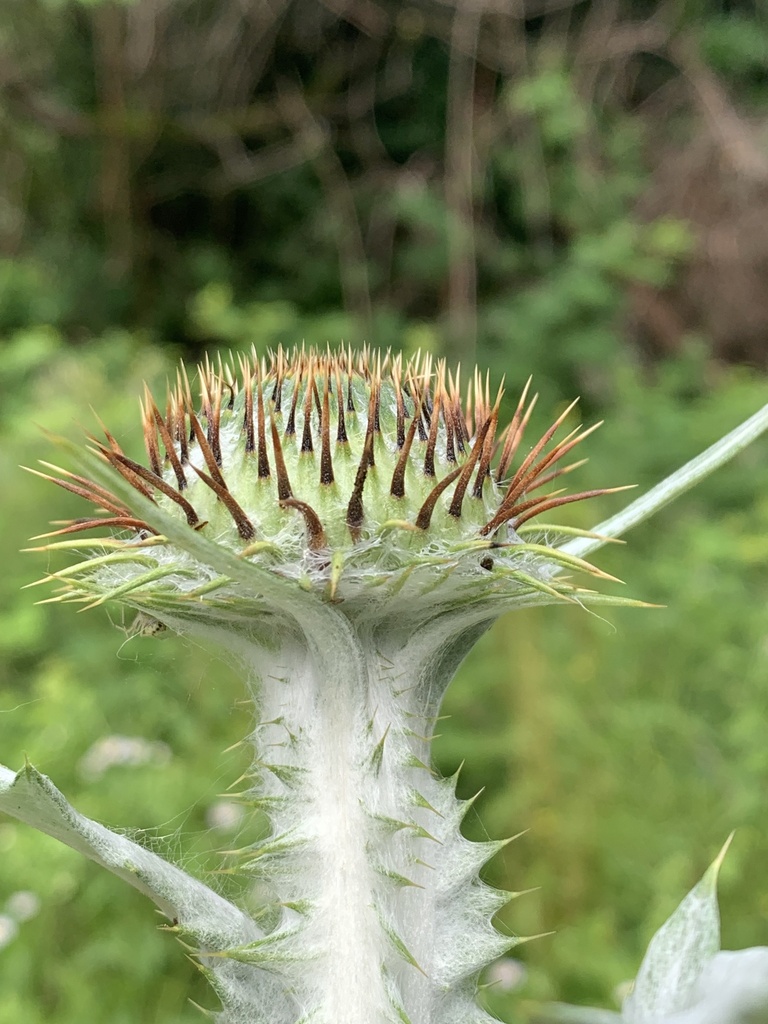
no rights reserved, uploaded by Tom Erler · CC0
Family: Asteraceae · Type: Perennial · Not Native
Conservation status: Cal-IPC Yes
Onopordum acanthium subsp. acanthium (Scotch thistle) is a non-native California perennial in the Asteraceae family, recognized by plant height, indument type, and pappus color.
Scotch thistle is a naturalized perennial herb found in northwestern California, the Cascade Range, Sierra Nevada, San Joaquin Valley, central western California, southwestern California, and the Modoc Plateau in disturbed sites at elevations below 1,600 meters. Flowering from May to August, this plant produces purple or white flowers in heads with linear phyllaries bearing delicate spines up to 5 millimeters long. Growing up to 3 meters tall with a canescent-tomentose (soft, woolly) appearance, the plant develops robust stems covered in a grayish-white felt-like indumentum. Its large leaves extend 1 to 5 meters long, deeply dentate with 8 to 10 pairs of widely triangular lobes, creating an impressive and imposing silhouette. The fruit is 4 to 5 millimeters long with a distinctive pink to reddish pappus measuring 7 to 9 millimeters.
Identification and appearance
Key characters: 2 sympatric species; key features are plant height, indument type, and pappus color
Habitat and range
Habitat: Disturbed sites
Elevation: < 1600 m
Outside California: native to Europe
Bloom period
Onopordum acanthium subsp. acanthium blooms May-Aug.
Conservation status
Cal-IPC Yes
How to tell it apart
vs Cirsium: Native and other thistles have a receptacle densely covered with soft bristly hairs; Onopordum's receptacle is naked and honeycombed (pitted), without bristles.; vs Carduus: Carduus has a bristly receptacle and a pappus of simple barbed hairs; Onopordum has a naked fleshy receptacle and a broadly gray-cottony plant with spiny-winged stems.; vs Silybum: Milk thistle has shiny green leaves boldly marbled with white veins; Onopordum leaves are uniformly gray-woolly, not marbled.; vs Arctium: Burdock heads have hooked, burr-forming phyllaries and broad unspined leaves; Onopordum has straight spine-tipped phyllaries and spiny gray leaves.; vs Centaurea: Star-thistles have leathery spine-tipped phyllaries but soft, unspined leaf blades; Onopordum has broad continuous spiny wings running down the stem and cottony spiny leaves.
Frequently asked questions
Is Onopordum acanthium subsp. acanthium native to California?
No. Onopordum acanthium subsp. acanthium is not native to California (recorded as not native).
When does Onopordum acanthium subsp. acanthium bloom?
Onopordum acanthium subsp. acanthium blooms May-Aug.
What plant family does Onopordum acanthium subsp. acanthium belong to?
Onopordum acanthium subsp. acanthium is in the Asteraceae family, genus Onopordum.
Is Onopordum acanthium subsp. acanthium invasive in California?
Onopordum acanthium subsp. acanthium is listed by Cal-IPC with an invasiveness rating of Yes.
What habitat does Onopordum acanthium subsp. acanthium grow in?
Onopordum acanthium subsp. acanthium grows in Disturbed sites.
Related species
Other California species in the same genus, family, or bioregion.
Sources: Jepson eFlora · CalPhotos
Last updated 2026-09-30
Data from The California Species Project — 14,000+ California species with verified data from CNPS, CDFW, USFWS, Cal-IPC, and more.