Opuntia engelmannii var. engelmannii
Engelmann prickly-pear, Engelmann Prickly-Pear
Wikimedia Commons · CC BY-SA
Family: Cactaceae · Type: Shrub · Native
Opuntia engelmannii var. engelmannii (Engelmann prickly-pear) is a native California shrub in the Cactaceae family, recognized by mounding habit, spine count and coloration.
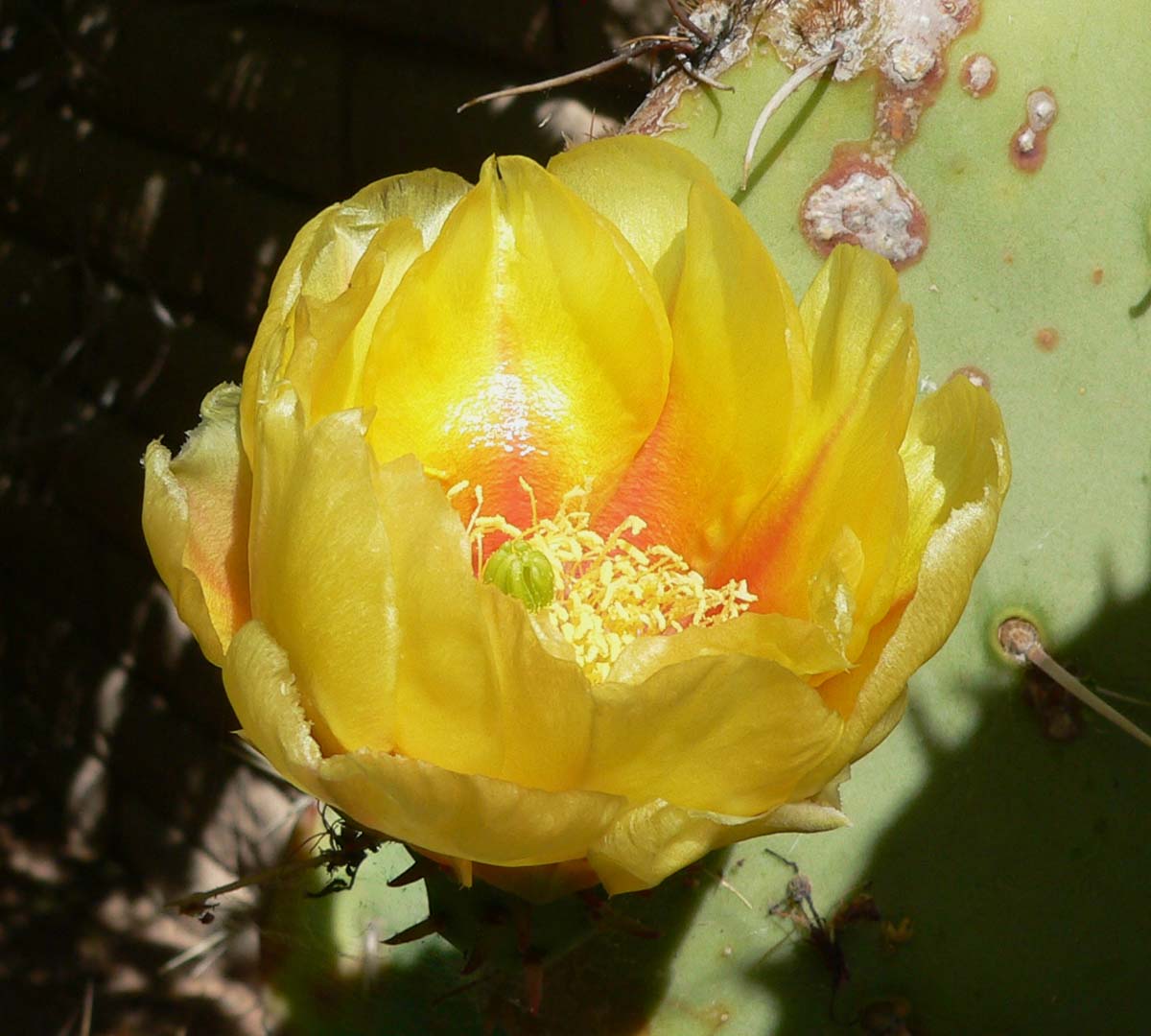
Engelmann prickly-pear is a native shrub found in southern desert mountains, eastern Peninsular Ranges, and Desert Mountains in desert scrub and dry oak woodland at elevations of 900 to 1,500 meters. Flowering from March to May, this plant produces large yellow flowers with white filaments and a yellow-green stigma. Growing as a mound-forming shrub less than 1 meter tall, it develops gray-green segments with distinctive yellow spines 4 to 5 centimeters long, often with chalky-white coating and reddish-brown bases. Its segments are generally obovate, spreading to ascending, with areoles containing 3 to 12 spines that are straight and somewhat appressed to the stem. The fruit is juicy and red-purple, reaching 4 to 6.5 centimeters long and containing seeds 4 to 6 millimeters in size.
Identification and appearance
Key characters: 10 sympatric species; mounding habit, spine count and coloration
Habitat and range
Habitat: Desert scrub, dry oak woodland
Elevation: 900-1500 m
California counties: San Diego, San Bernardino, Riverside
Outside California: to Nevada, Texas, Mexico
Bloom period
Opuntia engelmannii var. engelmannii blooms Mar-May.
How to tell it apart
vs Cylindropuntia: Opuntia has flat paddle segments; Cylindropuntia has cylindrical stems with papery spine sheaths.; vs Echinocereus: Opuntia has flat pads; Echinocereus has cylindrical stems that branch into clusters.; vs Euphorbia: Opuntia has true spines from areoles on fleshy pads; Euphorbia has milky sap and no areoles.; vs Austrocylindropuntia: Opuntia has broad flat pads; Austrocylindropuntia has pencil-thin cylindrical stems.; vs Cephalocereus: Opuntia has flat jointed pads; Cephalocereus has tall unbranched columns with woolly hair.
Frequently asked questions
Is Opuntia engelmannii var. engelmannii native to California?
Yes. Opuntia engelmannii var. engelmannii is native to California (recorded as native).
When does Opuntia engelmannii var. engelmannii bloom?
Opuntia engelmannii var. engelmannii blooms Mar-May.
Where in California does Opuntia engelmannii var. engelmannii grow?
Opuntia engelmannii var. engelmannii occurs in San Diego, San Bernardino, Riverside, at elevations of 900-1500 m.
What plant family does Opuntia engelmannii var. engelmannii belong to?
Opuntia engelmannii var. engelmannii is in the Cactaceae family, genus Opuntia.
What habitat does Opuntia engelmannii var. engelmannii grow in?
Opuntia engelmannii var. engelmannii grows in Desert scrub, dry oak woodland.
Related species
Other California species in the same genus, family, or bioregion.
Sources: Jepson eFlora · Index of California Plant Names · CalPhotos
Last updated 2026-10-07
Data from The California Species Project — 14,000+ California species with verified data from CNPS, CDFW, USFWS, Cal-IPC, and more.