Opuntia ficus-indica
Mission prickly-pear, Mission Prickly-Pear
no rights reserved · CC0
Family: Cactaceae · Type: Shrub / Tree · Not Native
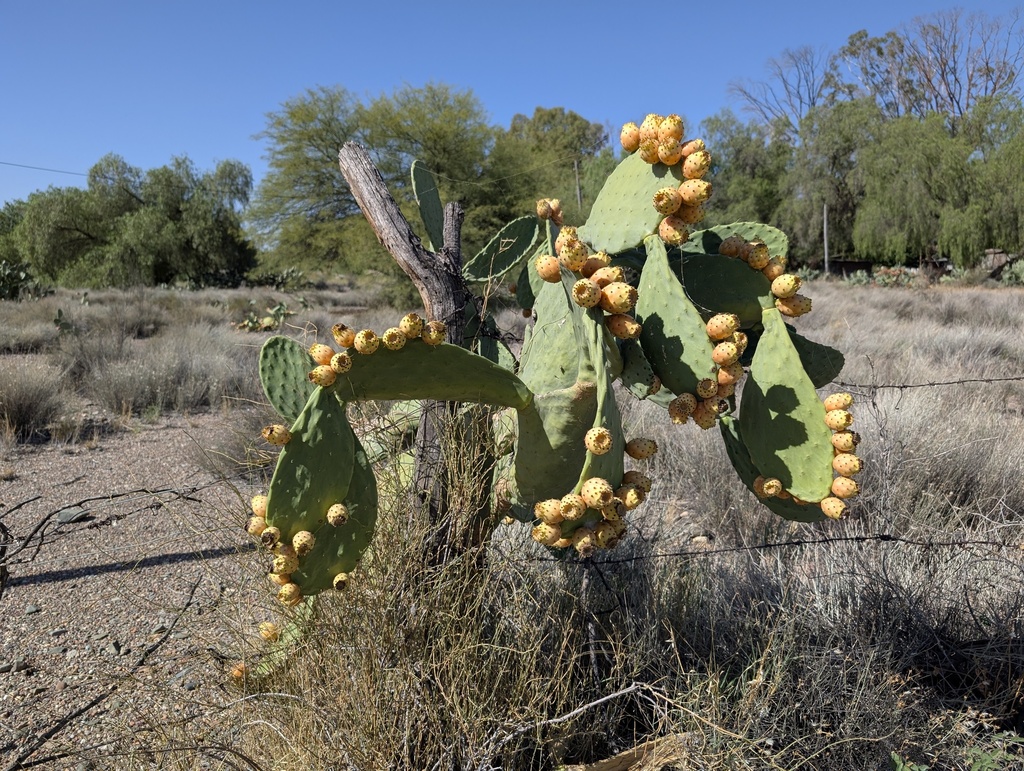
Opuntia ficus-indica (Mission prickly-pear) is a non-native California shrub / tree in the Cactaceae family, recognized by large tree form, massive segments, typically spineless.
Mission prickly-pear is a naturalized tree found in southern California Coast, southern Coast Ranges, coastal southern California, southern Channel Islands, western Transverse Ranges, and western Peninsular Ranges in dry coastal habitats at elevations of 6 to 450 meters. Flowering from May to June, this plant produces yellow or orange inner perianth flowers with pale green to pale pink filaments. Growing as a tree-like succulent with branches generally ascending, reaching 4 to 5 meters tall with gray-green elliptic-obovate segments 25 to 43 centimeters long. Its branches are typically spineless, but occasionally have white-tan or brown-gray spines up to 3 centimeters long when present. The fruit is large and juicy, measuring 6 to 9 centimeters long, ranging in color from yellow-orange to purple and containing numerous areoles.
Identification and appearance
Key characters: 14 sympatric species; large tree form, massive segments, typically spineless
Habitat and range
Habitat: dry coastal habitats
Elevation: 6-450 m
California counties: Los Angeles, San Diego, Orange, Ventura, Riverside, Tulare, San Luis Obispo, Santa Barbara, Santa Cruz, Monterey
Outside California: cultivated in warm regions worldwide, native range unknown
Bloom period
Opuntia ficus-indica blooms May-Jun.
How to tell it apart
vs Cylindropuntia: Opuntia has flat paddle segments; Cylindropuntia has cylindrical stems with papery spine sheaths.; vs Echinocereus: Opuntia has flat pads; Echinocereus has cylindrical stems that branch into clusters.; vs Euphorbia: Opuntia has true spines from areoles on fleshy pads; Euphorbia has milky sap and no areoles.; vs Austrocylindropuntia: Opuntia has broad flat pads; Austrocylindropuntia has pencil-thin cylindrical stems.; vs Cephalocereus: Opuntia has flat jointed pads; Cephalocereus has tall unbranched columns with woolly hair.
Frequently asked questions
Is Opuntia ficus-indica native to California?
No. Opuntia ficus-indica is not native to California (recorded as not native).
When does Opuntia ficus-indica bloom?
Opuntia ficus-indica blooms May-Jun.
Where in California does Opuntia ficus-indica grow?
Opuntia ficus-indica occurs in Los Angeles, San Diego, Orange, Ventura, Riverside, Tulare, San Luis Obispo, Santa Barbara and other counties, at elevations of 6-450 m.
What plant family does Opuntia ficus-indica belong to?
Opuntia ficus-indica is in the Cactaceae family, genus Opuntia.
What habitat does Opuntia ficus-indica grow in?
Opuntia ficus-indica grows in dry coastal habitats.
Related species
Other California species in the same genus, family, or bioregion.
Sources: Jepson eFlora · Index of California Plant Names · CalPhotos
Last updated 2026-10-07
Data from The California Species Project — 14,000+ California species with verified data from CNPS, CDFW, USFWS, Cal-IPC, and more.