Oreocarya subretusa
Crater lake oreocarya, Crater Lake Cryptantha
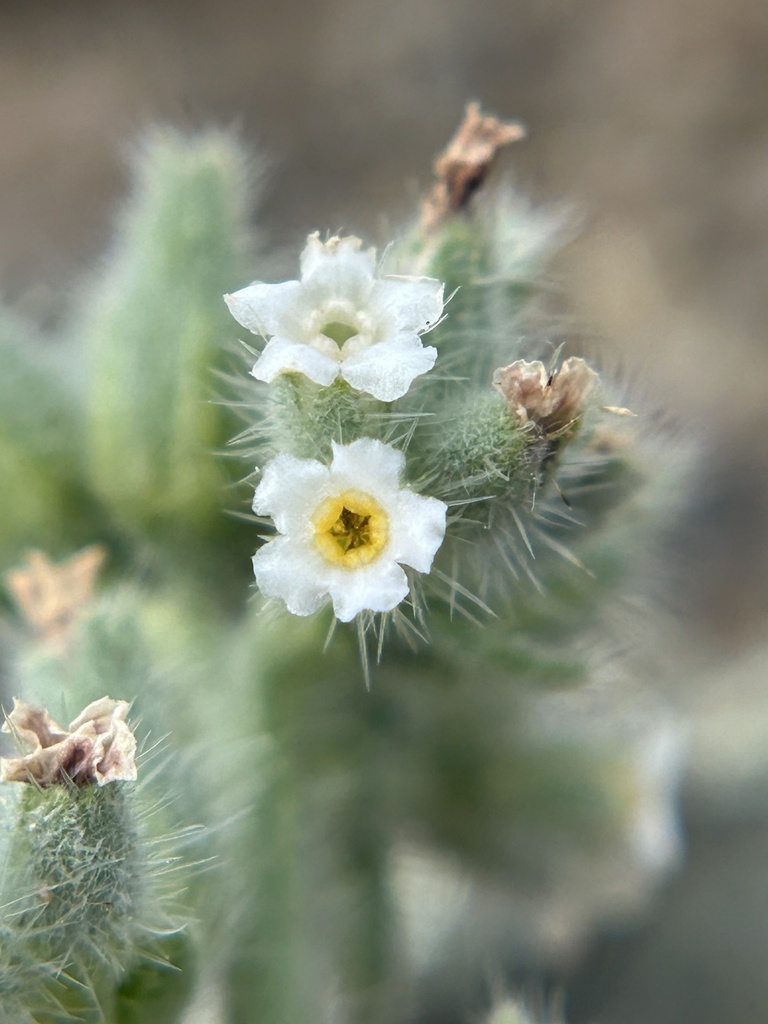
no rights reserved · CC0
Family: Boraginaceae · Type: Perennial · Native
Oreocarya subretusa (Crater lake oreocarya) is a native California perennial in the Boraginaceae family, recognized by notched leaf tips diagnostic.
Crater lake oreocarya is a California native perennial found in the southeastern Klamath Ranges from Scott Mountains to Mount Eddy, the high Cascade Range, and Modoc Plateau in conifer forest to subalpine habitats at elevations of 2,050 to 2,720 meters. Flowering from July to August, this plant produces yellow-appendaged white flowers in dense, cylindric clusters with blossoms 4 to 6 millimeters in diameter. Growing in dense clusters with stout gray-green stems 5 to 20 centimeters tall, it forms a woody, branched caudex with multiple stems. Its basal rosette leaves are thick and spoon-shaped, 1 to 4 centimeters long, gray-green with strigose surfaces and sparse appressed bristles. The fruit consists of 2 to 4 narrow-ovate nutlets 3 to 4.8 millimeters long, with convex surfaces that are slightly tubercled and wrinkled.
Identification and appearance
Key characters: 2 sympatric species; notched leaf tips diagnostic
Habitat and range
Habitat: Pumice, ash, occasionally serpentine, generally conifer forest to subalpine
Elevation: (1320)2050-2720 m
California counties: Siskiyou, Shasta, Modoc, Trinity, Mono
Outside California: to eastern Oregon, northern Nevada
Bloom period
Oreocarya subretusa blooms Jul-Aug.
How to tell it apart
vs Cryptantha: Cryptanthas are slender annuals with tiny inconspicuous white flowers; Oreocarya are stout perennials from a woody branched caudex with showier, densely clustered white or yellow flowers.; vs Hackelia: Stickseed nutlets bear hooked marginal prickles that cling to clothing; Oreocarya nutlets are smooth to roughened but lack hooked prickles.; vs Plagiobothrys: Popcornflowers are annuals of moist ground, often red-staining, in open coils; Oreocarya are harsh, bristly perennials forming cushions on dry rocky or desert sites.; vs Cynoglossum: Hound's-tongue is a tall, leafy-stemmed biennial with broad soft leaves and reddish-blue flowers; Oreocarya is low and cushion-like with narrow bristly leaves and white or yellow flowers.; vs Cryptantha: Beyond size, Oreocarya has persistent basal rosettes and a woody caudex, whereas Cryptantha germinates fresh each year with no woody base.
Frequently asked questions
Is Oreocarya subretusa native to California?
Yes. Oreocarya subretusa is native to California (recorded as native).
When does Oreocarya subretusa bloom?
Oreocarya subretusa blooms Jul-Aug.
Where in California does Oreocarya subretusa grow?
Oreocarya subretusa occurs in Siskiyou, Shasta, Modoc, Trinity, Mono, at elevations of (1320)2050-2720 m.
What plant family does Oreocarya subretusa belong to?
Oreocarya subretusa is in the Boraginaceae family, genus Oreocarya.
What habitat does Oreocarya subretusa grow in?
Oreocarya subretusa grows in Pumice, ash, occasionally serpentine, generally conifer forest to subalpine.
Related species
Other California species in the same genus, family, or bioregion.
- Oreocarya tumulosa — New york mountains oreocarya
- Oreocarya virginensis — Virgin river oreocarya
- Oreocarya abortiva — Bow-nut oreocarya
- Oreocarya confertiflora — Yellow-flowered oreocarya
- Oreocarya crymophila — Subalpine oreocarya
- Oreocarya flavoculata — Yellow-eyed oreocarya
- Pectocarya anisocarpa — Unequal-fruited pectocarya
- Pectocarya heterocarpa — Mixed-nut pectocarya
Sources: Jepson eFlora · Index of California Plant Names · CalPhotos
Last updated 2026-10-06
Data from The California Species Project — 14,000+ California species with verified data from CNPS, CDFW, USFWS, Cal-IPC, and more.