Osmorhiza brachypoda
California sweet cicely
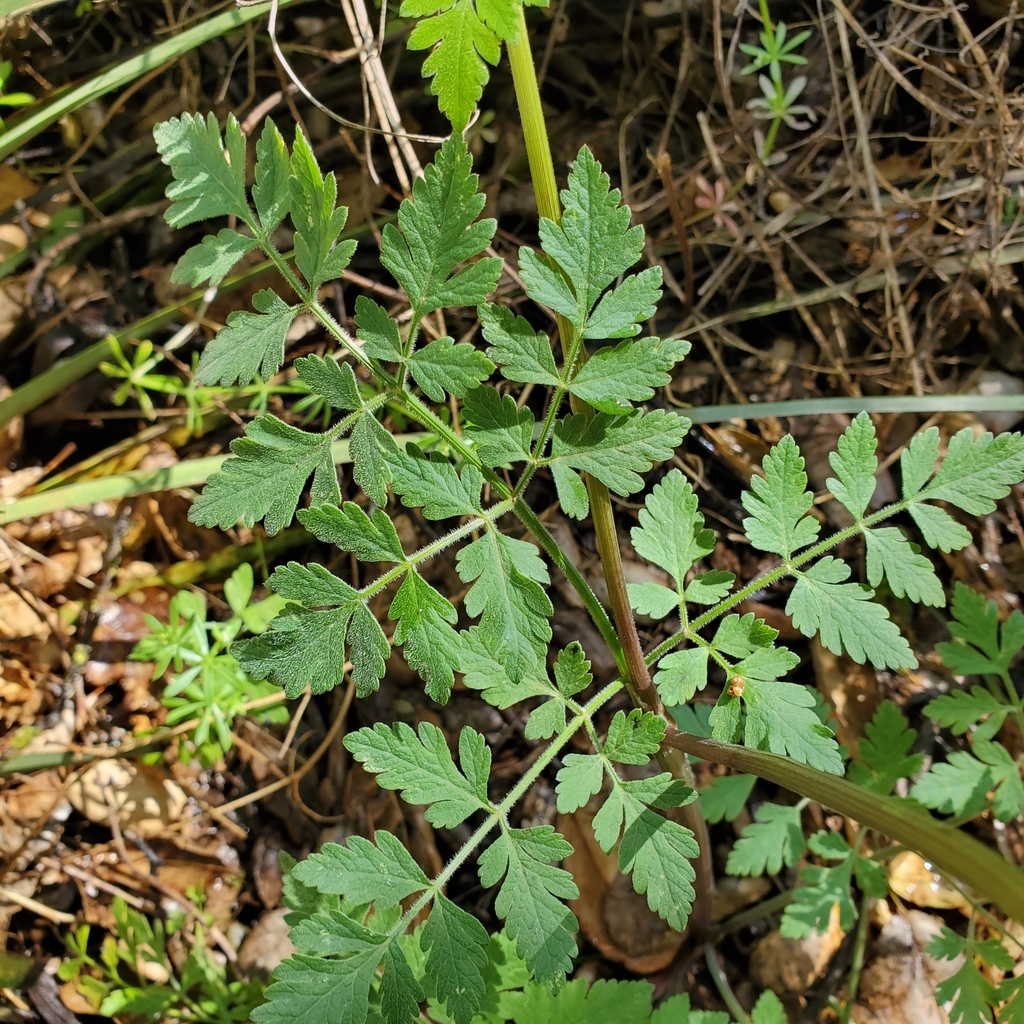
no rights reserved · CC0
Family: Apiaceae · Type: Herb · Native
Osmorhiza brachypoda (California sweet cicely) is a native California herb in the Apiaceae family, recognized by green-yellow flowers and bractlets.
California sweet cicely is a native perennial found in central Sierra Nevada Forests, northern Sierra Nevada High Country, Tehama, San Francisco Bay Area, southern Coast Ranges, Transverse Ranges, and Peninsular Ranges in moist ravines, conifer forests, and woodlands at elevations of 200 to 2,000 meters. Flowering from March to May, this plant produces green-yellow flowers in small clusters with spreading-ascending rays. Growing 30 to 80 centimeters tall with finely hairy stems, it has a delicate, spreading growth habit. Its complex leaves are 10 to 20 centimeters long, ovate to triangular-ovate, divided into 2 to 3 ternate sections with leaflets 2 to 8 centimeters long that are serrate or irregularly cut. The fruit is an oblong-fusiform shape 12 to 20 millimeters long with bristly ribs and a short tail.
Identification and appearance
Key characters: 1 sympatric species; green-yellow flowers and bractlets are diagnostic
Habitat and range
Habitat: Moist ravines, conifer forest, woodland
Elevation: 200-2000 m
California counties: Kern, Los Angeles, San Diego, Fresno, Orange, Madera, Ventura, Riverside, San Luis Obispo, Tulare, Monterey, San Benito, Santa Barbara, San Bernardino, Tuolumne, Contra Costa, Mariposa, Calaveras, Butte, Santa Clara, Trinity, El Dorado, Amador, Santa Cruz, Alameda, Placer
Outside California: central Arizona
Bloom period
Osmorhiza brachypoda blooms Mar-May.
How to tell it apart
vs Torilis: Osmorhiza fruits are smooth and elongated; Torilis fruits are tiny and covered in hooked bristles.; vs Koelreuteria: Osmorhiza has white umbel flowers; Koelreuteria has showy yellow panicles and is a tree.; vs Anthriscus: Osmorhiza fruits are club-shaped and 8-22mm long; Anthriscus fruits are beaked and under 7mm.; vs Geranium: Osmorhiza has tiny umbel flowers; Geranium has large 5-petaled flowers.; vs Toxicodendron: Osmorhiza has compound umbels; Toxicodendron has drooping panicles and is woody.
Frequently asked questions
Is Osmorhiza brachypoda native to California?
Yes. Osmorhiza brachypoda is native to California (recorded as native).
When does Osmorhiza brachypoda bloom?
Osmorhiza brachypoda blooms Mar-May.
Where in California does Osmorhiza brachypoda grow?
Osmorhiza brachypoda occurs in Kern, Los Angeles, San Diego, Fresno, Orange, Madera, Ventura, Riverside and other counties, at elevations of 200-2000 m.
What plant family does Osmorhiza brachypoda belong to?
Osmorhiza brachypoda is in the Apiaceae family, genus Osmorhiza.
What habitat does Osmorhiza brachypoda grow in?
Osmorhiza brachypoda grows in Moist ravines, conifer forest, woodland.
Related species
Other California species in the same genus, family, or bioregion.
Sources: Jepson eFlora · Index of California Plant Names · CalPhotos
Last updated 2026-10-07
Data from The California Species Project — 14,000+ California species with verified data from CNPS, CDFW, USFWS, Cal-IPC, and more.