Oxytheca perfoliata
Round-leaf puncturebract, Round-Leaf Puncturebract
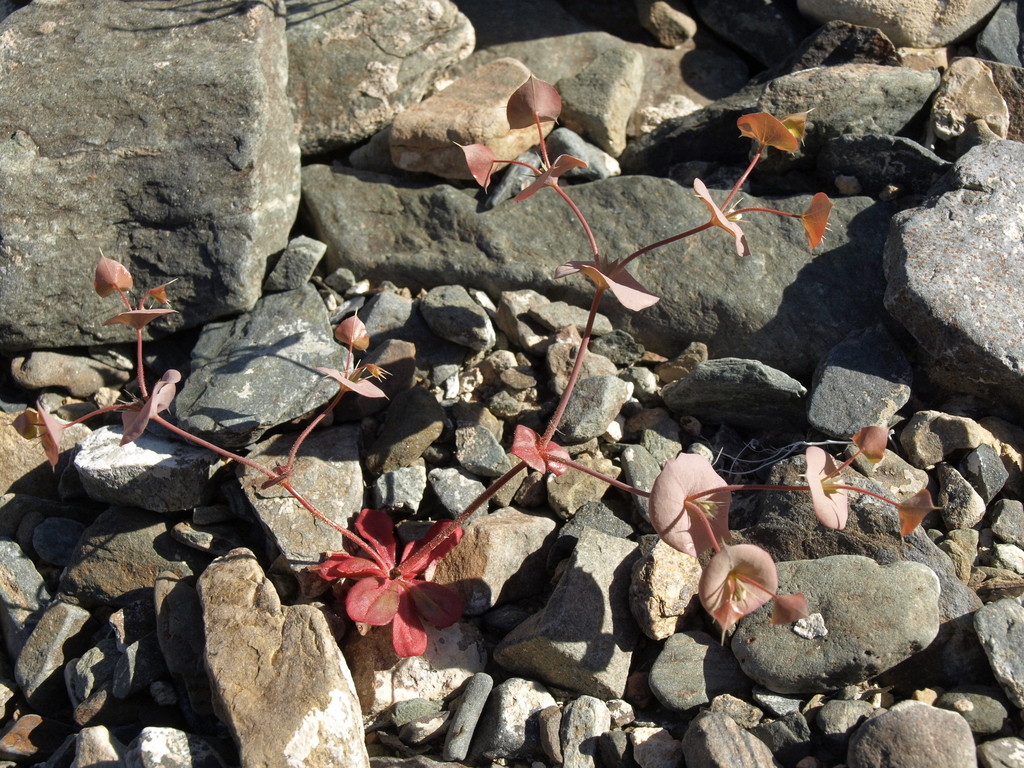
(c) Jim Morefield, some rights reserved (CC BY), uploaded by Jim Morefield · licence
Family: Polygonaceae · Type: Herb · Native
Oxytheca perfoliata (Round-leaf puncturebract) is a native California herb in the Polygonaceae family, recognized by . Key difference: fused vs free bracts.
Round-leaf puncturebract is a California native annual found in southern San Joaquin Valley, Great Basin, and Mojave Desert regions in sandy or gravelly habitats at elevations of 600 to 1,900 meters. Flowering from April to August, this plant produces white to yellow-green or pink flowers in small clusters approximately 1.5 to 2.5 millimeters long. Growing with spreading stems 6 to 20 centimeters wide and reaching up to 20 centimeters in diameter, it forms low, sprawling plants across the ground. Its leaves have blades 1 to 6 centimeters long, 0.3 to 1.5 centimeters wide, with distinctive ciliate margins and a glabrous surface. The plant's unique inflorescence features bracts fused around nodes, forming distinctive clusters 1 to 2.5 centimeters in diameter with small red-tipped awns.
Identification and appearance
Key characters: 1 sympatric species. Key difference: fused vs free bracts
Habitat and range
Habitat: Common. Sand or gravel
Elevation: 600-1900 m
California counties: San Bernardino, Inyo, Mariposa, Santa Barbara, Kern, Mono, Los Angeles, Riverside, San Luis Obispo, Ventura, Tulare, Lassen, San Benito
Outside California: to southwestern Utah, northwestern Arizona
Bloom period
Oxytheca perfoliata blooms Apr-Aug.
How to tell it apart
vs Eriogonum: Oxytheca has cup-like involucres with 3-4 awns; Eriogonum has larger, awnless involucres.; vs Mucronea: Oxytheca has 3-4 awns per involucre; Mucronea has different involucre structure.; vs Claytonia: Oxytheca is in Polygonaceae with awned involucres; Claytonia is in Montiaceae with no involucres.; vs Sidotheca: Oxytheca has smooth-edged petals; Sidotheca has fringed or 3-lobed petals.; vs Acanthoscyphus: Oxytheca has 3-5 awns per involucre; Acanthoscyphus has 7-30+ awns creating bristly appearance.
Frequently asked questions
Is Oxytheca perfoliata native to California?
Yes. Oxytheca perfoliata is native to California (recorded as native).
When does Oxytheca perfoliata bloom?
Oxytheca perfoliata blooms Apr-Aug.
Where in California does Oxytheca perfoliata grow?
Oxytheca perfoliata occurs in San Bernardino, Inyo, Mariposa, Santa Barbara, Kern, Mono, Los Angeles, Riverside and other counties, at elevations of 600-1900 m.
What plant family does Oxytheca perfoliata belong to?
Oxytheca perfoliata is in the Polygonaceae family, genus Oxytheca.
What habitat does Oxytheca perfoliata grow in?
Oxytheca perfoliata grows in Common. Sand or gravel.
Related species
Other California species in the same genus, family, or bioregion.
Sources: Jepson eFlora · Index of California Plant Names · CalPhotos
Last updated 2026-10-07
Data from The California Species Project — 14,000+ California species with verified data from CNPS, CDFW, USFWS, Cal-IPC, and more.