Packera cana
Woolly groundsel
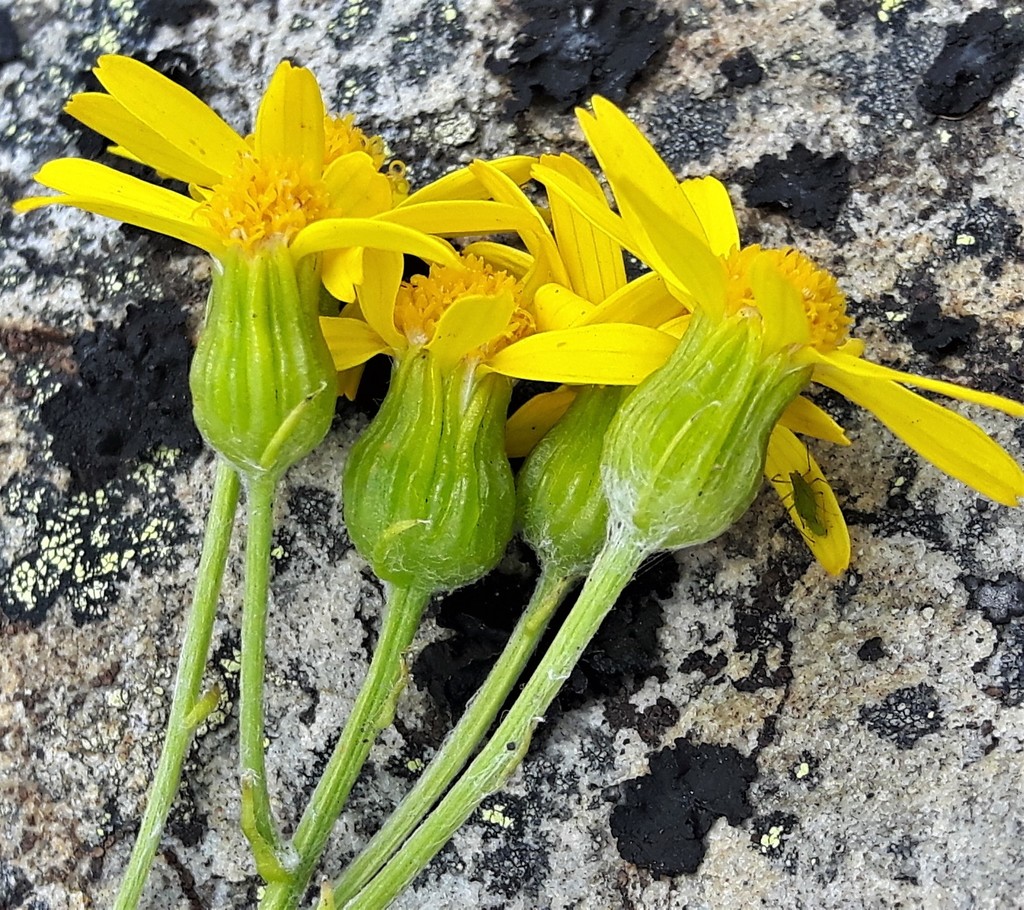
(c) Peter L Achuff, some rights reserved (CC BY), uploaded by Peter L Achuff · licence
Family: Asteraceae · Type: Subshrub · Native
Packera cana (Woolly groundsel) is a native California subshrub in the Asteraceae family, recognized by . Distinguished by persistent woolly coating on leaves.
Woolly groundsel is a California native perennial found in the Klamath Ranges, California Ranges, Sierra Nevada, and Great Basin in sagebrush scrub and rocky slopes at elevations of 1,200 to 3,500 meters. Flowering from June to August, this plant produces yellow ray flowers in heads 8 to 15 millimeters wide, arranged in flat-topped clusters. Growing with densely woolly stems 10 to 30 centimeters tall emerging from a thick, branched caudex, it forms distinctive rosettes. Its basal leaves are broadly ovate to lanceolate, 2.5 to 5 centimeters long, with persistently woolly undersides and edges that are entire or slightly wavy. The fruit is 2.5 to 3.5 millimeters long and glabrous.
Identification and appearance
Key characters: 16 sympatric species. Distinguished by persistent woolly coating on leaves.
Habitat and range
Habitat: Locally abundant. Sagebrush scrub, rocky slopes, crevices
Elevation: 1200-3500 m
California counties: Inyo, Mono, Tulare, Alpine, Modoc, Lassen, Nevada, Siskiyou, Fresno, Shasta, Madera, Tuolumne, Sierra, Mariposa, Plumas, El Dorado, Trinity, Placer, Del Norte
Outside California: to British Columbia, Manitoba, Minnesota, Kansas, New Mexico
Bloom period
Packera cana blooms Jun-Aug.
How to tell it apart
vs Senecio: Packera has green or red bract tips and fibrous roots; Senecio often has black bract tips and taproots.; vs Jacobaea: Packera is native with soft-toothed leaf margins; Jacobaea is non-native with harder-edged leaves.; vs Arnica: Packera has alternate leaves and many small heads; Arnica has opposite leaves and fewer large heads.; vs Eriophyllum: Packera has green leaves with soft hairs; Eriophyllum has densely woolly gray-white leaves.; vs Eriogonum: Packera has yellow daisy flowers; buckwheat has ball-like clusters of tiny pink/white/yellow flowers.
Frequently asked questions
Is Packera cana native to California?
Yes. Packera cana is native to California (recorded as native).
When does Packera cana bloom?
Packera cana blooms Jun-Aug.
Where in California does Packera cana grow?
Packera cana occurs in Inyo, Mono, Tulare, Alpine, Modoc, Lassen, Nevada, Siskiyou and other counties, at elevations of 1200-3500 m.
What plant family does Packera cana belong to?
Packera cana is in the Asteraceae family, genus Packera.
What habitat does Packera cana grow in?
Packera cana grows in Locally abundant. Sagebrush scrub, rocky slopes, crevices.
Related species
Other California species in the same genus, family, or bioregion.
Sources: Jepson eFlora · Index of California Plant Names · CalPhotos
Last updated 2026-10-07
Data from The California Species Project — 14,000+ California species with verified data from CNPS, CDFW, USFWS, Cal-IPC, and more.