Packera subnuda var. subnuda
Cleftleaf groundsel
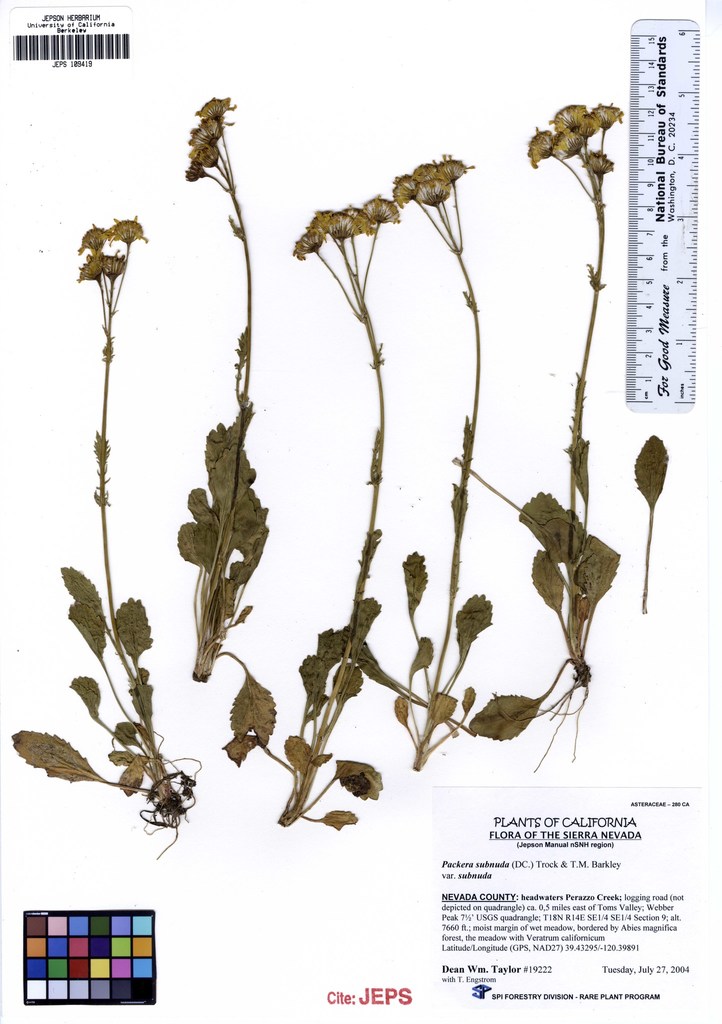
(c) Dean Wm. Taylor, some rights reserved (CC BY) · licence
Family: Asteraceae · Type: Perennial · Native
Packera subnuda var. subnuda (Cleftleaf groundsel) is a native California perennial in the Asteraceae family, recognized by . Distinguished by solitary head with 2 large bractlets and 13 rays.
Cleftleaf groundsel is a California native perennial found in northern and central Sierra Nevada Mountains and Modoc Plateau in damp or marshy meadows, lakeshores, and streambanks at elevations of 1,500 to 3,000 meters. Flowering from June to September, this plant produces white ray flowers 7 to 12 millimeters long with yellow disk centers arranged in radiate heads. Growing 10 to 30 centimeters tall with glabrous stems emerging from a creeping slender caudex, it has a solitary or occasionally clustered growth habit. Its basal leaves are distinctive, measuring 2 to 4 centimeters long and 1 to 3 centimeters wide, with ovate to obovate shapes that are nearly entire or slightly toothed along the edges. The plant produces numerous disk flowers, typically 40 to 55 in each flower head, with green phyllaries that are sometimes tinged red at the tips.
Identification and appearance
Key characters: 8 sympatric species. Distinguished by solitary head with 2 large bractlets and 13 rays.
Habitat and range
Habitat: Uncommon. Damp or marshy meadows, lakeshores, streambanks
Elevation: 1500-3000 m
California counties: Mono, Tuolumne, Butte, Plumas, Alpine, Mariposa, Lassen, Tehama, Modoc, Nevada, Tulare
Outside California: to British Columbia, Montana, Wyoming, Nevada
Bloom period
Packera subnuda var. subnuda blooms Jun-Sep.
How to tell it apart
vs Senecio: Packera has green or red bract tips and fibrous roots; Senecio often has black bract tips and taproots.; vs Jacobaea: Packera is native with soft-toothed leaf margins; Jacobaea is non-native with harder-edged leaves.; vs Arnica: Packera has alternate leaves and many small heads; Arnica has opposite leaves and fewer large heads.; vs Eriophyllum: Packera has green leaves with soft hairs; Eriophyllum has densely woolly gray-white leaves.; vs Eriogonum: Packera has yellow daisy flowers; buckwheat has ball-like clusters of tiny pink/white/yellow flowers.
Frequently asked questions
Is Packera subnuda var. subnuda native to California?
Yes. Packera subnuda var. subnuda is native to California (recorded as native).
When does Packera subnuda var. subnuda bloom?
Packera subnuda var. subnuda blooms Jun-Sep.
Where in California does Packera subnuda var. subnuda grow?
Packera subnuda var. subnuda occurs in Mono, Tuolumne, Butte, Plumas, Alpine, Mariposa, Lassen, Tehama and other counties, at elevations of 1500-3000 m.
What plant family does Packera subnuda var. subnuda belong to?
Packera subnuda var. subnuda is in the Asteraceae family, genus Packera.
What habitat does Packera subnuda var. subnuda grow in?
Packera subnuda var. subnuda grows in Uncommon. Damp or marshy meadows, lakeshores, streambanks.
Related species
Other California species in the same genus, family, or bioregion.
- Packera werneriifolia — Hoary groundsel
- Packera bernardina — San bernardino ragwort
- Packera bolanderi var. bolanderi — Seacoast ragwort
- Packera breweri — Brewer's ragwort
- Packera cana — Woolly groundsel
- Packera clevelandii — Cleveland's ragwort
- Palafoxia arida — Desert palafox
- Palafoxia arida var. arida — Desert needle
- Palafoxia arida var. gigantea — Giant spanish-needle
Sources: Jepson eFlora · Index of California Plant Names · CalPhotos
Last updated 2026-10-06
Data from The California Species Project — 14,000+ California species with verified data from CNPS, CDFW, USFWS, Cal-IPC, and more.