Panicum antidotale
Blue panic grass
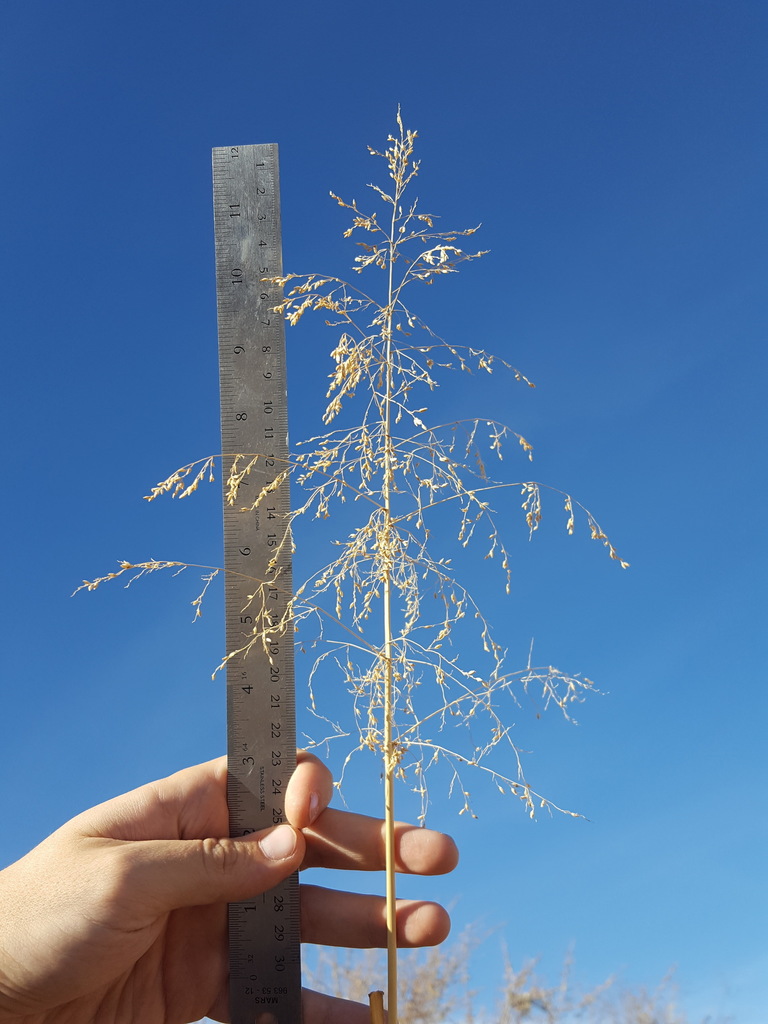
(c) Alex Abair, some rights reserved (CC BY) · licence
Family: Poaceae · Type: Grass · Not Native
Panicum antidotale (Blue panic grass) is a non-native California grass in the Poaceae family, recognized by distinctive for large size (5-25 dm) and hard, woody stems.
Blue panic grass is a naturalized perennial grass found in the Inner South Coast Ranges in open, generally disturbed areas and fields at elevations of 300 to 600 meters. Flowering from April to October, this grass produces brown, green, or purple spikelets in dense clusters approximately 2.5 to 3 millimeters long. Growing with erect, hard stems 50 to 250 centimeters tall that develop 5 to 12 distinctive nodes, it spreads through underground rhizomes. Its leaves feature long blades 15 to 30 centimeters in length, 4 to 12 millimeters wide, with glabrous upper surfaces and densely ciliate ligules. The inflorescence develops 13 to 28 centimeters long, with primary branches 9 to 18 centimeters and spikelets clustered one to two per node.
Identification and appearance
Key characters: 6 sympatric species; distinctive for large size (5-25 dm) and hard, woody stems
Habitat and range
Habitat: Open, generally disturbed areas, fields
Elevation: 300-600 m
California counties: San Bernardino, Riverside, Inyo, Imperial, Los Angeles
Outside California: to Utah, Texas, northern Mexico, native to India
Bloom period
Panicum antidotale blooms Apr-Oct.
How to tell it apart
vs Deschampsia: Panicum has thick rigid lemmas and well-developed lower glumes; hairgrass has thin awned florets and tiny glumes.; vs Dichanthelium: Panicum has a single flowering period; rosette grass produces two distinct flower types (spring and summer).; vs Hilaria: Panicum has single spikelets on branches; curly mesquite has spikelets in clusters of three along a spike.; vs Sorghum: Panicum has single spikelets throughout panicle; sorghum has three-spikelet groups at branch tips.; vs Echinochloa: Panicum has a membranous ligule and panicle; barnyard grass lacks a ligule and has bristly branches.
Frequently asked questions
Is Panicum antidotale native to California?
No. Panicum antidotale is not native to California (recorded as not native).
When does Panicum antidotale bloom?
Panicum antidotale blooms Apr-Oct.
Where in California does Panicum antidotale grow?
Panicum antidotale occurs in San Bernardino, Riverside, Inyo, Imperial, Los Angeles, at elevations of 300-600 m.
What plant family does Panicum antidotale belong to?
Panicum antidotale is in the Poaceae family, genus Panicum.
What habitat does Panicum antidotale grow in?
Panicum antidotale grows in Open, generally disturbed areas, fields.
Related species
Other California species in the same genus, family, or bioregion.
- Panicum capillare — Witch grass
- Panicum dichotomiflorum subsp. dichotomiflorum — Fall panic grass
- Panicum hillmanii — Hillman's panic grass
- Panicum hirticaule subsp. hirticaule — Roughstalk witch grass
- Panicum miliaceum subsp. miliaceum — Broom corn millet
- Panicum oligosanthes var. scribnerianum — Scribner's panic grass
Sources: Jepson eFlora · Index of California Plant Names · CalPhotos
Last updated 2026-10-07
Data from The California Species Project — 14,000+ California species with verified data from CNPS, CDFW, USFWS, Cal-IPC, and more.