Panicum capillare
Witch grass, Witch Grass
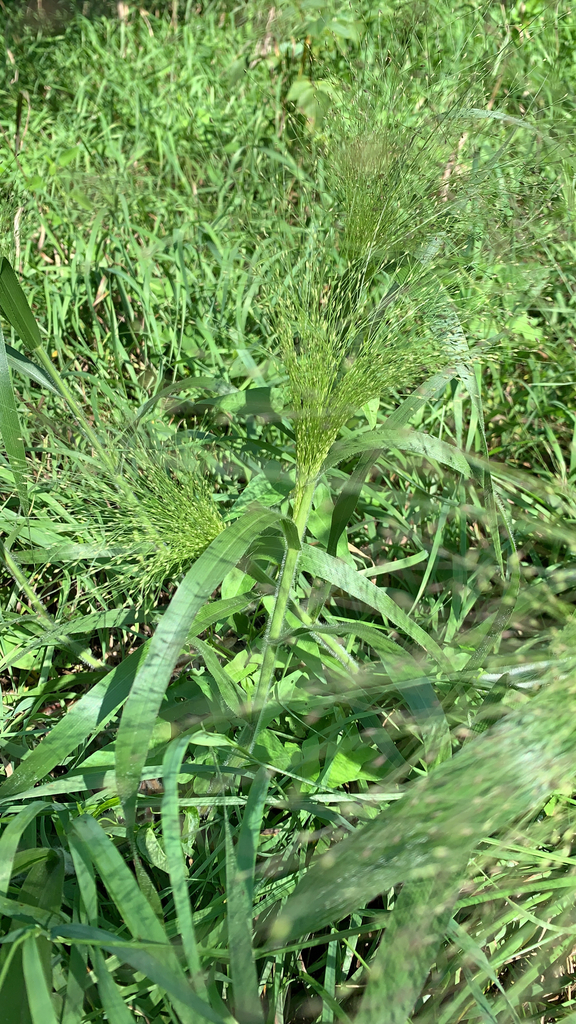
no rights reserved · CC0
Family: Poaceae · Type: Grass · Native
Panicum capillare (Witch grass) is a native California grass in the Poaceae family, recognized by annual habit, very open inflorescence, and tail-like spikelet tips.
Witch grass is a native annual found in California in open places, fields, and roadsides at elevations below 1,500 meters. Flowering from February to December, this plant produces delicate pale green to whitish panicle-like flower clusters that spread widely. Growing with slender stems 20 to 100 centimeters tall, it has a loose, open growth habit with spreading branches. Its leaf blades are 5 to 30 centimeters long, 5 to 20 millimeters wide, with short soft hairs covering the upper surface that give the plant a slightly rough texture. The tiny spikelets are 2 to 3.5 millimeters long, with a distinctive tapered tip on the lower floret that adds to its delicate appearance.
Identification and appearance
Key characters: 11 sympatric species; key features are annual habit, very open inflorescence, and tail-like spikelet tips
Habitat and range
Habitat: Open places, fields, roadsides
Elevation: < 1500 m
California counties: Alameda, Siskiyou, Kern, Stanislaus, Calaveras, Napa, Santa Barbara, Los Angeles, Modoc, Lassen, Plumas, Inyo, Lake, San Diego, Contra Costa, Humboldt, Riverside, Butte, Orange, Trinity, Tuolumne, Amador, Mendocino, Ventura, San Bernardino, Madera, Solano, Colusa, Tulare, Glenn, Placer, Shasta, El Dorado, Yolo, Mono, San Joaquin, Sacramento, Yuba, Alpine, Monterey, Tehama, Fresno, Sonoma, Imperial, San Francisco, San Luis Obispo, Santa Clara, Santa Cruz, Sutter, Nevada, Sierra, Mariposa, Del Norte, San Mateo, Merced
Outside California: to Canada, eastern United States
Bloom period
Panicum capillare blooms Feb-Dec.
How to tell it apart
vs Deschampsia: Panicum has thick rigid lemmas and well-developed lower glumes; hairgrass has thin awned florets and tiny glumes.; vs Dichanthelium: Panicum has a single flowering period; rosette grass produces two distinct flower types (spring and summer).; vs Hilaria: Panicum has single spikelets on branches; curly mesquite has spikelets in clusters of three along a spike.; vs Sorghum: Panicum has single spikelets throughout panicle; sorghum has three-spikelet groups at branch tips.; vs Echinochloa: Panicum has a membranous ligule and panicle; barnyard grass lacks a ligule and has bristly branches.
Frequently asked questions
Is Panicum capillare native to California?
Yes. Panicum capillare is native to California (recorded as native).
When does Panicum capillare bloom?
Panicum capillare blooms Feb-Dec.
Where in California does Panicum capillare grow?
Panicum capillare occurs in Alameda, Siskiyou, Kern, Stanislaus, Calaveras, Napa, Santa Barbara, Los Angeles and other counties, at elevations of < 1500 m.
What plant family does Panicum capillare belong to?
Panicum capillare is in the Poaceae family, genus Panicum.
What habitat does Panicum capillare grow in?
Panicum capillare grows in Open places, fields, roadsides.
Related species
Other California species in the same genus, family, or bioregion.
- Panicum dichotomiflorum subsp. dichotomiflorum — Fall panic grass
- Panicum hillmanii — Hillman's panic grass
- Panicum hirticaule subsp. hirticaule — Roughstalk witch grass
- Panicum miliaceum subsp. miliaceum — Broom corn millet
- Panicum oligosanthes var. scribnerianum — Scribner's panic grass
- Panicum rigidulum subsp. rigidulum — Redtop panicum
Sources: Jepson eFlora · Index of California Plant Names · CalPhotos
Last updated 2026-10-07
Data from The California Species Project — 14,000+ California species with verified data from CNPS, CDFW, USFWS, Cal-IPC, and more.