Panicum hirticaule subsp. hirticaule
Roughstalk witch grass, Roughstalk Witch Grass
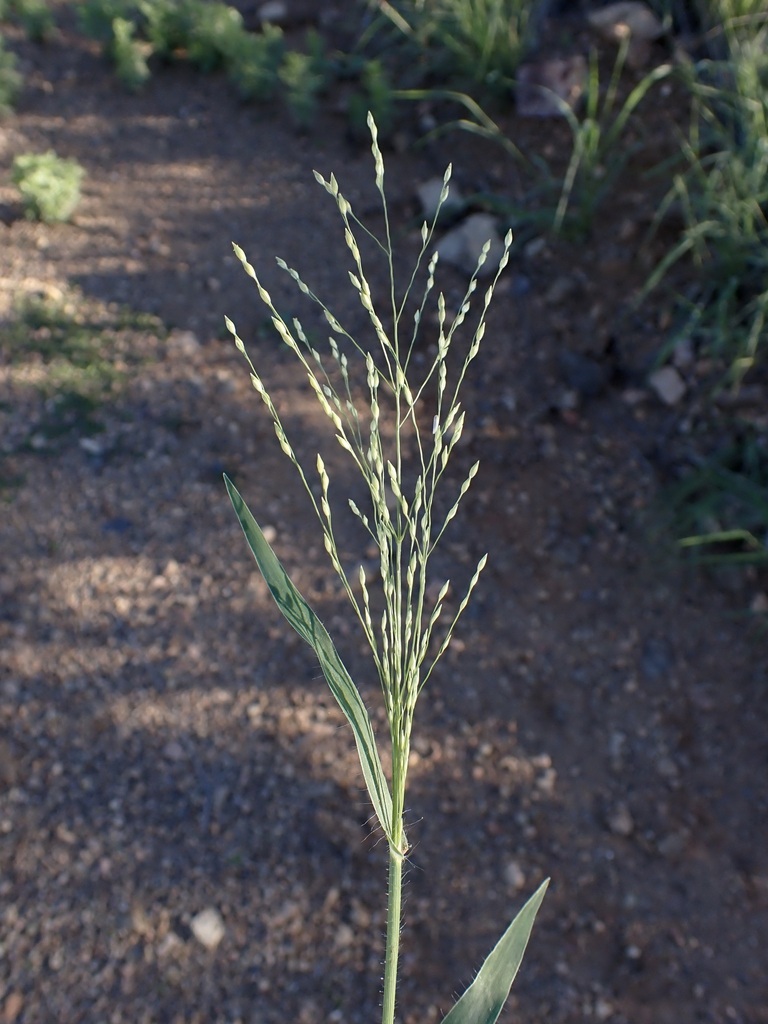
(c) Sue Carnahan, some rights reserved (CC BY), uploaded by Sue Carnahan · licence
Family: Poaceae · Type: Grass · Native
Conservation status: CNPS 2B.1
Panicum hirticaule subsp. hirticaule (Roughstalk witch grass) is a native California grass in the Poaceae family, recognized by desert habitat and visible axis between glumes and florets are key.
Roughstalk witch grass is a rare (CNPS 2B.1) California native annual grass found in the southern desert bioregion in sandy soils and creosote-bush scrub at elevations below 1,400 meters. Flowering from August to December, this grass produces green spikelets about 2.5 to 3 millimeters long in open branching clusters. Growing with slender stems 10 to 80 centimeters tall, it develops leaves with sparse short hairs on the upper surface and blades 7 to 20 centimeters long. Its leaf sheaths are 2 to 6 centimeters long with a tiny ciliate membrane ligule less than 2 millimeters wide. The spikelets have distinctive features including a lower glume with 5 veins and asymmetrical florets with crescent-shaped scars.
Identification and appearance
Key characters: 6 sympatric species; desert habitat and visible axis between glumes and florets are key
Habitat and range
Habitat: Sandy soils, open sites, creosote-bush scrub
Elevation: < 1400 m
California counties: Riverside, San Bernardino, San Diego, Imperial
Outside California: to Texas, South America
Bloom period
Panicum hirticaule subsp. hirticaule blooms Aug-Dec.
Conservation status
CNPS 2B.1
How to tell it apart
vs Deschampsia: Panicum has thick rigid lemmas and well-developed lower glumes; hairgrass has thin awned florets and tiny glumes.; vs Dichanthelium: Panicum has a single flowering period; rosette grass produces two distinct flower types (spring and summer).; vs Hilaria: Panicum has single spikelets on branches; curly mesquite has spikelets in clusters of three along a spike.; vs Sorghum: Panicum has single spikelets throughout panicle; sorghum has three-spikelet groups at branch tips.; vs Echinochloa: Panicum has a membranous ligule and panicle; barnyard grass lacks a ligule and has bristly branches.
Frequently asked questions
Is Panicum hirticaule subsp. hirticaule native to California?
Yes. Panicum hirticaule subsp. hirticaule is native to California (recorded as native).
When does Panicum hirticaule subsp. hirticaule bloom?
Panicum hirticaule subsp. hirticaule blooms Aug-Dec.
Where in California does Panicum hirticaule subsp. hirticaule grow?
Panicum hirticaule subsp. hirticaule occurs in Riverside, San Bernardino, San Diego, Imperial, at elevations of < 1400 m.
What plant family does Panicum hirticaule subsp. hirticaule belong to?
Panicum hirticaule subsp. hirticaule is in the Poaceae family, genus Panicum.
Is Panicum hirticaule subsp. hirticaule rare or endangered?
Panicum hirticaule subsp. hirticaule carries California Rare Plant Rank 2B.1, state rank S2.
Related species
Other California species in the same genus, family, or bioregion.
Sources: Jepson eFlora · CNPS Rare Plant Inventory · Index of California Plant Names · CalPhotos · CDFW CNDDB
Last updated 2026-10-07
Data from The California Species Project — 14,000+ California species with verified data from CNPS, CDFW, USFWS, Cal-IPC, and more.