Parapholis incurva
Curved sicklegrass
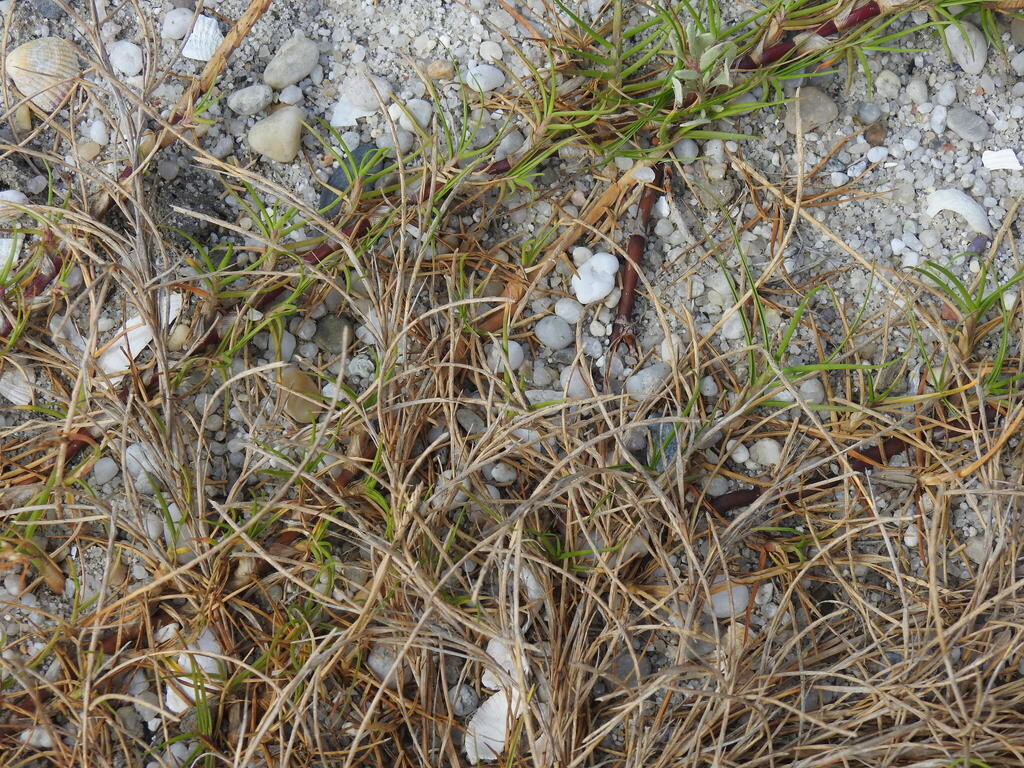
(c) Duarte Frade, some rights reserved (CC BY) · licence
Family: Poaceae · Type: Grass · Not Native
Parapholis incurva (Curved sicklegrass) is a non-native California grass in the Poaceae family, recognized by . Distinguished by size, inflorescence length, and leaf rolling.
Curved sicklegrass is a naturalized annual found in coastal regions including northern California Coast, eastern North Coast Ranges, western Sacramento Valley, northern San Joaquin Valley, Central Coast, Southern Coast, and Channel Islands in disturbed, well-drained salt marsh soils at elevations below 100 meters. Flowering from April to June, this grass produces small, pale green to straw-colored spikelets in delicate, curved inflorescences. Growing with decumbent to erect stems 3 to 35 centimeters tall, it branches throughout or remains unbranched. Its narrow leaves are typically 1 to 10 centimeters long, barely 1 to 3 millimeters wide, and often tightly inrolled. The grass forms dense, low-growing clusters in maritime habitats, with spikelets arranged in slender, arching clusters 2 to 15 centimeters long.
Identification and appearance
Key characters: 1 sympatric species. Distinguished by size, inflorescence length, and leaf rolling.
Habitat and range
Habitat: Disturbed, well drained soils of salt marshes, generally above highest tide level
Elevation: < 100 m
California counties: San Diego, San Mateo, Ventura, Humboldt, Los Angeles, Orange, Contra Costa, Santa Barbara, Marin, San Luis Obispo, Alameda, Solano, Sonoma, Mendocino, Monterey, San Francisco, Yolo, Kern, Colusa, San Bernardino, Merced, Santa Clara, Santa Cruz, Glenn, Napa, Stanislaus, Del Norte, Calaveras, Fresno, San Joaquin, Tuolumne
Outside California: to British Columbia, Mexico, native to Europe
Bloom period
Parapholis incurva blooms Apr-Jun.
How to tell it apart
vs Distichlis: Parapholis has curved spikes with embedded spikelets; Distichlis has stiff upright branches with protruding spikelets.; vs Stenotaphrum: Parapholis is a delicate tufted annual; Stenotaphrum is robust with thick spreading stolons.; vs Aegilops: Parapholis completely lacks awns; Aegilops has prominent bristles on glumes.; vs Scribneria: Parapholis is completely awnless; Scribneria has an awn on the lemma.
Frequently asked questions
Is Parapholis incurva native to California?
No. Parapholis incurva is not native to California (recorded as not native).
When does Parapholis incurva bloom?
Parapholis incurva blooms Apr-Jun.
Where in California does Parapholis incurva grow?
Parapholis incurva occurs in San Diego, San Mateo, Ventura, Humboldt, Los Angeles, Orange, Contra Costa, Santa Barbara and other counties, at elevations of < 100 m.
What plant family does Parapholis incurva belong to?
Parapholis incurva is in the Poaceae family, genus Parapholis.
What habitat does Parapholis incurva grow in?
Parapholis incurva grows in Disturbed, well drained soils of salt marshes, generally above highest tide level.
Related species
Other California species in the same genus, family, or bioregion.
Sources: Jepson eFlora · Index of California Plant Names · CalPhotos
Last updated 2026-10-07
Data from The California Species Project — 14,000+ California species with verified data from CNPS, CDFW, USFWS, Cal-IPC, and more.