Paraserianthes lophantha
Plume albizia, Plume Acacia
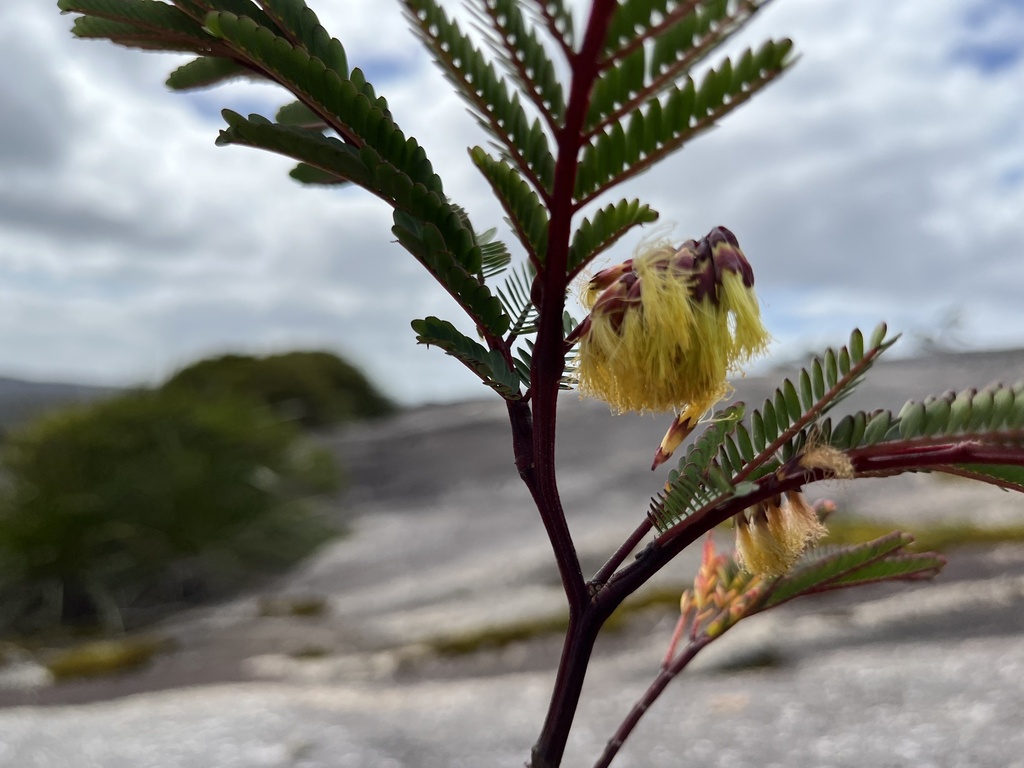
(c) dizzyurid, some rights reserved (CC BY) · licence
Family: Fabaceae · Type: Shrub / Tree · Not Native
Conservation status: Cal-IPC Yes
Paraserianthes lophantha (Plume albizia) is a non-native California shrub / tree in the Fabaceae family, recognized by Australian genus naturalized along California coast, representing a tropical legume lineage.
Plume albizia is a naturalized shrub found in coastal California bioregions including Central Coast, San Francisco Bay, southern Coastal Ranges, southern California Coast, Channel Islands, western Transverse Ranges, and Peninsular Ranges at elevations below 300 meters. Flowering from May to July, this plant produces greenish-yellow flowers in axillary spike-like racemes with numerous stamens conspicuously extending beyond the flower. Growing as a small, unarmed evergreen shrub or small tree with multiple stems, it reaches moderate heights with distinctive feathery foliage. Its even-pinnate leaves have multiple primary leaflets with approximately 50 secondary leaflets, each less than one centimeter long, and feature a distinctive gland on the leaf petiole. The fruit is an oblong, brown pod 5 to 10 centimeters long that develops slowly and does not readily split open.
Identification and appearance
Key characters: Australian genus naturalized along California coast, representing a tropical legume lineage
Habitat and range
Habitat: Generally disturbed, coastal areas
Elevation: < 300 m
California counties: Los Angeles, Santa Barbara, Marin, San Francisco, San Luis Obispo, San Diego, Orange, Monterey, Ventura, San Mateo, Santa Cruz
Outside California: native to southeastern Asia, southwestern Australia
Bloom period
Paraserianthes lophantha blooms May-Jul.
Conservation status
Cal-IPC Yes
How to tell it apart
vs Albizia: Silk-tree has pink flowers with stamens fused only at the base and flat papery straight pods; Paraserianthes has greenish-yellow bottlebrush spikes with stamens fused below into a tube.; vs Acacia: Bipinnate acacias bear flowers in round or short puffball heads and are often unarmed with phyllode leaves; Paraserianthes has elongate axillary spike-like racemes and true twice-pinnate leaves with a petiolar gland.; vs Calliandra: Fairy-dusters have flowers in showy round heads with red or pink stamens; Paraserianthes flowers are greenish-yellow in cylindric spike-like racemes.; vs Mimosa: Sensitive-plants often have prickles and touch-sensitive leaflets with pink puff heads; Paraserianthes is unarmed with non-sensitive leaves and greenish flower spikes.; vs Neltuma: Mesquite is spiny with just 1--2 pairs of pinnae and long seed-pinched pods; Paraserianthes is unarmed with many pinnae and flat pods.
Frequently asked questions
Is Paraserianthes lophantha native to California?
No. Paraserianthes lophantha is not native to California (recorded as not native).
When does Paraserianthes lophantha bloom?
Paraserianthes lophantha blooms May-Jul.
Where in California does Paraserianthes lophantha grow?
Paraserianthes lophantha occurs in Los Angeles, Santa Barbara, Marin, San Francisco, San Luis Obispo, San Diego, Orange, Monterey and other counties, at elevations of < 300 m.
What plant family does Paraserianthes lophantha belong to?
Paraserianthes lophantha is in the Fabaceae family, genus Paraserianthes.
Is Paraserianthes lophantha invasive in California?
Paraserianthes lophantha is listed by Cal-IPC with an invasiveness rating of Yes.
Related species
Other California species in the same genus, family, or bioregion.
Sources: Jepson eFlora · Index of California Plant Names · CalPhotos
Last updated 2026-10-07
Data from The California Species Project — 14,000+ California species with verified data from CNPS, CDFW, USFWS, Cal-IPC, and more.