Parietaria hespera var. hespera
Rillita pellitory
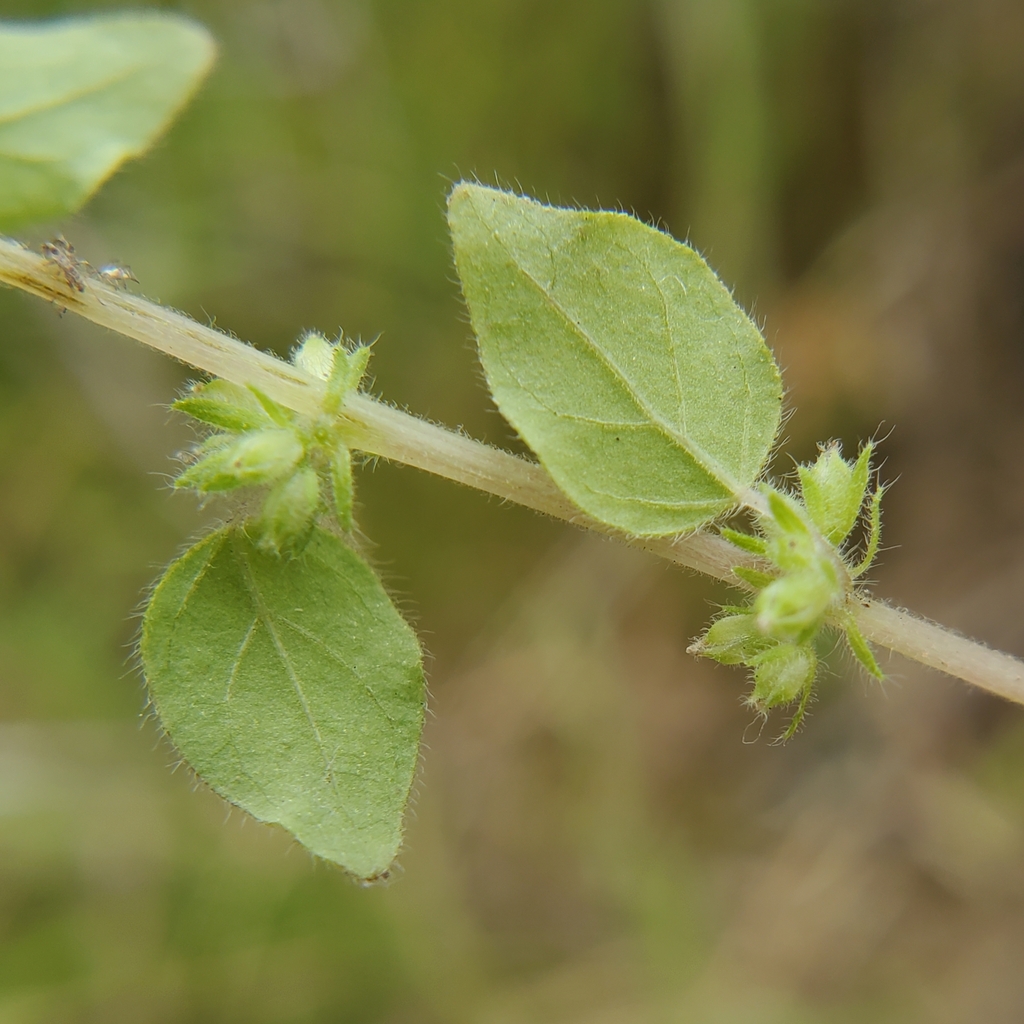
no rights reserved, uploaded by John Cowles · CC0
Family: Urticaceae · Type: Herb · Native
Parietaria hespera var. hespera (Rillita pellitory) is a native California herb in the Urticaceae family, recognized by leaf shape and erect flower orientation.
Rillita pellitory is a California native annual found in southern Sierra Nevada foothills, central Coast Ranges, southwestern California, southern Transverse and Peninsular Ranges, Mojave Desert (excluding mountains), and Sonoran Desert at elevations of 5 to 1,375 meters. Flowering from March to June, this plant produces green to dark red-brown flowers in small, inconspicuous clusters. Growing with delicate stems typically 10 to 30 centimeters tall, it spreads in loose, sprawling clusters. Its leaves are distinctive, with narrow ovate to lanceolate blades that are longer than they are wide, typically found on older stems with a subtle variation in shape. In dry habitats like rocky slopes, oak woodlands, and desert scrub, this subtle annual blends seamlessly into its rugged landscapes.
Identification and appearance
Key characters: 3 sympatric species; distinguished by leaf shape and erect flower orientation
Habitat and range
Habitat: Rocky slopes, dry washes, in oak woodland, coastal scrub, chaparral, desert scrub
Elevation: 5-1375 m
California counties: San Diego, Riverside, San Bernardino, Ventura, Los Angeles, Inyo, Orange, Kern, Santa Barbara, Monterey, San Luis Obispo, Imperial, Santa Cruz, Tulare, Alpine
Outside California: to Utah, New Mexico, northwestern Mexico
Bloom period
Parietaria hespera var. hespera blooms Mar-Jun.
How to tell it apart
vs Stellaria: Parietaria has alternate leaves in nettle-family clusters; Stellaria has opposite leaves with chickweed flowers.; vs Mirabilis: Parietaria has tiny nettle flowers in small clusters; Mirabilis has showy trumpet-like flowers.; vs Acalypha: Parietaria has smooth leaf edges; Acalypha has toothed leaves and spike-like flower clusters.; vs Euphorbia: Parietaria has simple flowers in small clusters; Euphorbia has milky sap and unique cyathia.; vs Sairocarpus: Parietaria has tiny green nettle flowers; Sairocarpus has snapdragon-like flowers.
Frequently asked questions
Is Parietaria hespera var. hespera native to California?
Yes. Parietaria hespera var. hespera is native to California (recorded as native).
When does Parietaria hespera var. hespera bloom?
Parietaria hespera var. hespera blooms Mar-Jun.
Where in California does Parietaria hespera var. hespera grow?
Parietaria hespera var. hespera occurs in San Diego, Riverside, San Bernardino, Ventura, Los Angeles, Inyo, Orange, Kern and other counties, at elevations of 5-1375 m.
What plant family does Parietaria hespera var. hespera belong to?
Parietaria hespera var. hespera is in the Urticaceae family, genus Parietaria.
What habitat does Parietaria hespera var. hespera grow in?
Parietaria hespera var. hespera grows in Rocky slopes, dry washes, in oak woodland, coastal scrub, chaparral, desert scrub.
Related species
Other California species in the same genus, family, or bioregion.
Sources: Jepson eFlora · Index of California Plant Names · CalPhotos
Last updated 2026-10-07
Data from The California Species Project — 14,000+ California species with verified data from CNPS, CDFW, USFWS, Cal-IPC, and more.