Parnassia palustris
Marsh grass of parnassus
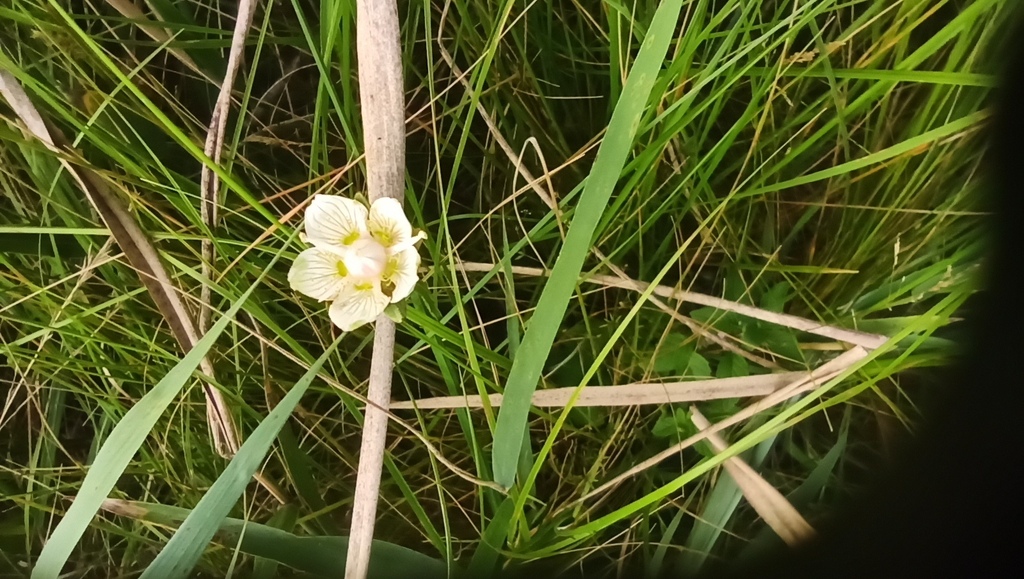
(c) Nadezhda Kiseleva, some rights reserved (CC BY) · licence
Family: Parnassiaceae · Type: Herb · Native
Parnassia palustris (Marsh grass of parnassus) is a native California herb in the Parnassiaceae family, recognized by entire petals and distinctive staminodes clearly diagnostic.
Marsh grass of parnassus is a California native perennial found in the Klamath Ranges, northern Coast Ranges, high Cascade Range, Sierra Nevada, San Francisco Bay Area, southern Coast Ranges, San Bernardino Mountains, and eastern Sierra Nevada in wet banks and meadows at elevations up to 3,600 meters. Flowering from July to October, this plant produces white flowers with delicate round-ovate petals 8 to 20 millimeters long, accompanied by distinctive thread-like staminodes with spherical tips. Growing with slender stems 15 to 47 centimeters tall, it forms graceful clumps in moist environments. Its leaves are lance-ovate, 2 to 5 centimeters long, with bases tapering to heart-shaped, creating a soft, elegant foliage. The plant bears small fruits 8 to 12 millimeters long, completing its seasonal growth cycle.
Identification and appearance
Key characters: 5 sympatric species; entire petals and distinctive staminodes clearly diagnostic
Habitat and range
Habitat: Wet banks, meadows
Elevation: < 3600 m
California counties: Mendocino, Fresno, Tulare, Mono, Amador, Alpine, Del Norte, El Dorado, Lake, Madera, Marin, Tuolumne, Mariposa, Monterey, Placer, Plumas, Santa Cruz, Shasta, Tehama, Sierra, Sonoma, Trinity, Inyo, Nevada, San Benito, San Luis Obispo, Siskiyou, Butte, Humboldt
Outside California: to Alaska, eastern Canada, Eurasia
Bloom period
Parnassia palustris blooms Jul-Oct.
How to tell it apart
vs Limnanthes: Parnassia has fringed staminodes between stamens; meadowfoam has simple stamens without staminodes.; vs Limonium: Parnassia has solitary flowers on single stems; sea lavender has flowers in branching clusters.; vs Linum: Parnassia has fringed staminodes; flax has simple stamens and capsules splitting into 10 segments.; vs Ayenia: Parnassia has broad petals and fringed staminodes; Ayenia has thread-like petals and fused stamen tube.; vs Drosera: Parnassia has smooth leaves; sundew has leaves covered with sticky insect-trapping hairs.
Frequently asked questions
Is Parnassia palustris native to California?
Yes. Parnassia palustris is native to California (recorded as native).
When does Parnassia palustris bloom?
Parnassia palustris blooms Jul-Oct.
Where in California does Parnassia palustris grow?
Parnassia palustris occurs in Mendocino, Fresno, Tulare, Mono, Amador, Alpine, Del Norte, El Dorado and other counties, at elevations of < 3600 m.
What plant family does Parnassia palustris belong to?
Parnassia palustris is in the Parnassiaceae family, genus Parnassia.
What habitat does Parnassia palustris grow in?
Parnassia palustris grows in Wet banks, meadows.
Related species
Other California species in the same genus, family, or bioregion.
- Parnassia parviflora — Small-flowered grass-of-parnassus
- Parnassia sp. — Grass-of-parnassus
- Parnassia cirrata — San Bernardino Grass-Of-Parnassus
- Parnassia cirrata var. cirrata — San bernardino grass-of-parnassus
- Parnassia cirrata var. intermedia — Cascade grass-of-parnassus
- Parnassia fimbriata — Fringed grass of parnassus
- Parnassiaceae sp. — Grass-of-parnassus family
Sources: Jepson eFlora · Index of California Plant Names · CalPhotos
Last updated 2026-10-07
Data from The California Species Project — 14,000+ California species with verified data from CNPS, CDFW, USFWS, Cal-IPC, and more.