Parthenium hysterophorus
Santa maria
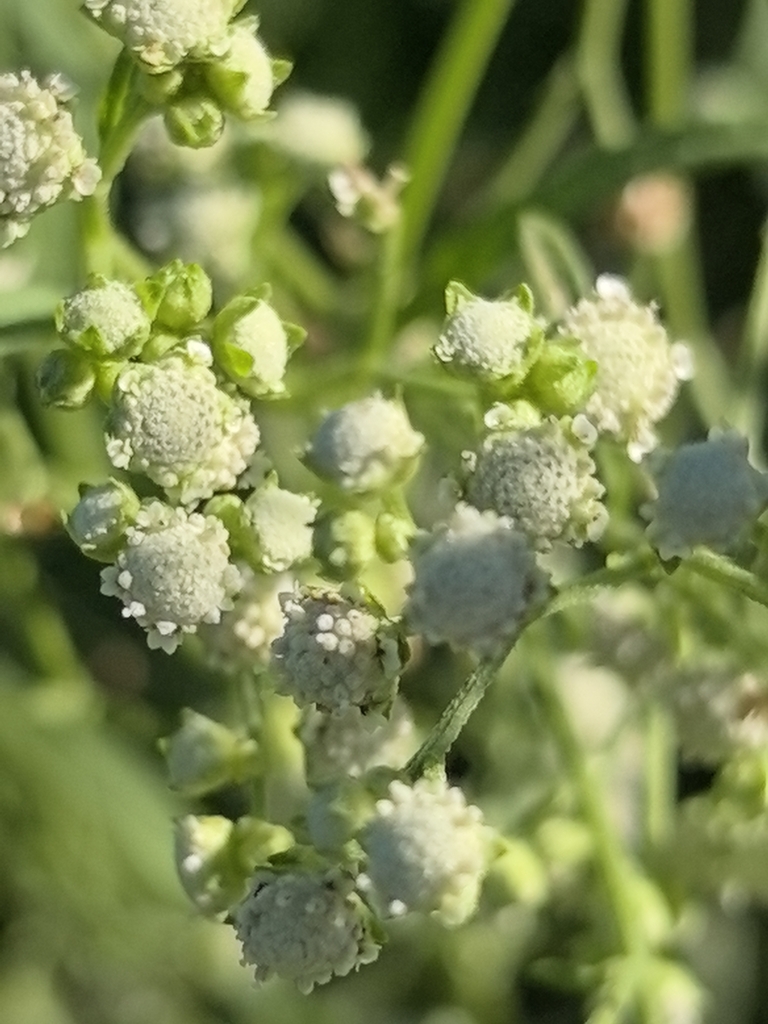
no rights reserved, uploaded by Sinaloa Silvestre · CC0
Family: Asteraceae · Type: Herb
Conservation status: Cal-IPC Yes
Parthenium hysterophorus (Santa maria) is a California herb in the Asteraceae family, recognized by Tropical American genus recently naturalized in Southern California, representing a New World lineage not otherwise established in the state.
Santa maria is a naturalized perennial found in disturbed ground and dry creek channels at elevations below 50 meters. Flowering from March to November, this plant produces small white ray flowers in panicle-like clusters with heads 4 to 5 millimeters in diameter. Growing with much-branched stems 30 to 200 centimeters tall that are ribbed and minutely hairy, it develops a complex branching structure. Its leaves are distinctive, with proximal leaves being petioled and gland-dotted, while distal leaves become progressively less divided, ending in linear terminal segments. The plant produces distinctive fruits with black, three-angled ray fruits bearing two small white scales.
Identification and appearance
Key characters: Tropical American genus recently naturalized in Southern California, representing a New World lineage not otherwise established in the state
Habitat and range
Habitat: Disturbed ground, dry creek channels
Elevation: < 50 m
Outside California: native from Mexico to northern South America, widely introduced in warm-temperate to tropical areas +- worldwide
Bloom period
Parthenium hysterophorus blooms Mar-Nov.
Conservation status
Cal-IPC Yes
How to tell it apart
vs Ambrosia: Parthenium heads carry 5 small white ray florets and look bisexual; Ambrosia heads are unisexual — nodding male spikes and spiny female burs — and never show white rays.; vs Artemisia: Artemisia heads are rayless and yellowish, the foliage often aromatic; Parthenium shows 5 short white rays around each tiny head.; vs Achillea: Yarrow also holds white heads in flat-topped clusters, but its leaves are feathery, 2-3-pinnately dissected and it spreads by rhizomes; Parthenium has coarser, gland-dotted leaves and a taprooted weedy habit.; vs Anthemis: Mayweeds bear solitary daisy heads with many showy white rays and a domed disk; Parthenium heads are minute (4-5 mm) with only 5 short rays, borne in branched panicle-like clusters.; vs Iva: Iva has greenish, nodding, rayless heads; Parthenium shows small white rays and gland-dotted foliage.
Frequently asked questions
When does Parthenium hysterophorus bloom?
Parthenium hysterophorus blooms Mar-Nov.
What plant family does Parthenium hysterophorus belong to?
Parthenium hysterophorus is in the Asteraceae family, genus Parthenium.
Is Parthenium hysterophorus invasive in California?
Parthenium hysterophorus is listed by Cal-IPC with an invasiveness rating of Yes.
What habitat does Parthenium hysterophorus grow in?
Parthenium hysterophorus grows in Disturbed ground, dry creek channels.
Related species
Other California species in the same genus, family, or bioregion.
Sources: Jepson eFlora · CalPhotos
Last updated 2026-10-07
Data from The California Species Project — 14,000+ California species with verified data from CNPS, CDFW, USFWS, Cal-IPC, and more.