Paspalum distichum
Knot grass
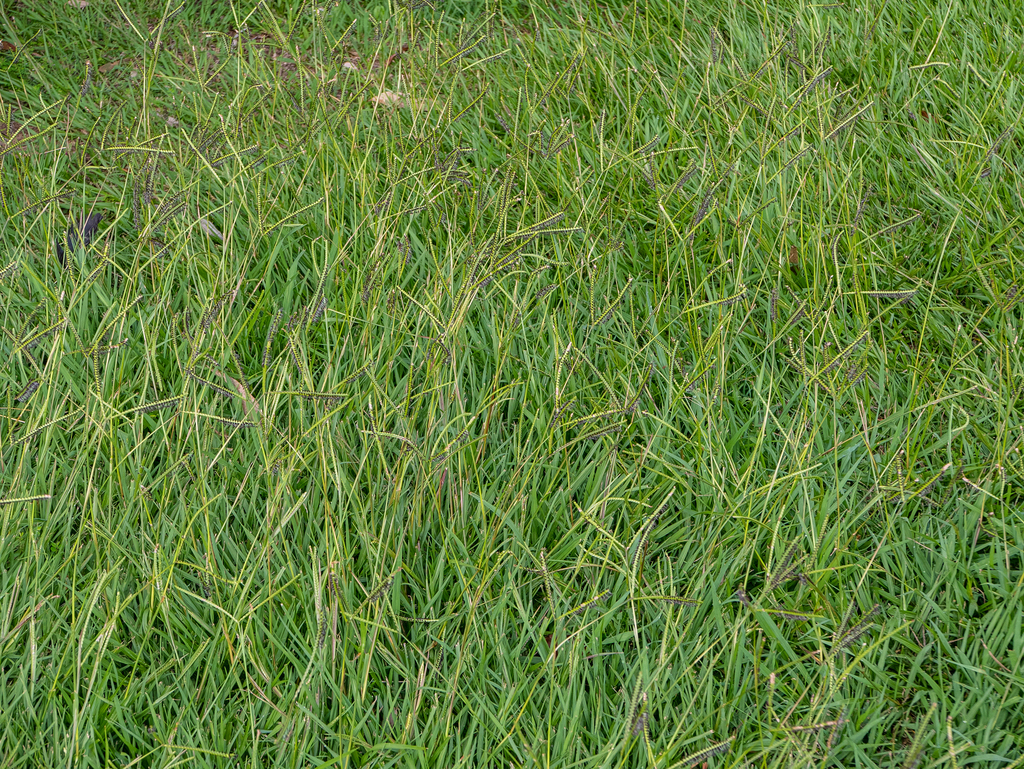
(c) John Robert McPherson, some rights reserved (CC BY-SA) · licence
Family: Poaceae · Type: Grass · Native
Paspalum distichum (Knot grass) is a native California grass in the Poaceae family, recognized by native status, wetland habitat, shorter stature, and glabrous spikelet margins.
Knot grass is a native perennial found in California's Central Valley, Great Basin, and northern Mojave Desert regions in wet habitats including lake edges, rice fields, and roadside ditches at elevations up to 1,770 meters. Flowering from June to October, this plant produces straw-colored to partially purple spikelets in 2 to 3 ascending, often arched racemes. Growing with creeping or clumped stems 5 to 63 centimeters tall, it spreads across wet ground with distinctive flat or folded leaf blades 1.8 to 11.5 millimeters wide. Its leaves are glabrous to softly pubescent, with short ligules 1 to 2 millimeters long and inrolled tips. The fruit is a small yellow grain 1.9 to 2.1 millimeters long, typical of grass species.
Identification and appearance
Key characters: 3 sympatric species; key features are native status, wetland habitat, shorter stature, and glabrous spikelet margins
Habitat and range
Habitat: Edges of lakes, ponds, rice fields, wet roadside ditches
Elevation: < 1770 m
California counties: Placer, Lake, Orange, Riverside, Stanislaus, Santa Clara, Alameda, Los Angeles, Fresno, Kern, Humboldt, Tehama, Yolo, San Diego, Imperial, San Mateo, Inyo, San Bernardino, Sutter, Ventura, Butte, Santa Barbara, Tuolumne, Colusa, San Joaquin, Tulare, Mono, Monterey, Santa Cruz, Shasta, Sonoma, Solano, San Luis Obispo, Merced, El Dorado, Calaveras, Amador, Contra Costa, Madera, Napa, Nevada, Plumas, Siskiyou, Marin, Mendocino, San Francisco, Sacramento, Yuba, Glenn, Del Norte, Lassen
Outside California: to Washington, eastern United States, South America, warm areas worldwide
Bloom period
Paspalum distichum blooms Jun-Oct.
How to tell it apart
vs Setaria: Paspalum has hardened leathery spikelets in rows; foxtail has soft spikelets with bristles beneath each one.; vs Eleusine: Paspalum has spikelets in two rows per branch; goosegrass has spikelets in a single row on each branch.; vs Cynodon: Paspalum has thick leathery spikelets in neat rows; bermudagrass has tiny spikelets in a single row.; vs Bromus: Paspalum has single-flowered leathery spikelets; brome has multi-flowered membranous spikelets with awns.; vs Plantago: Paspalum is a grass with leathery spikelets; plantain has broad ribbed leaves and spike-like seed heads.
Frequently asked questions
Is Paspalum distichum native to California?
Yes. Paspalum distichum is native to California (recorded as native).
When does Paspalum distichum bloom?
Paspalum distichum blooms Jun-Oct.
Where in California does Paspalum distichum grow?
Paspalum distichum occurs in Placer, Lake, Orange, Riverside, Stanislaus, Santa Clara, Alameda, Los Angeles and other counties, at elevations of < 1770 m.
What plant family does Paspalum distichum belong to?
Paspalum distichum is in the Poaceae family, genus Paspalum.
What habitat does Paspalum distichum grow in?
Paspalum distichum grows in Edges of lakes, ponds, rice fields, wet roadside ditches.
Related species
Other California species in the same genus, family, or bioregion.
Sources: Jepson eFlora · Index of California Plant Names · CalPhotos
Last updated 2026-10-07
Data from The California Species Project — 14,000+ California species with verified data from CNPS, CDFW, USFWS, Cal-IPC, and more.